August 12, 2010
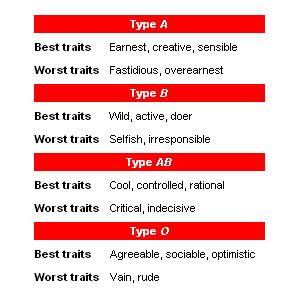
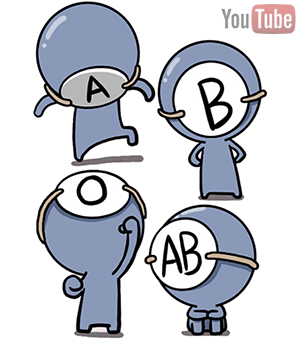
Ketsuekigata is a Japanese pseudoscience based on human blood types. There is a popular belief in Japan that a person’s ABO blood type is predictive of their personality, temperament, and compatibility with others. Ultimately deriving from ideas of historical scientific racism, the popular belief originates with publications by Masahiko Nomi in the 1970s. The scientific community dismisses such beliefs as superstition. Discussion of blood types is widely popular in women’s magazines as a way of gauging relationship compatibility with a potential or current partner. Morning television shows feature blood type horoscopes, and similar horoscopes are published daily in newspapers. In addition, a series of four books that describe people’s character by blood type ranked third, fourth, fifth and ninth on a list of best selling books in Japan in 2008.
Although there is no proven correlation between blood type and personality, it remains popular with the many matchmaking services that cater to blood type. In this way, it is similar to the use of astrological signs in the West, which is also popular in Japan. Asking one’s blood type is common in Japan, and people are often surprised when a non-Japanese does not know his or her own blood type.
Posted in Humor, Philosophy, World |
Leave a Comment »
August 12, 2010

Formosa [fawr-moh-suh] is the name given to Taiwan (Ilha Formosa, ‘Beautiful Isle’) by passing Portuguese mariners in 1544. It is now also the name of a province of Argentina, a city in Brazil, a small island off the northwest coast of Africa, and the language of Taiwanese aborigines.
Posted in Language, World |
Leave a Comment »
August 11, 2010
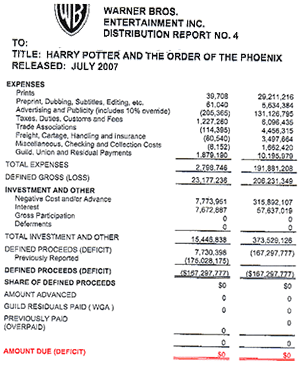
Hollywood accounting refers to the notoriously opaque accounting methods used by Hollywood to budget and record profits for film projects. Expenditures can be inflated to reduce or eliminate the profit of the project thereby reducing the amount which the corporation must pay in royalties or other profit-sharing agreements based on the net profit.
For example, Winston Groom’s price for the screenplay rights to his novel Forrest Gump included a share of the profits; however, due to Hollywood accounting, the film’s commercial success was converted into a net loss, and Groom received nothing. That being so, he has refused to sell the screenplay rights to the novel’s sequel, stating that he, ‘cannot in good conscience allow money to be wasted on a failure.’
Posted in Art, Money, Politics |
Leave a Comment »
August 11, 2010

Fecal bacteriotherapy, also known as fecal transfusion, fecal transplant, or human probiotic infusion (HPI), is a medical treatment for patients with gastrointestinal conditions which require restoration of normal bacterial flora from stool obtained from a healthy donor.
Posted in Health, Science |
Leave a Comment »
August 11, 2010

Flashblood (also called Flushblood) is a technique employed by drug users in which an addict injects himself with blood extracted from another drug user, most commonly one who has injected heroin. After injecting themselves with heroin using a syringe, the user will extract approximately one teaspoon of blood from the vein. Another user will then inject the withdrawn blood into themselves. It is unclear if there is enough heroin in the injected blood to get high or if the high that many users claim is a result of traces of the heroin that had been injected by the user, or if the high is simply the result of the placebo effect.
Posted in Drugs, Health |
1 Comment »
August 11, 2010

A police box is a British telephone kiosk or callbox located in a public place for the use of members of the police, or for members of the public to contact the police. Unlike an ordinary callbox, its telephone is located behind a hinged door so it can be used from the outside, and the interior of the box is, in effect, a miniature police station for use by police officers. Police boxes pre-date the era of mobile telecommunications; now police officers, in many countries, carry two-way radios and/or mobile phones rather than relying on fixed kiosks. Many boxes are now disused or have been withdrawn from service.
British police boxes were usually blue, except in Glasgow, where they were red until the late sixties. In addition to a telephone, they contained equipment such as an incident book and a first aid kit. Today the image of the blue police box is a trademark of the BBC as it is widely associated with the science fiction television programme Doctor Who, in which the protagonist’s time machine, a TARDIS, is in the shape of a 1960s British police box.
Posted in World |
Leave a Comment »
August 11, 2010
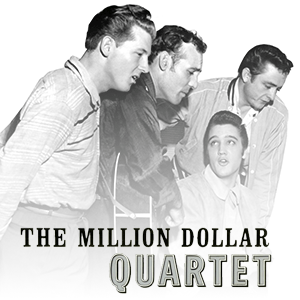
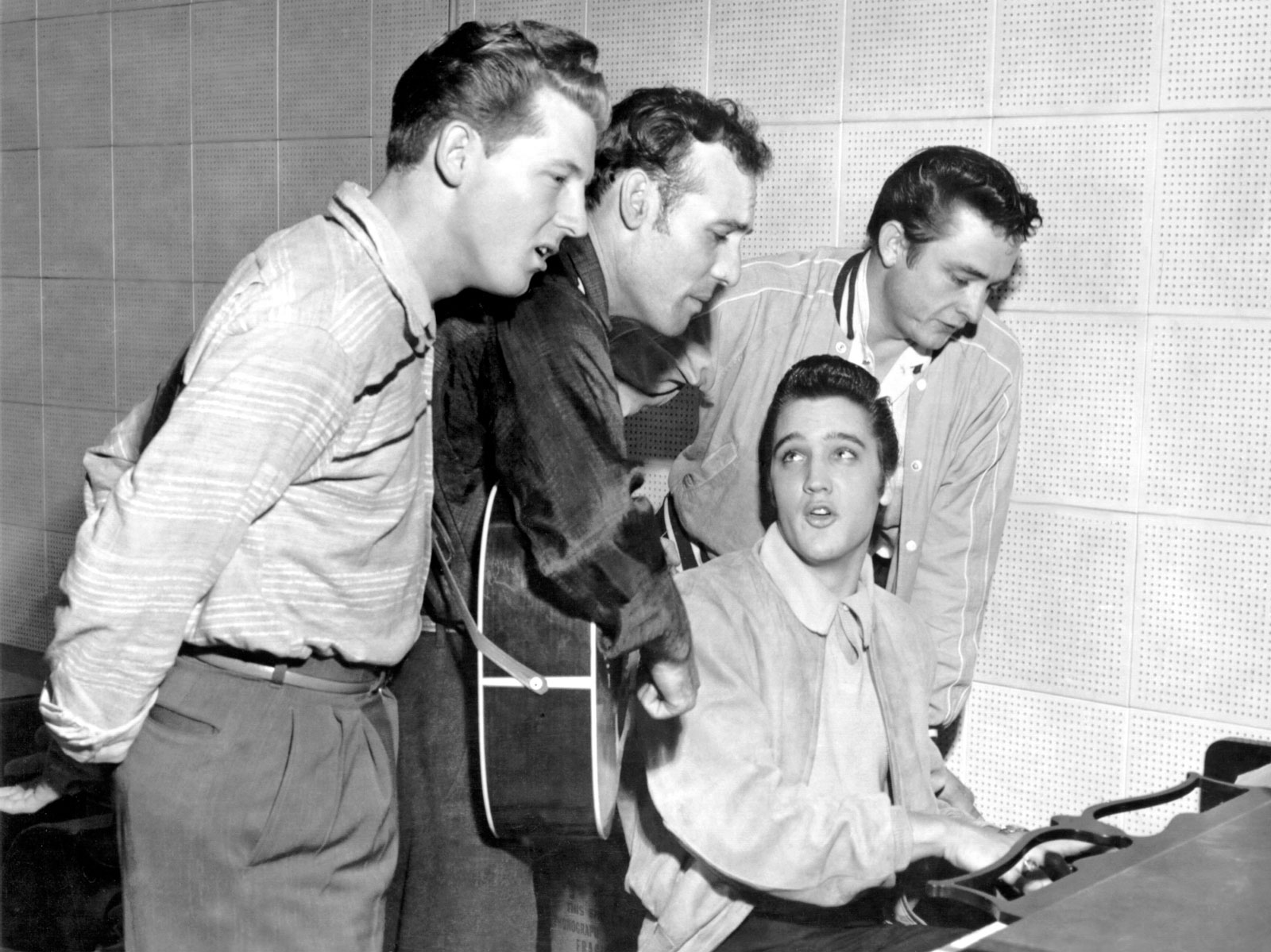
The Million Dollar Quartet is the name given to recordings made on Tuesday December 4, 1956 in the Sun Record Studios in Memphis, Tennessee. The recordings were of an impromptu jam session between Elvis Presley, Jerry Lee Lewis, Carl Perkins, and Johnny Cash.
Posted in Art |
Leave a Comment »
August 10, 2010


The custom of drinking beer from a boot-shaped glass is common in German themed bars, beer gardens, and the like. Machine pressed beer boots range in size from a shot glass up to 1 litre. The more popular mouth blown beer boots are typically 1 and 2 litres in size.
There are several different origin stories for the boot of beer. One tradition holds that a Prussian general swore to his troops that he would drink beer from his boot dependent on the successful outcome in a coming battle. When victorious, the general ordered a glass fashioned in the shape of a boot to fulfill his promise without, ‘having to taste his own feet.’ Another tradition holds that the boot began when German soldiers during World War I having nothing else to drink from instead passed around an actual leather boot of beer before heading into battle. They would flick the boot before drinking from it for good luck and again after drinking to wish the next soldier good luck.
Posted in Food, Humor, World |
Leave a Comment »
August 10, 2010
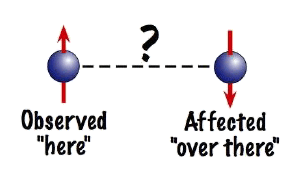
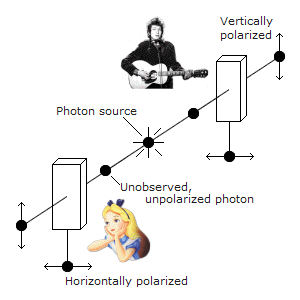
Quantum entanglement is a property of physics where two particles will act together and become a system. They behave like one object, but remain two separate objects. It is as if they now sit on the same teeter-totter seesaw. No matter how long the seesaw is, even if it is one million miles long, if one end is down the other end must be up, and this happens instantly. Even though each particle can tell what the other is doing, they do not send messages back and forth. There are no messages between the particles saying, ‘I’m going down, therefore, you must go up’ and waiting for the particle to receive the message. Yet, the particles are always connected and can behave as one.
Quantum Entanglement is one of the concepts that led Albert Einstein to dislike the theory of Quantum Mechanics. Along with his colleagues, Boris Podolsky and Nathan Rosen, Einstein used entanglement to try to disprove quantum mechanics. Einstein called entanglement ‘spooky action at a distance.’ Years later, however, John Bell proved with his theorem that entanglement is real and actually happens to tiny particles. Bell’s theorem was experimentally verified for the first time in 1980 by the French physicist Alain Aspect. Although one can probe a nearby particle to instantly affect its partner particle, it is impossible to control how they end up. In other words, probing the particle will influence its partner particle, but it is impossible to choose how to influence them. Therefore it is impossible to use quantum entanglement to send messages.
Posted in Science |
Leave a Comment »
August 10, 2010


In economics, a monopsony [muh-nop-suh-nee] is a market form in which only one buyer faces many sellers. It is an example of imperfect competition, similar to a monopoly, in which only one seller faces many buyers. As the only purchaser of a good or service, the ‘monopsonist’ may dictate terms to its suppliers in the same manner that a monopolist controls the market for its buyers.
The term was first introduced by Joan Robinson in her influential book, ‘The Economics of Imperfect Competition.’ Robinson credits classics scholar Bertrand Hallward of Peterhouse College, Cambridge with coining the term. A single-payer universal health care system, in which the government is the only ‘buyer’ of health care services, is an example of a monopsony. It has also been argued that Wal-Mart, in the United States, functions as a monopsony in certain market segments, as its buying power for a given item may dwarf the remaining market. The Canadian Wheat Board, established by the Parliament of Canada in 1935 as a producer marketing system, is a monopsonistic buyer of wheat and barley.
Posted in Language, Money, Politics |
Leave a Comment »
August 10, 2010

The Higgs Boson [boh-son] is a very small particle, which interacts with a field called the Higgs Field. This field creates a ‘drag’ on particles, and this drag gives the particles mass. An easy way to think of it is that this field grabs onto many other particles, giving them a resistance to being moved. This resistance is observed as the particle’s mass. This field only interacts with particles that have mass, which is why some particles can go the speed of light like photons and some cannot, like neutrons.
As it is much smaller than other particles, it is difficult to detect. The Large Hadron Collider at CERN is the tool that scientists are now using to try to find it. Its existence is required in the Standard Model of particle physics, but it is the only particle in that model which has not yet been observed. If the the results of the work at CERN cannot show that the Higgs Boson exists, then a rewrite of our entire understanding of physics will be required.
Posted in Science, Technology |
Leave a Comment »
August 10, 2010

A bearer bond is a debt security issued by a business entity, such as a corporation, or by a government. It differs from the more common types of investment securities in that it is unregistered – no records are kept of the owner, or the transactions involving ownership. Whoever physically holds the paper on which the bond is issued owns the instrument. This is useful for investors who wish to retain anonymity. Recovery of the value of a bearer bond in the event of its loss, theft, or destruction is usually impossible.
Bearer bonds have historically been the financial instrument of choice for money launderers, tax evaders, and those just generally trying to conceal business transactions. In response, new issuances of bearer bonds were banned in the United States in 1982. All the bearer bonds issued by the U.S. Treasury have matured. They no longer pay interest to the holders. As of May 2009, the approximate amount outstanding is $100 million. Bearer bonds are still used in some parts of the world, notably in Central America.
Posted in Money, Politics |
Leave a Comment »





 The Daily Omnivore