August 10, 2010
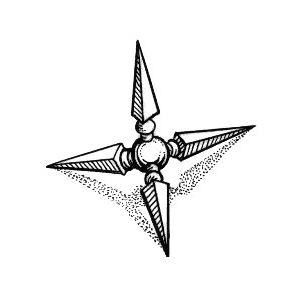
A caltrop is an antipersonnel weapon made up of two or more sharp nails or spines arranged in such a manner that one of them always points upward from a stable base. They may be thought of as the landmines of antiquity, useful to shape the battlefield and force the enemy into certain paths and approaches, or to provide a passive defense as part of a defensive works system. Caltrops served to slow down the advance of horses, war elephants, and human troops. They were said to be particularly effective against the soft feet of camels. In more modern times, caltrops are used against wheeled vehicles with pneumatic tires.
Posted in Technology, War |
Leave a Comment »
August 10, 2010
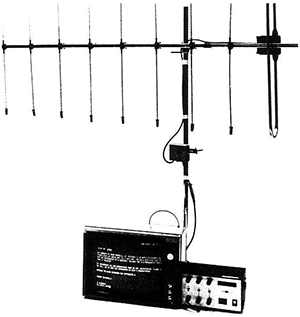
Van Eck phreaking is the process of eavesdropping on the contents of a CRT or LCD display by detecting its electromagnetic emissions. It is named after Dutch computer researcher Wim van Eck, who in 1985 published the first paper on it, including proof of concept. Phreaking is the process of exploiting telephone networks, used here because of its connection to eavesdropping.
Information that drives the video display takes the form of high frequency electrical signals. These oscillating electric currents create electromagnetic radiation in the RF range. These radio emissions are correlated to the video image being displayed, so, in theory, they can be used to recover the displayed image. In a 2009 test of electronic voting systems in Brazil, Van Eck phreaking was used to successfully compromise ballot secrecy as a proof of concept.
Posted in Politics, Technology |
Leave a Comment »
August 10, 2010

Wojtek (1942–1963), was a Syrian brown bear cub adopted by soldiers of the 22nd Artillery Supply Company of the Polish II Corps. During the Battle of Monte Cassino, Wojtek helped move ammunition. The name Wojtek is Slavic and has two meanings: ‘he who enjoys war’ or ‘smiling warrior.’
The bear was fed with fruits, marmalade, honey and syrup, and was often rewarded with beer, which became his favourite drink. He also enjoyed eating cigarettes. As one of the officially enlisted ‘soldiers’ of the company, he lived with the other men in their tents or in a transportable wooden crate. After the war, Wojtek was given to the Edinburgh Zoo. There he spent the rest of his days, often visited by journalists and former Polish soldiers, some of whom would toss him cigarettes. Wojtek died in December of 1963, at the age of 22.
Posted in Humor, War |
Leave a Comment »
August 10, 2010

In the United States, a Sadie Hawkins Dance is usually a less formal dance sponsored by a high school, middle school or college, in which female students invite male students. This is contrary to the usual custom of male students inviting females to school dances such as Prom, in the spring and Homecoming, in the fall.
The Sadie Hawkins dance is named after the Li’l Abner comic strip character Sadie Hawkins, created by cartoonist Al Capp. In the strip, the unmarried women of Dogpatch got one day a year to chase the bachelors and ‘marry up’ with the ones they caught. The event was first introduced in a daily strip which ran on November 13, 1937.
Posted in Education, Games |
Leave a Comment »
August 10, 2010

The Capgras delusion is a disorder in which a person holds a delusion that a friend, spouse, parent or other close family member has been replaced by an identical-looking impostor. The Capgras delusion is classed as a delusional misidentification syndrome, a class of delusional beliefs that involves the misidentification of people, places, or objects. It can occur in acute, transient, or chronic forms.
The delusion is most common in patients diagnosed with schizophrenia, although it can occur in connection with a number of conditions, including brain injury and dementia. It occurs more frequently in females by a ratio of three for every two men. Although the Capgras delusion is commonly called a syndrome, because it can occur as part of, or alongside, various other disorders and conditions, some researchers have argued that it should be considered a symptom, rather than a syndrome or classification in its own right. The condition is named after Joseph Capgras, a French psychiatrist who first described the disorder in 1923.
Posted in Health, Science |
Leave a Comment »
August 10, 2010
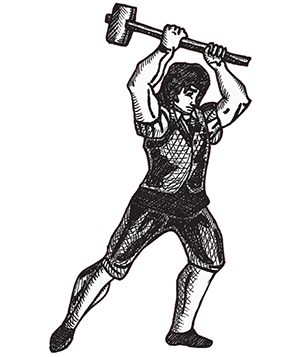
The Luddites [luhd-ahyts] were a social movement of British textile artisans in the nineteenth century who protested – often by destroying mechanized looms – against the changes produced by the Industrial Revolution. It took its name from Ned Ludd, a proletariat folk hero, who was credited with being the first to fight back against mechanization. The principal objection of the Luddites was to the introduction of automated looms that could be operated by cheap, relatively unskilled labour, resulting in the loss of jobs for many skilled textile workers. The movement began in 1811 when mills and pieces of factory machinery were burned by handloom weavers, and for a short time was so strong that Luddites clashed in battles with the British Army. Measures taken by the British government to suppress the movement included a mass trial at York in 1812 that resulted in many executions and penal transportations.
The action of destroying new machines had a long tradition before the Luddites, especially within the textile industry. Many inventors of the 18th century were attacked by vested interests who were threatened by new and more efficient ways of making yarn and cloth. Samuel Crompton, for example, had to hide his new spinning mule in the roof of his house at Hall i’ th’ Wood in 1779 to prevent it being destroyed by the mob. In modern usage, ‘Luddite’ is a term describing those opposed to industrialization, automation, computerization or new technologies in general.
Posted in Money, Politics, Technology |
Leave a Comment »
August 9, 2010
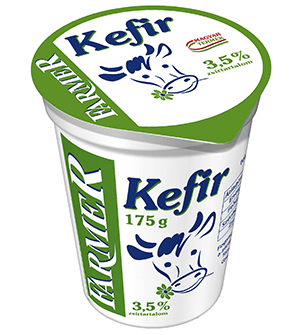
Kefir [kuh-feer] is a fermented milk drink that originated with shepherds of the Caucasus region, who discovered that fresh milk carried in leather pouches would occasionally ferment into an effervescent beverage.
It is prepared by inoculating cow, goat, or sheep’s milk with kefir grains (a combination of bacteria and yeasts in a matrix of proteins, lipids, and sugars). Traditional kefir was made in skin bags that were hung near a doorway; the bag would be knocked by anyone passing through the doorway to help keep the milk and kefir grains well mixed. Dairy-free alternatives are available, such as coconut milk kefir and soy milk kefir.
Posted in Food, World |
Leave a Comment »
August 9, 2010
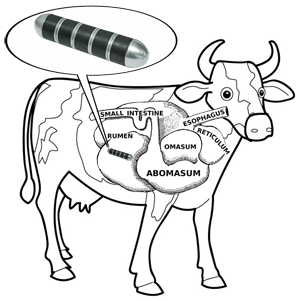
A cow magnet is a preventive veterinary medical device for cattle. A rancher or dairy farmer feeds a magnet to each calf at branding time; the magnet settles in the rumen or reticulum and remains there for the life of the animal. When the cow grazes, it often consumes and swallows what is called tramp iron: baling and barbed wire, staples, nails, and other metallic objects.
These objects are indigestible and would lodge in the reticulum and cause inflammation resulting in lower milk production (for dairy cattle) or lower weight gain (for feeder stock). This condition is called hardware disease. The cow magnet attracts such objects and prevents them from becoming lodged in the animal’s tissue. While the resultant mass of iron remains in the cow’s rumen as a sort of bezoar, it does not cause the severe problems of hardware disease.
Posted in Food, Technology |
1 Comment »
August 9, 2010
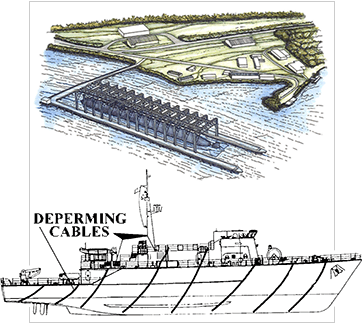
Deperming [dee-purm-ing] is a procedure for erasing the permanent magnetism from ships and submarines to camouflage them against magnetic detection vessels and enemy marine mines. A sea-going metal-hulled ship or submarine, by its very nature, develops a magnetic signature as it travels due to a magneto-mechanical interaction with the Earth’s magnetic field. This signature can be exploited by magnetic mines, or facilitate the detection of a submarine by ships or aircraft with magnetic anomaly detection (MAD) equipment.
Specialized deperming facilities, such as the United States Navy’s Lambert’s Point Deperming Station are used to perform the procedure. Heavy gauge copper cables are wrapped around the hull and superstructure of the vessel, and very high electrical currents (as high as 4000 amps) are pulsed through the cables. This has the effect of ‘resetting’ the ship’s magnetic signature. It is also possible to assign a specific signature that is best suited to the particular area of the world in which the ship will operate. Over time the deperm will begin to degrade and the procedure must be redone periodically to maintain the desired effect.
Posted in Technology, War |
Leave a Comment »
August 9, 2010
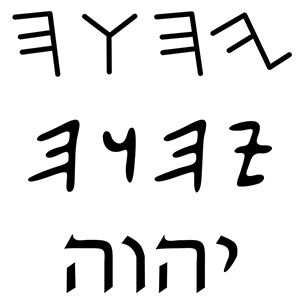
Ineffability [in-ef-fuh-bil-uh-tee] is concerned with ideas that cannot or should not be expressed in spoken words (or language in general), often being in the form of a taboo or incomprehensible term. Illogical statements, principles, reasons, and arguments are intrinsically ineffable along with impossibilities, contradictions, and paradoxes.
Terminology describing the nature of experience cannot be properly conveyed in symbolic language; it is believed that this knowledge is only held by the individual from which it originates. Obscene profanity and vulgarisms, however, can easily (and clearly) be stated – but they simply should not be and so are still considered ineffable.
Posted in Language, Philosophy |
Leave a Comment »
August 9, 2010
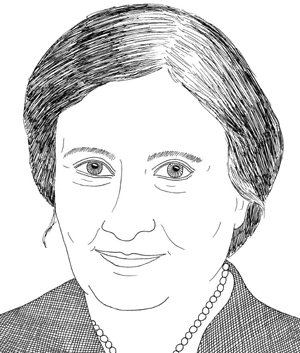
The Montessori [mon-tuh-sawr-ee] method is an approach to educating children based on the research of Italian physician and educator Maria Montessori (1870–1952). The focus of the method is on providing the student freedom to manage their own education. The role of the teacher (sometimes called director, directress, or guide) is to watch over the learning environment to remove any obstacles that would interfere with the student’s natural development.
The method is primarily applied with young children (2–6), due to the young child’s unique instincts and sensitivity to conditions in the environment. However, it is sometimes conducted with elementary age (6–12) children and occasionally with infants and toddlers, as well as at the middle and high school level.
Posted in Education, Philosophy |
Leave a Comment »
August 9, 2010
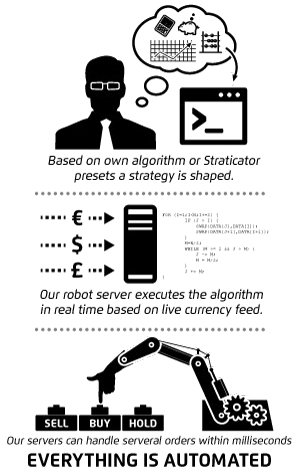
In electronic financial markets, algorithmic trading or automated trading, also known as algo trading, black-box trading or robo trading, is the use of computer programs for entering trading orders with the computer algorithm deciding on aspects of the order such as the timing, price, or quantity of the order, or in many cases initiating the order without human intervention. Investment decisions and implementation may be augmented at any stage with algorithmic support or may operate completely automatically (‘on auto-pilot’).
Algorithmic Trading is widely used by pension funds, mutual funds, and other buy side (investor driven) institutional traders, to divide large trades into several smaller trades in order to manage market impact, and risk. Sell side traders, such as market makers and some hedge funds, provide liquidity to the market, generating and executing orders automatically. A special class of algorithmic trading is ‘high-frequency trading’ (HFT), in which computers make elaborate decisions to initiate orders based on information that is received electronically, before human traders are capable of processing the information.
Posted in Money, Technology |
1 Comment »



 The Daily Omnivore