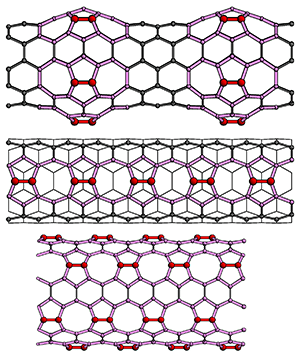
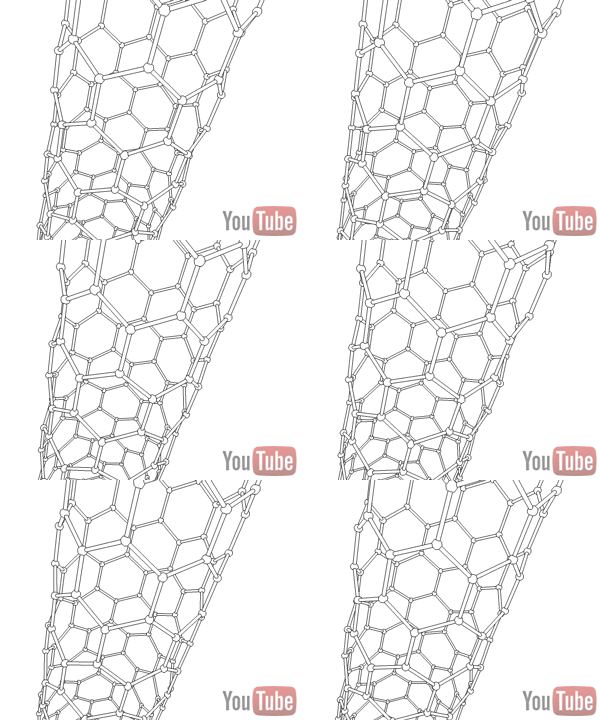
Carbon nanotubes are a molecular configuartion (or allotrope) of carbon with a cylindrical structure. Nanotubes have been constructed with length-to-diameter ratio of up to 132,000,000:1, which is significantly larger than any other material. These cylindrical carbon molecules have novel properties which make them potentially useful in many applications in nanotechnology, electronics, optics, and other fields of materials science, as well as potential uses in architectural fields. They exhibit extraordinary strength and unique electrical properties, and are efficient thermal conductors.
Nanotubes are members of the fullerene structural family, which also include spherical buckyballs. The ends of a nanotube may be capped with a hemisphere of the buckyball structure. Their name is derived from their size, since the diameter of a nanotube is on the order of a few nanometers (approximately 1/50,000th of the width of a human hair), while they can be up to 18 centimeters in length.


 The Daily Omnivore
Leave a comment