September 20, 2010

Nacirema [nak-uh-ree-ma] (American backwards) is a tongue-in-cheek reference to the people of the United States. Anthropologists and sociologists use the term to examine (with a degree of anthropological self-distancing) aspects of the behavior and society of American people.
The original use of the term was in ‘Body Ritual Among the Nacirema’, which satirizes anthropological papers on ‘other’ cultures, and the Northern American Culture. Horace Miner wrote the paper and originally published it in the June 1956 edition of American Anthropologist.
Posted in Humor, World |
Leave a Comment »
September 20, 2010

The Kayan are an ethnic minority of Burma. Women of the various Kayan tribes identify themselves by their different form of dress. The Kayan Lahwi tribe are the most renowned as they wear ornaments known as neck rings, brass coils that are placed around the neck. The government of Burma has discouraged this practice in its efforts to modernize and ease some of the cultural restrictions placed upon women. Consequently, many women in Burma began breaking the tradition, though a few older women still wear them and in remote villages some of the younger girls as well. In Thailand, however, the practice has gained popularity in recent years because it draws tourists who bring business to the tribe.
Coils are first applied to young girls when they are around six years old. Each coil is replaced with longer coil, as the weight of the brass pushes the collar bone down and compresses the rib cage. Contrary to popular belief, the neck is not actually lengthened; the illusion of a stretched neck is created by the deformation of the clavicle.
Posted in World |
Leave a Comment »
September 20, 2010
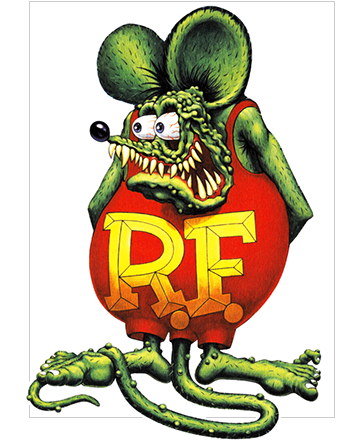
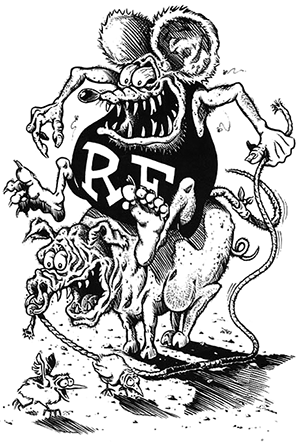
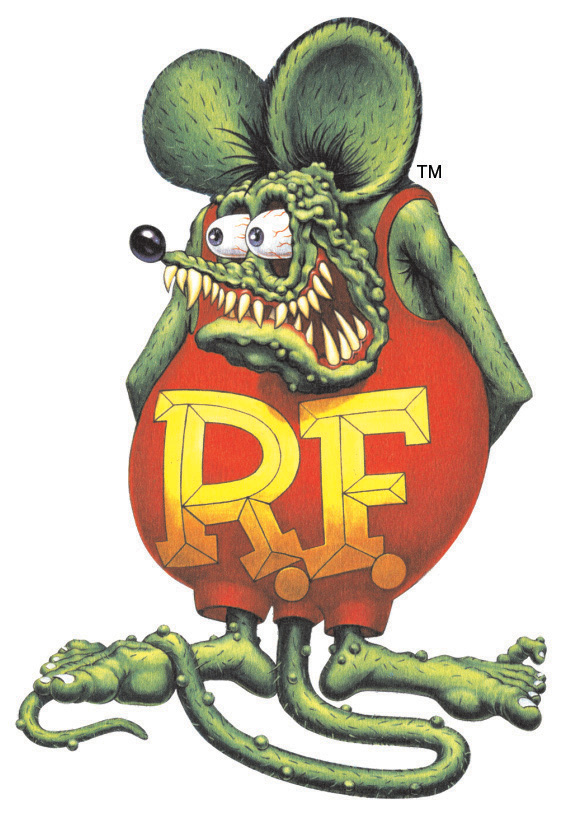
Rat Fink is one of the several hot-rod characters created by artist Ed ‘Big Daddy’ Roth. Roth’s hatred for Mickey Mouse led him to draw the original Rat Fink, who came to symbolize the hot-rod and ‘Kustom Kulture’ scene of the 1950s and 1960s. Although Detroit native Stanley Mouse is credited with creating the so-called ‘Monster Hot Rod’ art form, Roth is accepted as the individual who popularized it. The Rat Fink is a green, depraved-looking mouse with bulging, bloodshot eyes, an oversized mouth with yellowed, narrow teeth, and a red T-shirt with yellow ‘R.F.’ on it. Other artists associated with Roth also drew the character, including Steve Fiorilla, who illustrated Roth’s catalogs.
A Rat Fink revival in the late 1980s and the 1990s centered around the West Coast grunge/punk rock movements. The term ‘fink’ was originally underworld slang for an informer, comparable to ‘stool pigeon.’ It is also thought to have been a toned-down form of ‘ratfucking,’ a slang term for playing dirty tricks.
Posted in Art, Humor |
Leave a Comment »
September 20, 2010

L’esprit de l’escalier (staircase wit) is thinking of a clever remark when it is too late. The German word Treppenwitz and the Yiddish word trepverter are used to express the same idea. This name for the phenomenon comes from French encyclopedist and philosopher Denis Diderot. A remark was made to him at a dinner party which left him speechless at the time because, he explains, ‘a sensitive man like me, overwhelmed by the argument levelled against him, becomes confused and can only think clearly again [when he reaches] the bottom of the stairs.’ The reception room was located on the étage noble, the noble storey, upstairs, so that to have reached the bottom of the stairs means to have definitively left the gathering in question.
Diderot’s fellow-philosophe Jean-Jacques Rousseau also recognised his own affliction with l’esprit de l’escalier, staircase wit. In his autobiographical book Confessions he blamed such social blunders and missed opportunities for turning him into a misanthrope, and reassured himself that he was better at ‘conversations by mail’.
Posted in Language, World |
Leave a Comment »
September 20, 2010
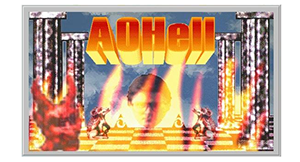

AOHell was a program that modified early versions of America Online. It included a fake account generator, social engineering (or phishing) tools, and email, IM, and chatroom automation. Released in 1994 by a hacker known as ‘Da Chronic,’ AOHell provided a number of utilities which ran on top of the America Online client software. Upon loading, the program played a short clip from Dr. Dre’s 1993 song ‘Nuthin’ but a ‘G’ Thang.’ It was the first program of its kind, and spawned a large number of copycats. Over a period of 10 years, more than 1000 programs would be released for various versions of AOL.
In the manual, the creator of AOHell claims that he created the program because the AOL administrators would frequently shut down hacker and pirate chatrooms for violation of AOL’s terms of service while refusing to shut down the pedophilia chat rooms which regularly traded child pornography. Da Chronic claimed when he confronted AOL about it, he was met with an account deletion. His goal was,'[To have] 20,000+ idiots using AOHell to knock people offline, steal passwords and credit card information, and to basically annoy the hell out of everyone.’
Posted in Humor, Technology |
Leave a Comment »
September 19, 2010


The Original Whizzinator is a product intended to fraudulently defeat drug tests. The Whizzinator comes as a kit complete with dried urine and syringe, heater packs (to keep the urine at body temperature), a false penis (available in several skin tones including white, tan, latino, brown, and black) and an instruction manual. The company also offered a female version of the Whizzinator, called ‘Number One.’
The device received media coverage in 2005 after Onterrio Smith, a former Minnesota Vikings running back, was caught with one at the Minneapolis-St. Paul International Airport, which resulted in his suspension. Actor Tom Sizemore was also caught with a Whizzinator that year. In 2008, federal prosecutors in Pittsburgh won a 19-count indictment against Puck Technology, maker of the Whizzinator, and its owners for fraud and selling drug paraphernalia. As of 2011, the Whizzinator-XXX is being marketed by Alternative Lifestyle Systems for $139.95 through ‘High Times’ magazine as a strap-on ‘wet sex simulator’ containing ‘synthetic urine,’ ostensibly for synthetic watersports activity.
Posted in Drugs, Politics, Sex |
Leave a Comment »
September 17, 2010

OLED stands for Organic Light Emitting Diode. The ‘organic’ in OLED refers to organic material. Carbon is the basis of all organic matter. Examples of carbon-based substances include sugar, wood and the majority of plastics. ‘Light Emitting Diode’ describes the process of converting electric energy into light. OLEDs are used in television screens, computer monitors, mobile phones, watches, advertising, information and indication; they can also be used in light sources for general space illumination and in large-area light-emitting elements. An OLED display functions without a backlight. Thus, it can display deep black levels and can be thinner and lighter than liquid crystal displays and more power efficient. Similarly, in low ambient light conditions such as dark rooms, an OLED screen can achieve a higher contrast ratio than an LCD screen using either cold cathode fluorescent lamps or the more recently developed LED backlight. It can also be made up to 85% transparent and printed on flexible substrates.
The layer of organic material is sandwiched between two conductors (an anode and a cathode), which in turn are sandwiched between a glass top plate (seal) and a glass bottom plate (substrate). When electric Current is applied to the two conductors, a bright, electroluminescent light is produced directly from the organic material. OLED has more control over color expression than LCD because it only expresses pure colors when an electric Current stimulates the relevant Pixels. There are two main families of OLEDs. Those based upon small molecules, and more recently, those employing polymers.
Posted in Technology |
Leave a Comment »
September 17, 2010
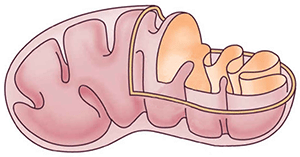
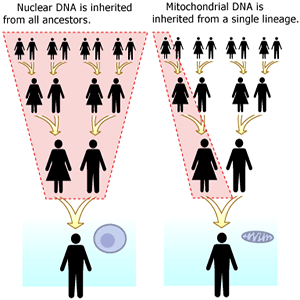
Mitochondrial [mahy-tuh-kon-dree-uhl] Eve refers to the most recent common matrilineal ancestor from whom all living humans are descended. Passed down from mother to offspring, all mitochondrial DNA (mtDNA) in every living person is directly descended from hers. Mitochondrial Eve is the female counterpart of Y-chromosomal Adam, the patrilineal most recent common ancestor, although they lived thousands of years apart. Mitochondrial Eve is generally estimated to have lived around 200,000 years ago, most likely in East Africa, when Homo sapiens sapiens were developing as a species separate from other hominids.
One of the misconceptions of mitochondrial Eve is that since all women alive today descended in a direct unbroken female line from her that she was the only woman alive at the time. However nuclear DNA studies indicate that the size of the ancient human population never dropped below some tens of thousands; there were many other women around at Eve’s time with descendants alive today, but somewhere in all their lines of descent there is at least one man (and men do not pass on their mothers’ mitochondrial DNA to their children). By contrast, Eve’s lines of descent to each person alive today includes at least one line of descent to each person which is purely matrilineal.
Posted in Science |
1 Comment »
September 17, 2010


Omertà [aw-mer-tah] is a popular attitude and code of honor, common in areas of southern Italy where criminal organizations like the Mafia, ‘Ndrangheta, and Camorra are strong. A common definition is the ‘code of silence.’ Omertà implies ‘the categorical prohibition of cooperation with state authorities or reliance on its services, even when one has been victim of a crime.’ Even if somebody is convicted for a crime he has not committed, he is supposed to serve the sentence without giving the police any information about the real criminal, even if that criminal has nothing to do with the Mafia himself. Within Mafia culture, breaking omertà is punishable by death.
The code was adopted by Sicilians long before the emergence of Cosa Nostra (some observers date it to the 16th century as a way of opposing Spanish rule). It is also deeply rooted in rural Crete, Greece. The origin of the word is often traced to the Spanish word ‘hombredad,’ meaning manliness, through the Sicilian word ‘omu’ for man. According to a different theory, the word comes from Latin ‘humilitas’ (humility), which became ‘umirtà’ and then finally omertà in some southern Italian dialects.
Posted in Language, World |
Leave a Comment »
September 17, 2010
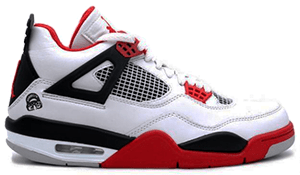

Mars Blackmon was a fictional character from the 1986 film ‘She’s Gotta Have It.’ He is also the alter-ego of filmmaker Spike Lee. In the film, he was a ‘Brooklyn-loving,’ die-hard New York Knicks fan. During the late 1980s and early 1990s, Blackmon became the primary pitchman in Nike commercials for Air Jordans, the basketball shoes worn by Michael Jordan. In these commercials, Mars Blackmon popularized the phrases ‘Is it the Shoes? Is it the Shoes? Is it the Shoes? … Money, it’s gotta be the shoes.’
Posted in Games, Humor, Money |
Leave a Comment »
September 17, 2010


Gianduja [gee-an-du-ya] is a sweet chocolate analogue containing about 30% hazelnut paste. It was invented in Turin, Italy by choclatier Caffarel in 1852, after taxes on cocoa beans hindered the production of conventional chocolate. It takes its name from a Carnival and marionette character who represents the archetypal Piedmontese, the Italian region where hazelnut confectionery is common. Ferreo Nutella is a giaduja spread first sold in Piedmont in 1963 and now available in over 75 countries.
Pietro Ferrero, who owned a patisserie in Alba, in the Langhe district of Piedmont, an area known for the production of hazelnuts, sold an initial batch of 300 kilograms (660 lb) of ‘Pasta Gianduja’ in 1946. This was originally a solid block, but in 1949, Pietro started to sell a creamy version in 1951 as ‘Supercrema.’ In 1963, Pietro’s son Michele revamped Supercrema with the intention of marketing it across Europe. Its composition was modified and it was renamed ‘Nutella.’ The first jar of Nutella left the Ferrero factory in Alba on 20 April 1964. The product was an instant success and remains widely popular. The estimated Italian production of Nutella averages 179,000 tons per year.
Posted in Food, World |
Leave a Comment »
September 16, 2010

Rococo [ruh-koh-koh] also referred to as ‘Late Baroque’ is an 18th century style which developed as Baroque artists gave up their symmetry and became increasingly more ornate, florid, and playful. Rococo rooms were designed as total works of art with elegant and ornate furniture, small sculptures, ornamental mirrors, and tapestry complementing architecture, reliefs, and wall paintings. It was largely supplanted by the Neoclassic style.
In 1835 the Dictionary of the French Academy stated that the word Rococo ‘usually covers the kind of ornament, style and design associated with Louis XV’s reign.’ The word Rococo is seen as a combination of the French rocaille, meaning stone, and coquilles, meaning shell, due to reliance on these objects as motifs of decoration. It may also be related to the Portuguese barroco (which refers to an irregularly shaped pearl), or Baroque style.
Posted in Art |
Leave a Comment »



 The Daily Omnivore