November 17, 2010


Multi-level marketing (MLM) is a marketing strategy in which the sales force is compensated not only for sales they personally generate, but also for the sales of others they recruit, creating a downline of distributors and a hierarchy of multiple levels of compensation. Other terms for MLM include network marketing, direct selling, and referral marketing. Although the products and company are supposed to be marketed directly to consumers and potential business partners by means of relationship referrals and word of mouth marketing, critics have charged that most MLMs are pyramid schemes.
MLM companies have been a frequent subject of criticism as well as the target of lawsuits. Criticism has focused on their similarity to illegal pyramid schemes, price-fixing of products, high initial start-up costs, emphasis on recruitment of lower-tiered salespeople over actual sales, encouraging if not requiring salespeople to purchase and use the company’s products, potential exploitation of personal relationships which are used as new sales and recruiting targets, complex and sometimes exaggerated compensation schemes, and cult-like techniques which some groups use to enhance their members’ enthusiasm and devotion. Not all MLM companies operate the same way, and MLM groups have persistently denied that their techniques are anything but legitimate business practices.
Posted in Money, Politics |
Leave a Comment »
November 17, 2010

Luna, also called the ‘Stafford Giant,’ is a 600 to 1000-year-old redwood tree in Humboldt County, California, that activist Julia Butterfly Hill lived in for 738 days beginning in 1997. The name Luna was given to it in 1997 by a group of Earth First! members, who built a small platform from salvaged wood to serve as a tree-sit platform. Hill occupied the tree in order to save the grove from being clear-cut by the Pacific Lumber Company. Although many refer to the tree as ‘she,’ giant redwoods produce both male and female cones, and technically are neither male nor female, but monoecious.
In November of 2000, an unknown vandal used a chainsaw to cut halfway through the tree. Civil engineer Steve Salzman designed a system to help the tree withstand the extreme windstorms which frequent the Northern California hillside, at speeds which peak between 60 and 100 miles per hour. Tree climbers installed a steel cable ‘collar’ around Luna’s main trunk 100 feet above the ground. Four cables radiate from this collar and are attached with turnbuckles to four remote anchor points 100-150 feet away.
Posted in Politics |
Leave a Comment »
November 17, 2010

Zener [zeh-ner] cards are cards used to conduct experiments for extra-sensory perception (ESP), most often clairvoyance. Perceptual psychologist Karl Zener designed the cards in the early 1930s for experiments conducted with his colleague, parapsychologist J. B. Rhine. Originally, tests for ESP were conducted using a standard deck of playing cards. There are just five different Zener cards: a hollow circle (one curve), a Greek cross (two lines), three vertical wavy lines (or ‘waves’), a hollow square (four lines), and a hollow five-pointed star. There are 25 cards in a pack, five of each design.
When Zener cards were first used, they were made out of a fairly thin translucent white paper. Several subjects or groups of subjects scored very highly until it was discovered that they had often been able to see the symbols through the backs of the cards. A redesign made it impossible to see the designs through the cards under any conditions. A subsequent deck featured an illustration of a building at Duke University on its reverse side, but the use of a non-symmetric reverse design allowed the deck to be exploited as a one-way deck.
Posted in Games, Philosophy, Science |
Leave a Comment »
November 17, 2010

Missing white woman syndrome (MWWS) or missing pretty girl syndrome is a vernacular term for the alleged disproportionately greater degree of coverage in television, radio, newspaper and magazine reporting of a misfortune, most often a missing person case, involving a young, attractive, white, middle-class (or above) woman, compared with cases concerning a missing male, or missing females of other ethnicities or economic classes. Notable cases: Chandra Levy, Elizabeth Smart, Laci Peterson, and Natalee Holloway.
Posted in Politics |
Leave a Comment »
November 17, 2010
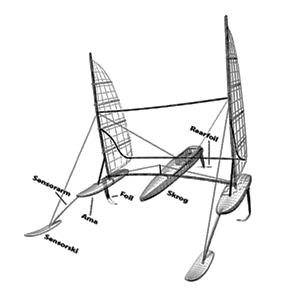
The Hobie TriFoiler is the fastest production sailboat ever created with a top speed of around 35 mph. Designed by the brothers Greg and Dan Ketterman, this trimaran has two sails, one on each ama, and hydrofoils that lift the hulls out of the water at speed. It lifts on the foils at wind speeds between 10 and 11 mph (18 km/h) and quickly accelerates to twice that speed in seconds.
The TriFoiler’s high price-tag ($12,900), fragility, and usage limited to winds between 10 and 25 mph (40 km/h) with low waves, led the Hobie Cat Company to discontinue production. Approximately 30 Trifoilers were built prior to production starting at Hobie in 1995 and another 170 were produced by Hobie before halt of production in 1999.
Posted in Games, Technology |
Leave a Comment »
November 16, 2010

Vladimir Grigoryevich Tretchikoff (1913 – 2006) was one of the most commercially successful artists of all time – his painting Chinese Girl (popularly known as ‘The Green Lady’) is one of the best selling art prints ever. Tretchikoff was a self-taught artist who painted realistic figures, portraits, still life and animals, with subjects often inspired by his early life in China and Malaysia, and later life in South Africa. Tretchikoff’s work was immensely popular with the general public, but is often seen by art critics as the epitome of kitsch (indeed, he was nicknamed the ‘King of Kitsch’).
He worked in oil, watercolour, ink, charcoal and pencil but is best known for his reproduction prints which sold worldwide in huge numbers. The reproductions were so popular that it was said Tretchikoff was second only to Picasso in his popularity. Tretchikoff once said that the only difference between himself and Vincent Van Gogh was that Van Gogh had starved whereas he had become rich.
Posted in Art, Money, World |
Leave a Comment »
November 16, 2010

Catullus 16 is a poem by Gaius Valerius Catullus (ca. 84 BC – ca. 54 BC). The poem, written in a hendecasyllabic (11-syllable) meter, was considered so explicit that a full English translation was not openly published until the late twentieth century:
read more »
Posted in Art, Language, Sex |
Leave a Comment »
November 16, 2010
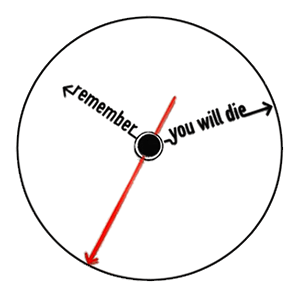
Memento mori is a Latin phrase translated as ‘Remember your mortality’ or “remember you will die’ – (literally: ‘[in the future] remember to die’). It names a genre of artistic creations that vary widely from one another, but which all share the same purpose: to remind people of their own mortality. The phrase has a tradition in art that dates back to antiquity. In ancient Rome, the words are believed to have been used on the occasions when a Roman general was parading through the streets during a victory triumph. Standing behind the victorious general was his slave, who was tasked to remind the general that, though his highness was at his peak today, tomorrow he could fall.
The thought came into its own with Christianity, whose strong emphasis on Divine Judgment, Heaven, Hell, and the salvation of the soul brought death to the forefront of consciousness. Most memento mori works are products of Christian art, although there are equivalents in Buddhist art.
Posted in Art, Death, Philosophy |
Leave a Comment »
November 16, 2010

Jeff Koons’s ‘Rabbit‘ began as an inflatable, store-bought, plastic toy. Its transformation started when Koons bought it, blew it up, and had it cast in highly polished stainless steel. It has crinkled ears like an inflatable toy, a spherical head, and bulbous appendages, yet its face is blank. While it appears to be a shiny, lightweight, Mylar balloon, it is actually quite heavy and hard and stands 41 inches tall.
Rabbit’s surface also calls to mind the use of shiny metals in both historical and social contexts. According to Koons, ‘Polished objects have often been displayed by the church and by wealthy people to set a stage of both material security and enlightenment of spiritual nature; the stainless steel is a fake reflection of that stage.’
Posted in Art |
Leave a Comment »
November 16, 2010

Principia Discordia is a Discordian religious text written by Greg Hill (Malaclypse The Younger) and Kerry Thornley (Omar Khayyam Ravenhurst). It was originally published under the title ‘Principia Discordia or How The West Was Lost’ in a limited edition of 5 copies in 1965. Discordianism is a religion centered on the idea that chaos is all that there is, and that disorder and order are both illusions that are imposed on chaos. There is some division as to whether it should be regarded as a parody religion, and if so to what degree.
It has been called ‘Zen for roundeyes,’ based on similarities with absurdist interpretations of the Rinzai school of Buddhism. Discordianism recognizes chaos, discord, and dissent as valid and desirable qualities, in contrast with most religions, which idealize harmony and order. While the Principia is full of literal contradictions and unusual humor, it contains several passages which propose that there is serious intent behind the work. Saints identified include Emperor Norton, Yossarian, Don Quixote, and Bokonon.
Posted in Humor, Language, Philosophy |
1 Comment »
November 16, 2010


Fnord is the typographic representation of disinformation or irrelevant information intending to misdirect, with the implication of a worldwide conspiracy. The word was coined as a nonsensical term with religious undertones in the Discordian religious text Principia Discordia (1965) by Kerry Thornley and Greg Hill, but was popularized by The Illuminatus! Trilogy (1975) of satirical conspiracy fiction novels by Robert Shea and Robert Anton Wilson.
read more »
Posted in Humor, Language, Philosophy |
Leave a Comment »
November 16, 2010

Kilgore Trout is a fictional character created by author Kurt Vonnegut. He was originally created as a fictionalized version of author Theodore Sturgeon (Vonnegut’s colleague in the genre of science fiction), although Trout’s consistent presence in Vonnegut’s works has also led critics to view him as the author’s own alter ego.
Trout, who has supposedly written over 117 novels and over 2000 short stories, is usually described as an unappreciated science fiction writer whose works are used only as filler material in pornographic magazines. However, he does have at least three fans: Eliot Rosewater and Billy Pilgrim—both Vonnegut characters—have a near-complete collection of Trout’s work or have read most of his work.
read more »
Posted in Art, Humor |
Leave a Comment »




 The Daily Omnivore