November 11, 2010
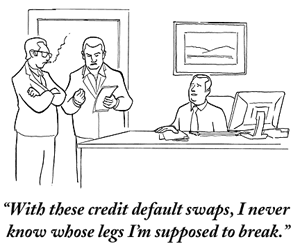
In finance, a derivative is a financial instrument (or, more simply, an agreement between two parties) that has a value, based on the expected future price movements of the asset to which it is linked—called the underlying— such as a share or a currency. There are many kinds of derivatives, with the most common being swaps, futures, and options.
Derivatives are a form of alternative investment, an investment product other than the traditional investments of stocks, bonds, cash or property. A derivative is not a stand-alone asset, since it has no value of its own. However, more common types of derivatives have been traded on markets before their expiration date as if they were assets. Among the oldest of these are rice futures, which have been traded on the Dojima Rice Exchange since the eighteenth century.
Posted in Language, Money |
Leave a Comment »
November 11, 2010

A quantum computer is a device for computation that makes direct use of quantum mechanical phenomena, such as superposition and entanglement, to perform operations on data. Quantum computers are different from traditional computers based on transistors. The basic principle behind quantum computation is that quantum properties can be used to represent data and perform operations on these data. If large-scale quantum computers can be built, they will be able to solve certain problems much faster than any current classical computers (for example Shor’s algorithm). The Bloch sphere is a representation of a qubit, the fundamental building block of quantum computers.
A classical computer has a memory made up of bits, where each bit represents either a one or a zero. A quantum computer maintains a sequence of qubits. A single qubit can represent a one, a zero, or, crucially, a quantum superposition where it is all possible states simultaneously. Although quantum computing is still in its infancy, experiments have been carried out in which quantum computational operations were executed on a very small number of qubits. Both practical and theoretical research continues, and many national government and military funding agencies support quantum computing research to develop quantum computers for both civilian and national security purposes, such as cryptanalysis.
Posted in Technology |
Leave a Comment »
November 11, 2010

The Whig Party was a political party of the United States during the era of Jacksonian democracy (1833 – 1856). The party was formed in opposition to the policies of President Andrew Jackson and his Democratic Party to promote the strength of the presidency and executive branch at the expense of Congress. The Whigs advocated the supremacy of Congress over the presidency, and favored a program of modernization and economic protectionism. In its two decades of existence, the Whig Party saw two of its candidates, William Henry Harrison and Zachary Taylor, elected president.
read more »
Posted in Language, Politics |
Leave a Comment »
November 11, 2010
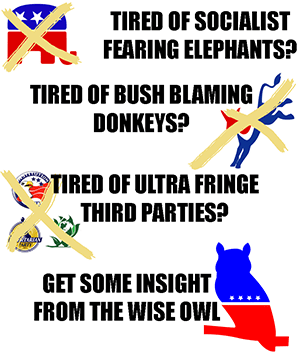
The Modern Whig Party is a United States political party whose stated intention is to be a ‘party for the rest of us.’ The Modern Whig Party describes itself as a mainstream, middle-of-the-road grassroots movement that caters to those voters who believe in various Republican issues but also believe in various other Democratic issues. Founded in 2008 by Iraq and Afghanistan veterans, the party has over 30,000 members nationally, with a sizable proportion affiliated with the American military. The general platform of the Modern Whig Party relates to fiscal responsibility, strong national defense, and social progress.
For its logo, the Modern Whig Party uses an owl, the symbol of the original Whig Party. As with the logos for the Democrats and the Republicans, a red, white, and blue color scheme is used, but with different meaning. Reportedly, the blue represents Democrats and the red, Republicans; the two colors are divided by a white band and four white stars. The party believes that the United States’ future lies in “meeting in the middle”, thus the placement of the stars in the middle of the owl.
Posted in Politics |
Leave a Comment »
November 11, 2010

Google Dashboard is a service launched by Google that allows a person with a Google Account to compile all the personal information associated with their account, or in their words, ‘Dashboard helps you answer the question: What information does Google have about me?’ The tool pulls together personal information from Google’s applications and services, such as Gmail, YouTube, or Blogger, and indicates whether the information is public or not. The service was launched in November, 2009.
Google created Dashboard in response to privacy concerns about how the company handles personal information. It launched the service at the 31st International Conference of Data Protection and Privacy Commissioners. The service allows a user to review and delete recent Google searches and view documents and other content created using Blogger, Picasa, Google Calendar, and other services.
Posted in Politics, Technology |
Leave a Comment »
November 10, 2010

A Million Random Digits with 100,000 Normal Deviates is a 1955 book by the RAND Corporation. The book, comprising primarily of a random number table, was an important 20th century work in the field of statistics and random numbers. It was produced starting in 1947 by an electronic simulation of a roulette wheel attached to a computer, the results of which were then carefully filtered and tested before being used to generate the table. The book was one of the last of a series of random number tables produced from the mid-1920s through the 1950s, after which the development of high speed computers allowed faster operation through the generation of pseudorandom numbers rather than reading them from tables.
The RAND table was an important breakthrough in delivering random numbers, because such a large and carefully prepared table had never before been available. In addition to being available in book form, one could also order the digits on a series of punched cards. The main use of the tables was in statistics and the experimental design of scientific experiments, especially those which employed the ‘Monte Carlo method,’ a class of computational algorithms used in cryptography.
Posted in Language, Technology |
Leave a Comment »
November 10, 2010

Xerostomia [zeer-uh-stoh-mee-uh] is the medical term for the subjective complaint of dry mouth due to a lack of saliva; sometimes colloquially called pasties, cottonmouth, drooth, doughmouth or des (like a desert). Xerostomia can cause difficulty in speech and eating. It also leads to halitosis and a dramatic rise in the number of cavities, as the protective effect of saliva’s remineralizing the enamel is no longer present, and can make the mucosa and periodontal tissue of the mouth more vulnerable to infection.
Notably, a symptom of heavy methamphetamine use usually called ‘meth mouth’ is largely caused by xerostomia which is worsened by the fact that methamphetamine at recreational doses can cause tight clenching of the jaw, bruxism (compulsive grinding of the teeth), or a repetitive ‘chewing’ movement like the user is chewing without food in the mouth.
Posted in Health, Language |
Leave a Comment »
November 10, 2010

Meta (from Greek: ‘after,’ ‘beyond,’ ‘with,’ ‘adjacent,’ ‘self’), is a prefix used in English to indicate a concept which is an abstraction from another concept, used to complete or add to the latter. In epistemology, the prefix meta is used to mean about (its own category). For example, metadata are data about data (who has produced them, when, what format the data are in and so on). Similarly, metamemory in psychology means an individual’s knowledge about whether or not they would remember something if they concentrated on recalling it.
Another, slightly different interpretation of this term is ‘about’ but not ‘on’ (exactly its own category). For example, in linguistics a grammar is considered as being expressed in a metalanguage, or a sort of language for describing another language (and not itself). In Greek, the prefix meta- is generally less esoteric than in English; Greek meta- is equivalent to the Latin words post- or ad-. The use of the prefix in this sense occurs occasionally in scientific English terms derived from Greek. For example: the term Metatheria (the name for the clade of marsupial mammals) uses the prefix meta- merely in the sense that the Metatheria occur on the tree of life adjacent to the Theria (the placental mammals).
Posted in Language, Philosophy |
Leave a Comment »
November 10, 2010

The term ‘Fucking New Guy‘ (FNG) is a derogatory term for new recruits, made popular by US troops in the Vietnam war. Every unit had an FNG, and the term was used across all unit types, from front line combat through to support and medical units. The term was not gender specific; female personnel could be FNGs as well.
FNGs were an important part of the group dynamic of US units in Vietnam and their treatment had at its core an overall sense of ‘us’ (those with experience of the war) and ‘them’ (those who were back in the United States). As one soldier said, FNGs were ‘still shitting stateside chow.’ It was in combat units that the FNG was truly ignored and hated by his colleagues. An FNG in a combat unit was ‘treated as a non-person, a pariah to be shunned and scorned, almost vilified, until he passed that magic, unseen line to respectability.’
read more »
Posted in Humor, Language, War |
Leave a Comment »
November 9, 2010

Jay Pinkerton (born June 15, 1977) is a nationally published humorist and a former editor of both CRACKED.com and Cracked magazine. Prior to joining Cracked, Pinkerton served as the managing editor of NationalLampoon.com. Since joining Cracked, Pinkerton has helped make CRACKED.com a leading comedy site, including by bringing in new contributors.
Jay Pinkerton initially registered his website, Jaypinkerton.com, to be a portfolio of his comedy and artwork. Afterwards, Pinkerton joined the forums of the Internet humor website ‘Pointless Waste of Time’ (PWOT), and took the attention of the site’s owner, David Wong, with whom Pinkerton worked with on a series of comedy articles. It was around this time that he first published his redone Spider-Man comics, spawning an Internet phenomenon. In addition to Cracked, Pinkerton’s work has also appeared on McSweeney’s Internet Tendency, Modern Humorist, CollegeHumor.com and numerous other sites. He has also been hired by Valve Software to write some of the sequel to Portal, Portal 2.
Posted in Art, Humor |
Leave a Comment »
November 9, 2010
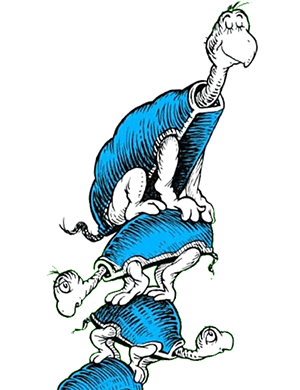
‘Turtles all the way down‘ is a jocular expression of the infinite regress problem in cosmology. The joke goes as follows: An Eastern guru affirms that the earth is supported on the back of a tiger. When asked what supports the tiger, he says it stands upon an elephant; and when asked what supports the elephant he says it is a giant turtle. When asked, finally, what supports the giant turtle, he is briefly taken aback, but quickly replies ‘Ah, after that it is turtles all the way down.’
The phrase was popularized by Stephen Hawking in 1988. The ‘turtle’ metaphor in the anecdote represents a popular notion of a primitive cosmological myth, viz. the flat earth supported on the back of a World Turtle.
Posted in Humor, Philosophy |
Leave a Comment »
November 9, 2010

Easter eggs are hidden messages, in-jokes or features in things like video games, web sites, DVDs and other media. For example, the HP 54622D, a professional oscilloscope, has an ‘Asteroids’ clone called ‘Rocks’ that can be accessed by entering a secret sequence of buttons. Google Maps contains an easter egg whereby a user asking for directions from Japan to China would be directed to jetski across the Pacific Ocean.
read more »
Posted in Games, Humor, Technology |
Leave a Comment »



 The Daily Omnivore