November 4, 2010

The Cremaster Cycle is an art project consisting of five feature length films, together with related sculptures, photographs, drawings, and artist’s books; it is the best-known work of American visual artist and filmmaker Matthew Barney.
The films were made over a period of eight years (1994–2002) and culminated in a major museum exhibition organized by Nancy Spector of the Solomon R. Guggenheim Museum in New York City, which traveled to the Museum Ludwig in Cologne and the Musée d’art Moderne in Paris from 2002-03. Barney’s longtime collaborator Jonathan Bepler composed and arranged the soundtracks for the films.
read more »
Posted in Art, Philosophy, Sex |
Leave a Comment »
November 4, 2010
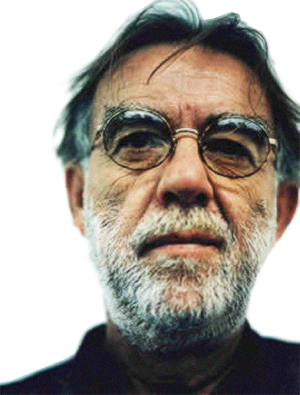
The Qatsi trilogy is the informal name given to a series of three films produced by Godfrey Reggio and scored by Philip Glass: Koyaanisqatsi: Life out of balance (1983), Powaqqatsi: Life in transformation (1988), and Naqoyqatsi: Life as war (2002). The titles of all three films are words from the language of the Hopi people; ‘qatsi’ means life. See Also: Baraka (1992) – an experimental documentary film directed by Ron Fricke, cinematographer on Koyaanisqatsi, and Chronos (1985) – an experimental film about the passage of time on different scales, also by Fricke.
Posted in Art, Philosophy, World |
1 Comment »
November 4, 2010

Balloon Dog is a sculpture by American artist, Jeff Koons. It is over ten feet tall, and constructed of high chromium stainless steel with a transparent color coating. It is part of the ‘Celebration’ series, which Koons began working on in 1993. Other forms in the series of sculptures and paintings include Valentine hearts, diamonds, and Easter eggs. Some of the pieces are still being fabricated. Each of the 20 different sculptures in the series comes in five differently colored ‘unique versions.’
read more »
Posted in Art, Money, Politics |
Leave a Comment »
November 4, 2010

Master Shake is a fictional character on Adult Swim’s television series, Aqua Teen Hunger Force. Like the other main characters, Meatwad and Frylock, Master Shake originally appeared in the Space Ghost Coast to Coast episode ‘Baffler Meal,’ and then made his first official appearance in the show’s first episode, ‘Rabbot’ Voice actor Dana Snyder provides Shake’s voice throughout the entire series. Master Shake lives next door to Carl Brutananadilewski in a suburban neighborhood in New Jersey with his roommates, Meatwad and Frylock. He spends most of his time watching TV, causing mischief, talking about women, sex, breasts, and porn.
He is also fond of playing cruel pranks on Meatwad. In ‘Video Ouija’ Shake commits suicide just so he can haunt Meatwad through his new video game. In ‘Reedickyoulus’ Shake kills Meatwad’s innocent kitten, in a microwave, just to upset Meatwad. His behavior is highly irregular, blaming others for his numerous mistakes, antagonizing Meatwad for pleasure, putting material goods above necessities, concocting poor lies to cover and justify his actions even when caught red-handed, and having an overall lack of empathy and regard for the safety of others. Shake has no official power, except his ability to shoot a substance from his straw, and almost every thing he throws to the ground explodes.
Posted in Art, Humor |
Leave a Comment »
November 4, 2010

The Business Plot (also the Plot Against FDR and the White House Putsch) was an alleged political conspiracy in 1933. Retired Marine Corps Major General and two time Medal of Honor winner Smedley Butler claimed that wealthy businessmen were plotting to create a fascist veterans’ organization and use it in a coup d’état to overthrow United States President Franklin D. Roosevelt.
In 1934 Butler testified to a Congressional committee on these claims. In the opinion of the committee, these allegations were credible, but no one was prosecuted. While historians have questioned whether or not a coup was actually close to execution, most agree that some sort of ‘wild scheme’ was contemplated and discussed.
Posted in Money, Politics |
Leave a Comment »
November 4, 2010

A labret [ley-bret] is form of body piercing; taken literally, it is any type of adornment that is attached to the facial lip (labrum). However, the term usually refers to a piercing that is below the bottom lip, above the chin. It is sometimes referred to as a ‘tongue pillar.’ Among the ancient Aztecs and Mayans, labret piercing was reserved for male members of the higher castes. The name derives from the Latin labrum ‘lip’ and the diminutive suffix -et. However, many in the body-piercing industry incorrectly give it a French pronunciation, though it is not a French word.
There are several different labret variations based on precisely where the piercing is positioned on the lower lip. These include a vertical labret (through the top of the lower lip), snake bites (dual piercings close together reminiscent of fangs), spiderbites (dual piercings very close together on the same side of the face), and a lowbret, which is placed as low as possible toward the chin. The initial piercing is usually done at 1.2 , 1.6 or 2.0 mm diameter. After initial healing, the piercing can then be (gradually) further stretched. Some people chose to stretch to sizes over 10 mm, and the jewelry worn at these larger sizes is then usually a round or oval ‘labret plug.’
Posted in Art, Language |
12 Comments »
November 4, 2010

PayPal Mafia is an informal term for the community of American businesspeople and investors centered in Silicon Valley, who were early employees of e-commerce service PayPal before founding a series of other technology companies. Paypal was founded by Max Levchin and Peter Thiel in 1998 and was aquired by eBay for $1.5 billion in 2002. The PayPal Mafia are often credited with inspiring Web 2.0, and for the re-emergence of consumer-focused Internet companies after the dot com bust of 2001.
read more »
Posted in Language, Money, Technology |
Leave a Comment »
November 3, 2010

A bucket bong, also called a gravity bong, is a method of consuming cannabis. The smoke in a gravity bong never actually passes through the water as it would in an ordinary bong. The water is used to draw the smoke into the container by pulling up, creating a change in air pressure. The smoke is then pushed into the mouth of the user by pushing down causing air compression.
Posted in Drugs, Technology |
Leave a Comment »
November 3, 2010

The DARPA PowerSwim program is developing a human-powered swimming device for use by combat and reconnaissance swimmers. The device uses the same oscillating foil approach to swimming that is exhibited by many fish and aquatic birds. This propulsion approach is more than 80-percent efficient in conversion of human motions to forward propulsion. Typical recreational swim fins are no more than 15-percent efficient in their conversion of human exertion to propulsive power, and freestyle swimming converts only 3-percent.
Posted in Technology, War |
Leave a Comment »
November 3, 2010

Valrhona is a French chocolate manufacturer based in the small town of Tain-l’Hermitage in Hermitage, a wine-growing district near Lyon. The company was founded in 1922 by a French pastry chef, Albéric Guironne, and is today one of the leading producers of chocolate in the world. The company also maintains the École du Grand Chocolat, a school for professional chefs with a focus on chocolate-based dishes and pastries. Valrhona focuses mainly on high-grade luxury chocolate marketed for professional as well as for private consumption. Though considered one of the foremost chocolate makers in the world, Valrhona is in roughly the same price range as Godiva and Neuhaus.
The product line includes chocolate confectionery, plain and flavored chocolate bars and bulk chocolate in bars or pellets. Valrhona produces vintage chocolate made from beans of a single year’s harvest from a specific plantation, primarily the Grand Crus which is grown in South America, the Oceania and the Caribbean. Currently three brands of vintage chocolates – Ampamakia, Gran Couva and Palmira – are in production with plantations on Madagascar, Trinidad and in Venezuela respectively.
Posted in Food, Money, World |
Leave a Comment »
November 3, 2010

Barefoot running was widespread for the majority of human history and is still relatively common in undeveloped populations. In competitive running virtually all modern athletes use running shoes, but a small minority of runners have achieved success running barefoot, including Olympic champions and world record holders Abebe Bikila and Tegla Loroupe, as well as Zola Budd. The biomechanics of running are changed quite significantly when shoes are used – in barefoot running, the balls of the feet strike the ground with the most force. With padded shoes more emphasis is placed on the heel and the back of the foot. Running in thin-soled, flexible shoes such as moccasins, VivoBarefoot and Vibram FiveFingers is biomechanically similar to barefoot running.
Barefoot running is experiencing a small resurgence of popularity. Its proponents believe it is healthier for feet and reduces the risk of chronic injuries, notably repetitive stress injuries due to the impact of heel striking in padded running shoes. These health claims are supported by some research and advocated by some authorities, but the research is not conclusive or widely accepted in the medical community. Barefoot running is not generally advocated by medical or sports organizations, who recommend that padded running shoes be worn, with particular consideration to foot type (type of pronation in heel strike gait).
Posted in Games, Health, Technology |
Leave a Comment »
November 3, 2010
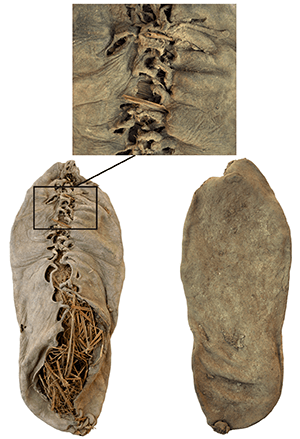
The Areni-1 shoe is a 5,500-year-old leather shoe that was found in 2008 in excellent condition in the ‘Areni-1’ cave in Armenia. It is a one-piece leather-hide shoe and the oldest piece of leather footwear in the world known to contemporary researchers (the oldest footwear of any kind yet discovered are a 10,000 year old pair of sandals made of sagebrush fiber, from Fort Rock Cave in Oregon). The use of shoes is believed to have begun between 40,000 and 26,000 years ago. The Areni-1 shoe was found in near-perfect condition due to the cool and dry conditions in the cave and a thick layer of sheep dung which acted as a solid seal.
Large storage containers were found in the same cave, many of which held well-preserved wheat, barley, and apricots, as well as other edible plants. The shoe contained grass and the archaeologists were uncertain as to whether this was because the grass was used as insulation to keep the foot warm, or used to preserve the shape of the shoe while not being worn. Radiocarbon analysis dates the shoes to 3,500 BCE (a few hundred years older than a leather shoe found on Ötzi the Iceman, 400 years older than shoes found at Stonehenge, and 1,000 years older than shoes found at the Great Pyramid of Giza).
Posted in Technology |
Leave a Comment »




 The Daily Omnivore