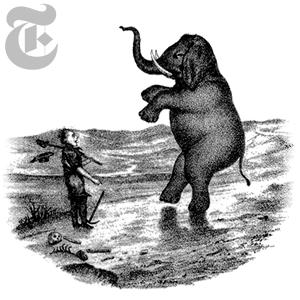
The phrase ‘seeing the elephant‘ is an Americanism of the mid to late 19th century. Those planning to travel west announced they were ‘going to see the elephant.’ Those turning back claimed they had seen the ‘elephant’s tracks’ or the ‘elephant’s tail,’ and confessed they’d seen more than enough of the animal. The expression is said to arise from a tale current when circus parades first featured elephants. A farmer, so the story went, hearing that a circus was in town, loaded his wagon with vegetables for the market there. He had never seen an elephant and very much wished to. On the way to town he encountered the circus parade, led by an elephant. The farmer was thrilled. His horses, however, were terrified.
Bolting, they overturned the wagon and ruined the vegetables. ‘I don’t give a hang,’ the farmer said, ‘for I have seen the elephant.’ The elephant symbolized both the high cost of their endeavor — the myriad possibilities for misfortune on the journey or in California — and, like the farmer’s circus elephant, an exotic sight, and unequaled experience, the adventure of a lifetime. As early as the 1590s, the English used the idiom to ‘see the lions.’ This referred to the Tower of London which is thought to have been one of the world’s oldest zoos. Travelers and visitors were hopeful for a glimpse of the animals, especially the lion which was the living emblem of the king.


 The Daily Omnivore
Leave a comment