February 24, 2011

The Pacific Northwest Tree Octopus was an internet hoax created in 1998 by Lyle Zapato. This fictitious endangered species of cephalopod was given the Latin name ‘Octopus paxarbolis.’ It was purported to be able to live both on land and in water, and was said to live in the Olympic National Forest and nearby rivers, spawning in water where its eggs are laid. Its major predator was said to be the Sasquatch.
Posted in Humor |
1 Comment »
February 24, 2011


The ear pull is a traditional Inuit game which tests the competitors’ ability to endure pain. In the ear pull, two competitors sit facing each other, their legs straddled and interlocked. A two-foot-long loop of string, similar to a thick, waxed dental floss, is looped behind their ears, connecting right ear to right ear, or left to left.
The competitors then pull upon the opposing ear using their own ear until the cord comes free or one player quits from the pain. The game has been omitted from some Arctic sports competitions due to safety concerns and the squeamishness of spectators; the event can cause bleeding and competitors sometimes require stitches.
Posted in Games |
Leave a Comment »
February 24, 2011

Gadsby: A Story of Over 50,000 Words Without Using the Letter ‘E’ is a 1939 novel by Ernest Vincent Wright. The plot revolves around the dying fictional city of Branton Hills, which is revitalized thanks to the efforts of protagonist John Gadsby and a youth group he organizes. The novel is written as a lipogram: a constrained writing or word game consisting of writing paragraphs or longer works in which a particular letter or group of letters is avoided. Though self-published and little-noticed in its time, the book is a favorite of fans of constrained writing and is a sought-after rarity among some book collectors.
Posted in Art, Language |
Leave a Comment »
February 24, 2011
Retroactive continuity (often shortened to retcon) refers to the alteration of previously established facts in a literary work. Retcons may be carried out for a variety of reasons, such as to accommodate sequels or further derivative works in the same series, to reintroduce popular characters, to resolve chronological issues, to reboot a familiar series for modern audiences, or to simplify an excessively complex continuity structure.
Retcons are common in pulp fiction, especially comic books published by long-established houses such as DC, Marvel and leading manga publishers. The long history of popular titles and the plurality of writers who contribute stories can often create situations that demand clarification or revision of exposition. Retcons appear as well in soap operas, serial drama, movie sequels, professional wrestling, video games, radio series, and other kinds of serial fiction.
Posted in Art, Language |
Leave a Comment »
February 24, 2011

Green Lantern is the name of several fictional characters, superheroes appearing in comic books published by DC Comics. The first (Alan Scott) was created by writer Bill Finger and artist Martin Nodell in All-American Comics #16 (July 1940). Each Green Lantern possesses a power ring and power lantern that gives the user great control over the physical world as long as the wielder has sufficient willpower and strength to wield it. The power ring can generate a variety of effects, sustained purely by the ring wearer’s imagination and strength of will. The greater the user’s willpower, the more effective the ring.
Stories in 2006 retconned the ring’s long-established ineffectiveness on yellow objects, stating that the ring-wielder need only feel fear, understand it and overcome it in order to affect yellow objects (however, it is a learned and practiced ability, making it a weakness to some Green Lanterns), giving retroactive credence to the explanation of the ring’s real but surmountable weakness to yellow.
Posted in Art |
Leave a Comment »
February 24, 2011

A placebo button, also called an idiot button, is a push-button with apparent functionality that actually has no effect when pressed, analogous to a placebo. In other cases, a control like a thermostat may not be connected. Although non-functional, the buttons can give the user an illusion of control. In some cases the button may have been functional, but may have failed or been disabled during installation or maintenance. Only in relatively rare cases will the button have been deliberately designed to do nothing. In many cases, a button may not appear to do something, but in fact cause behavior that is not immediately apparent; this can give the appearance of it being a placebo button.
Many walk buttons at pedestrian crossings were once functional in New York City, but now serve as placebo buttons. Some door-close buttons in elevators are placebo buttons, although some of them do in fact change the timing, and others are functional only when activated with a maintenance key. It has been reported that the temperature set point adjustment on thermostats in many office buildings are non-functional, installed to give tenants’ employees a similar illusion of control.
Posted in Humor, Technology |
Leave a Comment »
February 24, 2011

Stadium Events is the English title of the video game ‘Running Stadium’ by Bandai. The game was released for the NES in Japan in 1986, in the United States in 1987. It was one of two games released in North America that were designed and branded for the Family Fun Fitness mat, a short-lived running pad accessory for the NES. The North American, or NTSC, version of Stadium Events is universally accepted as the rarest and most valuable licensed NES game. A copy sold January 2011 on ebay for $22,806.00, the highest price ever paid for a video game
The two Family Fun Fitness-branded games that had already been released, as well as Bandai’s version of the running pad accessory, were pulled from shelves and presumed destroyed. Because of this odd sequence of events, only 2000 copies are believed to have been produced, of which it is estimated that 200 copies reached consumers before being recalled. Today, collectors who follow the online sale of rare video games believe that fewer than 20 complete copies of the game exist, only two of which are known to be factory sealed.
Posted in Games, Money |
Leave a Comment »
February 24, 2011

The T206 Honus Wagner baseball card depicts Pittsburgh Pirates’ Honus Wagner, a dead-ball era baseball player who is widely considered to be one of the best players of all time. The card was designed and issued by the American Tobacco Company (ATC) from 1909 to 1911 as part of its T206 series. Wagner refused to allow production of his card to continue, either because he did not want children to buy cigarette packs to get his card, or because he wanted more compensation from the ATC. Only 60 to 200 cards were ever distributed to the public.
In 1933, the card was first listed at a price value of US$50 in Jefferson Burdick’s The American Card Catalog, making it the most expensive baseball card in the world at the time. It has retained that title and is currently worth up to $2.8 million. The most famous T206 Honus Wagner is the ‘Gretzky’ card. The card has a controversial past, as some speculate that it was once altered, based on its odd texture and shape. In 1991 the card was sold to ice hockey figures Wayne Gretzky and Bruce McNall for $451,000. In 2007 they sold privately to an anonymous collector for $2.35 million.
Posted in Games, Money |
1 Comment »
February 24, 2011

The Turnip Prize is a spoof UK award that satirises the Tate Gallery’s Turner Prize by rewarding deliberately bad modern art. It was started mainly as a joke in 1999, but has gained national media attention and inspired other similar prizes. Credit is given for entries that have bad puns as titles, display ‘lack of effort’ and pass the crucial test of ‘is it shit?’; conversely, entries which show ‘too much effort’ or are ‘not shit enough’ are disqualified. The first prize is a turnip nailed to a block of wood.
Posted in Art, Humor |
Leave a Comment »
February 24, 2011

Vertebral [vur-tuh-bruhl] subluxation [suhb-luhk-sey-shuhn] is a controversial term that is commonly used by chiropractors to describe signs and symptoms of the spinal column. The chiropractic vertebral subluxation complex has been a source of controversy since its inception in 1895 due to its metaphysical origins and claims of far reaching effects on health and disease. Although some in the chiropractic profession reject the concept of subluxation and shun the use of this term as a diagnosis, its current and officially accepted status by the profession has been repeatedly confirmed.
In 2010 the General Chiropractic Council, the statutory regulatory body for chiropractors in the United Kingdom, issued guidance for chiropractors stating that the chiropractic vertebral subluxation complex ‘is not supported by any clinical research evidence that would allow claims to be made that it is the cause of disease or health concerns.’ A similar stance is taken by the National Health Service: ‘There is also no scientific evidence to support the idea that most illness is caused by misalignment of the spine.’
Posted in Health, Language, Science |
Leave a Comment »
February 24, 2011

The Waimea River is a river on the island of Kauai in the U.S. state of Hawaii. At approximate 12 miles in length, it is one of the longest rivers in the Hawaiian Islands. It rises in a wet plateau of the island’s central highlands, in the Alaka’i Swamp, the largest high-elevation swamp in the world. It flows south, passing through the 3,000-foot-deep (910 m) Waimea Canyon, known as the ‘Grand Canyon of the Pacific.’
Due to wave action, sand gets pushed up into a large hill in front of the river each winter. This creates a natural dam that water collects behind for months, and which is about 20 feet above the level of the ocean on the other side of the sand berm. Every year some one digs a trench through the sand releasing millions of gallons of fresh water into the ocean. This produces a standing wave which is perfect for body boarding and surfing on.
Posted in Games, Science |
Leave a Comment »
February 24, 2011
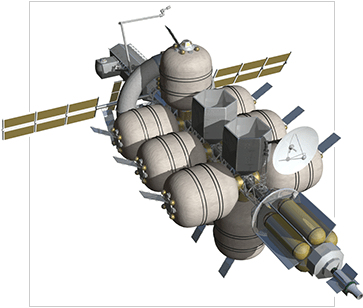
The NAUTILUS-X is a 2011 NASA proposal for a long-duration crewed space transport vehicle with an artificial gravity space habitat intended to promote crew-health for a crew of up to six persons on missions of up to two years duration. The partial-g torus-ring centrifuge would utilize both standard metal-frame and inflatable spacecraft structures and would provide 0.11 to 0.69g if built with the 40 feet (12 m) diameter option. As of 2011, developing and assembling the NAUTILUS-X ‘would take at least five years and require two or three rocket launches. It would cost about $3.7 billion.’
Posted in Technology |
Leave a Comment »






 The Daily Omnivore