February 24, 2011
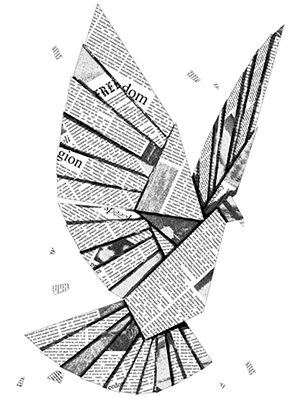
The concept of the Fourth Estate is a societal or political force or institution whose influence is not consistently or officially recognized. It now most commonly refers to the news media; especially print journalism. Thomas Carlyle attributed the origin of the term to Edmund Burke, who used it in a parliamentary debate in 1787 on the opening up of press reporting of the House of Commons of the United Kingdom. Earlier writers have applied the term to lawyers, to the queen of England (acting as a free agent, independent of the king), and to the proletariat.
Posted in Language, Politics |
Leave a Comment »
February 24, 2011
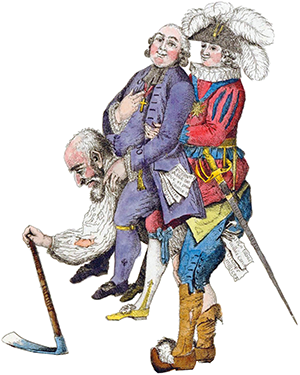
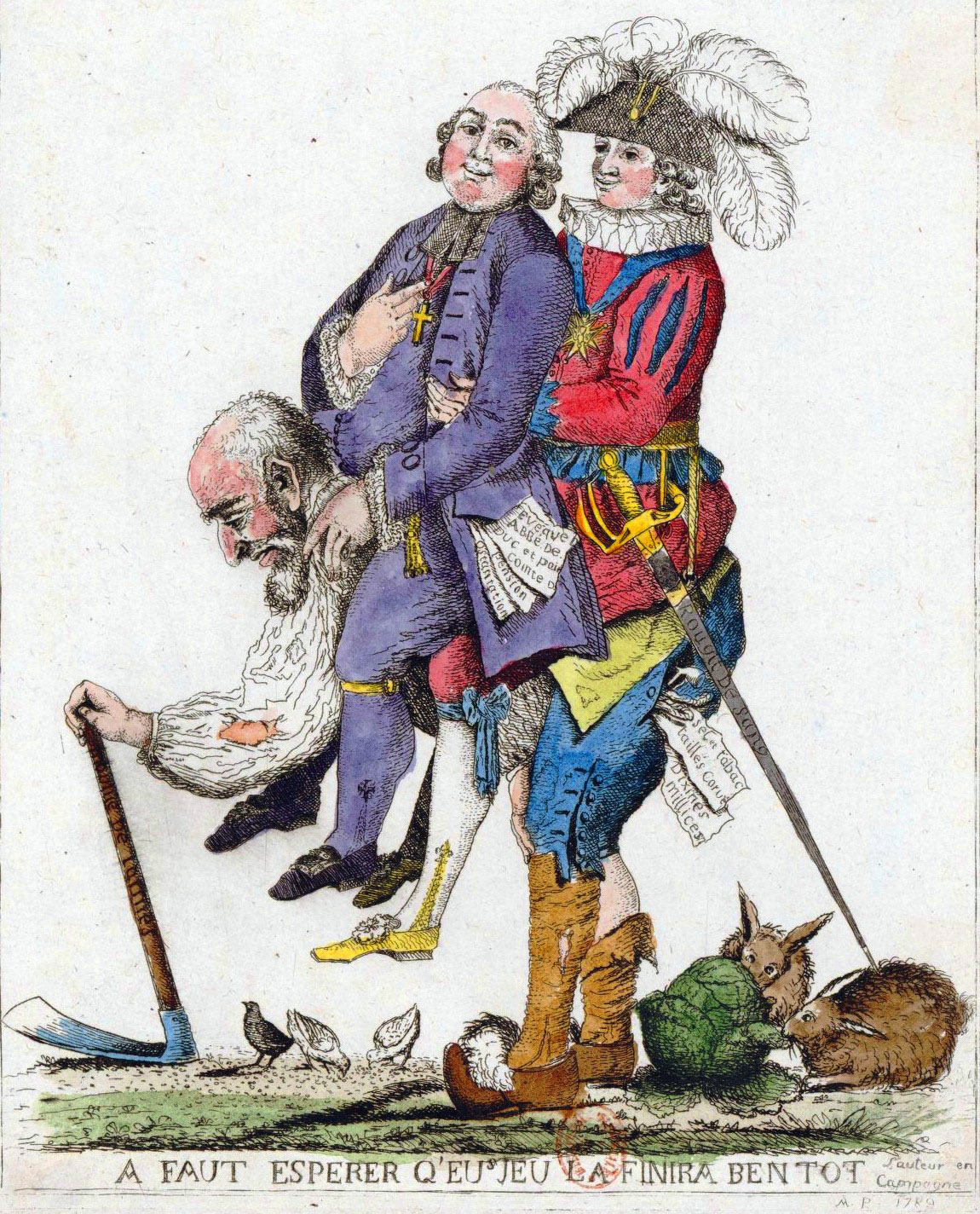
Estates of the realm were the broad divisions of a hierarchically conceived society in the Middle Ages and in Early Modern Europe. The first estate was typically the clergy, the second estate was the nobility, and the third estate was the commoners. While various realms inverted the order of the first two, commoners were universally tertiary, and often further divided into burghers (also known as bourgeoisie) and peasants; in some regions, there also was a population outside the estates.
An estate was usually inherited and based on occupation, similar to a caste. Legislative bodies or advisory bodies to a monarch were traditionally grouped along lines of these estates, with the monarch above all three estates. Meetings of the estates of the realm became early legislative and judicial parliaments. Monarchs often sought to legitimize their power by requiring oaths of fealty from the estates.
Posted in Language, Money, Politics |
Leave a Comment »
February 24, 2011
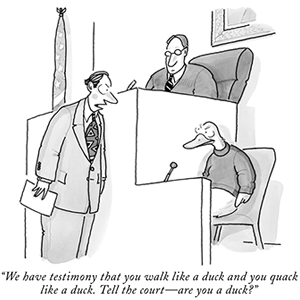
The duck test is a humorous term for a form of inductive reasoning. This is its usual expression: If it looks like a duck, swims like a duck, and quacks like a duck, then it probably is a duck. The test implies that a person can identify an unknown subject by observing that subject’s habitual characteristics. It is sometimes used to counter abstruse arguments that something is not what it appears to be.
Indiana poet James Whitcomb Riley (1849–1916) is sometimes credited with coining the phrase. The term was later popularized in the United States by Richard Cunningham Patterson Jr., United States ambassador to Guatemala during the Cold War in 1950, who used the phrase when he accused the Jacobo Arbenz Guzmán government of being Communist.
Posted in Humor, Language |
Leave a Comment »
February 24, 2011
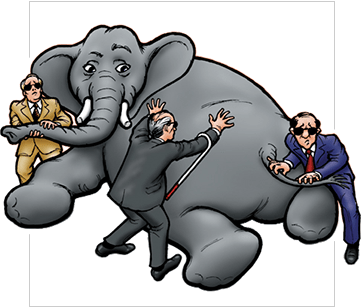
The term elephant test refers to situations in which an idea or thing ‘is hard to describe, but instantly recognizable when spotted.’ The term is often used in legal cases when there is an issue which may be open to interpretation, such as in the case of Cadogan Estates Ltd v Morris, when Lord Justice Stuart-Smith referred to ‘the well known elephant test. It is difficult to describe, but you know it when you see it.’
Posted in Humor, Language, Politics |
2 Comments »
February 24, 2011
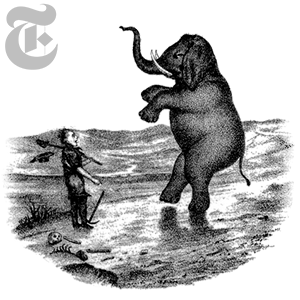
The phrase ‘seeing the elephant‘ is an Americanism of the mid to late 19th century. Those planning to travel west announced they were ‘going to see the elephant.’ Those turning back claimed they had seen the ‘elephant’s tracks’ or the ‘elephant’s tail,’ and confessed they’d seen more than enough of the animal. The expression is said to arise from a tale current when circus parades first featured elephants. A farmer, so the story went, hearing that a circus was in town, loaded his wagon with vegetables for the market there. He had never seen an elephant and very much wished to. On the way to town he encountered the circus parade, led by an elephant. The farmer was thrilled. His horses, however, were terrified.
Bolting, they overturned the wagon and ruined the vegetables. ‘I don’t give a hang,’ the farmer said, ‘for I have seen the elephant.’ The elephant symbolized both the high cost of their endeavor — the myriad possibilities for misfortune on the journey or in California — and, like the farmer’s circus elephant, an exotic sight, and unequaled experience, the adventure of a lifetime. As early as the 1590s, the English used the idiom to ‘see the lions.’ This referred to the Tower of London which is thought to have been one of the world’s oldest zoos. Travelers and visitors were hopeful for a glimpse of the animals, especially the lion which was the living emblem of the king.
Posted in Language, World |
Leave a Comment »
February 24, 2011
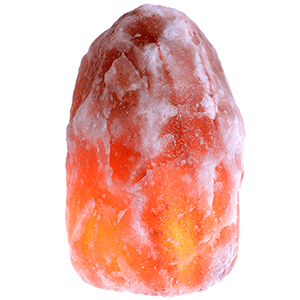
Himalayan salt is a marketing term for Halite (commonly known as rock salt) from Pakistan. It is mined in the Khewra Salt Mines, the second largest salt mine in the world, located about 300 km from the Himalayas, and about 160 kilometres from Islamabad, in the foothills of the Salt Range. The salt sometimes comes out in a reddish or pink color, with some crystals having an off-white to transparent color. It is commonly used for cooking similar to regular table salt, brine, and bath products.
Rock salts mined in several parts of the world, including Hawaii, Utah, Bolivia, the Murray-Darling basin of Australia, Peru, and Poland are marketed as Himalayan salt or pink salt. The color results from iron oxide. More recently, large crystal rocks are also used as Salt lamps. A salt lamp is a lamp carved from a larger salt crystal, often colored, with an incandescent bulb or a candle inside. The lamps give an attractive glow and are suitable for use as nightlights or for ambient mood lighting.
Posted in Food, Language, Money |
Leave a Comment »
February 24, 2011

The Marula is a medium-sized dioecious tree, indigenous to Africa. The fruits are used in the liqueur Amarula. The distribution of this species throughout Africa has followed the Bantu people in their migrations, as it has been an important item in their diet since time immemorial. When ripe, the fruits have a light yellow skin, with white flesh, rich in vitamin C, are succulent, tart with a strong and distinctive flavor.
The marula fruit is also eaten by various animals in Southern Africa. In the movie ‘Animals Are Beautiful People’ by Jamie Uys, released in 1974, some scenes portray elephants, warthogs and monkeys becoming intoxicated from eating fermented marula fruit. Later research showed that these scenes were improbable and, in all probability, staged. Elephants would need a huge amount of fermented marulas to have any effect on them, and the amount of water drunk by elephants each day would also dilute the effect.
Posted in Drugs, Food, Science |
Leave a Comment »
February 24, 2011

Ken Butler (b. 1948) is an artist and musician, as well as an experimental musical instrument builder. His Hybrid musical instruments and other artworks explore the interaction and transformation of common and uncommon objects, altered images, sounds and silence. The idea of bricolage, essentially using whatever is ‘at hand,’ is at the center of his art, encompassing a wide range of practice that combines live music, instrument design, performance art, theater, sculpture, installation, photography, film/video, graphic design, drawing, and collage.
Posted in Art, Technology |
Leave a Comment »
February 24, 2011

Yuri Landman (b. 1973) is a Dutch luthier (someone who makes or repairs stringed instruments) who has made several experimental electric string instruments for a list of artists including Lee Ranaldo of Sonic Youth, Liars, Jad Fair of Half Japanese and Liam Finn. He has also been active as a comic book creator, musician, and singer.
Posted in Art, Technology |
Leave a Comment »
February 23, 2011
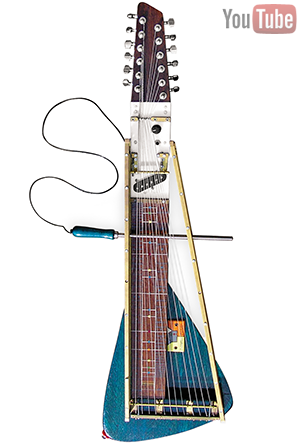
The Moodswinger is a twelve string electric zither with an additional third bridge designed by Dutch luthier Yuri Landman. The rod which functions as the third bridge divides the strings into two sections to cause an overtone multiphonic sound. In 2006 Landman was contacted by the noise band Liars to make an instrument for them. Although it closely resembles an electric guitar, it is actually a zither, as it has neither frets nor a proper neck. The pickup and electronics are built into the neck instead of in the body like usual electric guitars.
After Liars received their Moodswinger, they started recording their fourth album ‘Liars.’ The song ‘Leather Prowler’ is played with the Moodswinger, in many reviews confused with a piano. In 2008 the Moodswinger II was released as a serial product. Jessie Stein of The Luyas owns a copy. In 2009 Landman created a derivative version of the instrument called the Home Swinger, for workshops at festivals, where participants built their own copy within four hours.
Posted in Art, Technology |
Leave a Comment »
February 23, 2011
The term ‘analysis paralysis‘ refers to over-analyzing (or over-thinking) a situation, so that a decision or action is never taken, in effect paralyzing the outcome. A decision can be treated as over-complicated, with too many detailed options, so that a choice is never made, rather than try something and change if a major problem arises. A person might be seeking the optimal or ‘perfect’ solution upfront, and fear making any decision which could lead to erroneous results, when on the way to a better solution.
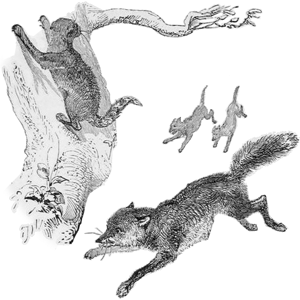
In Aesop’s Fables’ ‘The Fox and the Cat,’ the fox has ‘hundreds of ways of escaping’ while the cat has ‘only one.’ When they heard the hounds approaching, the cat scampered up a tree while ‘the Fox in his confusion was caught up by the hounds.’ The fable ends with the moral, ‘Better one safe way than a hundred on which you cannot reckon.’
Posted in Health, Language |
Leave a Comment »
February 23, 2011

Here Comes Science is a 2009 children’s album from Brooklyn-based band They Might Be Giants, packaged as a CD/DVD set. The album is the third in their line of educational albums, following 2005’s Here Come the ABCs and 2008’s Here Come the 123s. It is the band’s 14th studio album and fourth children’s album.
Posted in Art, Education, Science |
Leave a Comment »





 The Daily Omnivore