
Eratosthenes [er-uh-tos-thuh-neez] of Cyrene (276BCE–194BCE) was a Greek mathematician, geographer and astronomer. He was head of the Library of Alexandria from 240BC until his death: this was the most important library of the ancient world.
According to the Suda (a 10th century Byzantine encyclopedia) his contemporaries nicknamed him Beta, (the second letter of the Greek alphabet), because he was the second best in the world in almost any field. Eratosthenes was a friend of Archimedes, who also lived and worked in Alexandria. Archimedes was the greatest mathematician and inventor of the age, so perhaps the Beta nickname was not unjust.
The works Eratosthenes wrote are known to us only indirectly: the great Library was destroyed, and no copies survived. Eratosthenes made several remarkable discoveries and inventions. He was the first person to calculate the circumference of the Earth (with remarkable accuracy), and he invented a system of latitude and longitude. He calculated the tilt of the earth’s axis (again with remarkable accuracy); he may also have accurately calculated the distance from the earth to the sun and invented the leap day.
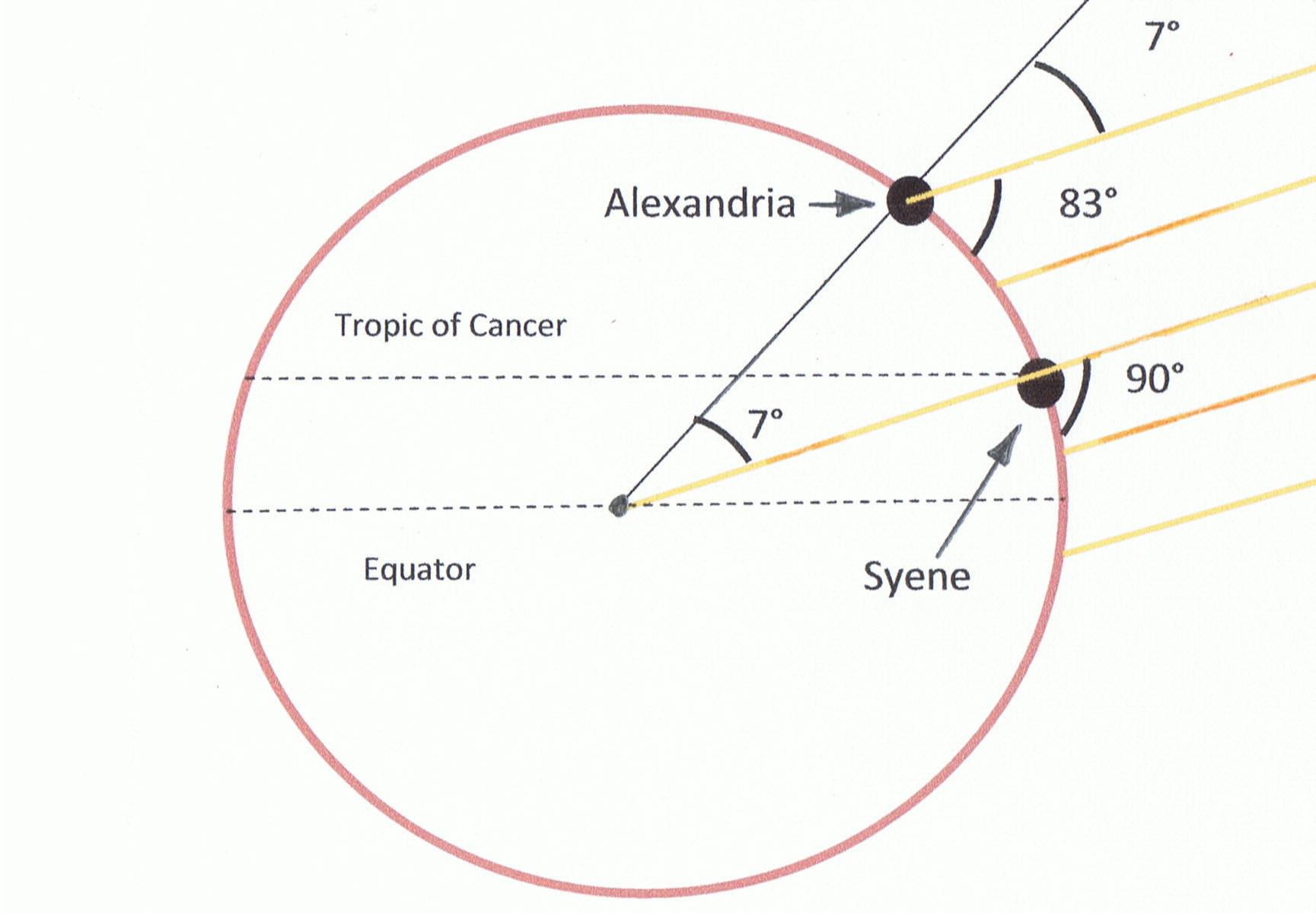
Eratosthenes measured the circumference of the earth without leaving Egypt. He knew that on the summer solstice at local noon at the city now called Aswan on the Tropic of Cancer, the sun would appear at the zenith, directly overhead. He also knew, from measurement, that in Alexandria, the angle of elevation of the sun would be 1/50 of a full circle (7°12′) south of the zenith at the same time. Assuming that Alexandria was due north of Syene he concluded that the distance from Alexandria to Syene must be 1/50 of the total circumference of the earth.
His estimated distance between the cities was 5000 stadia (about 500 geographical miles or 800km) by estimating the time that he had taken to travel from Syene to Alexandria by camel. He rounded the result to a final value of 700 stadia per degree, which implies a circumference of 252,000 Egyptian stadia or 39,375 km, an error of less than 1%. The method is an early application of trigonometry in the measurement science of geodesy.


 The Daily Omnivore
Leave a comment