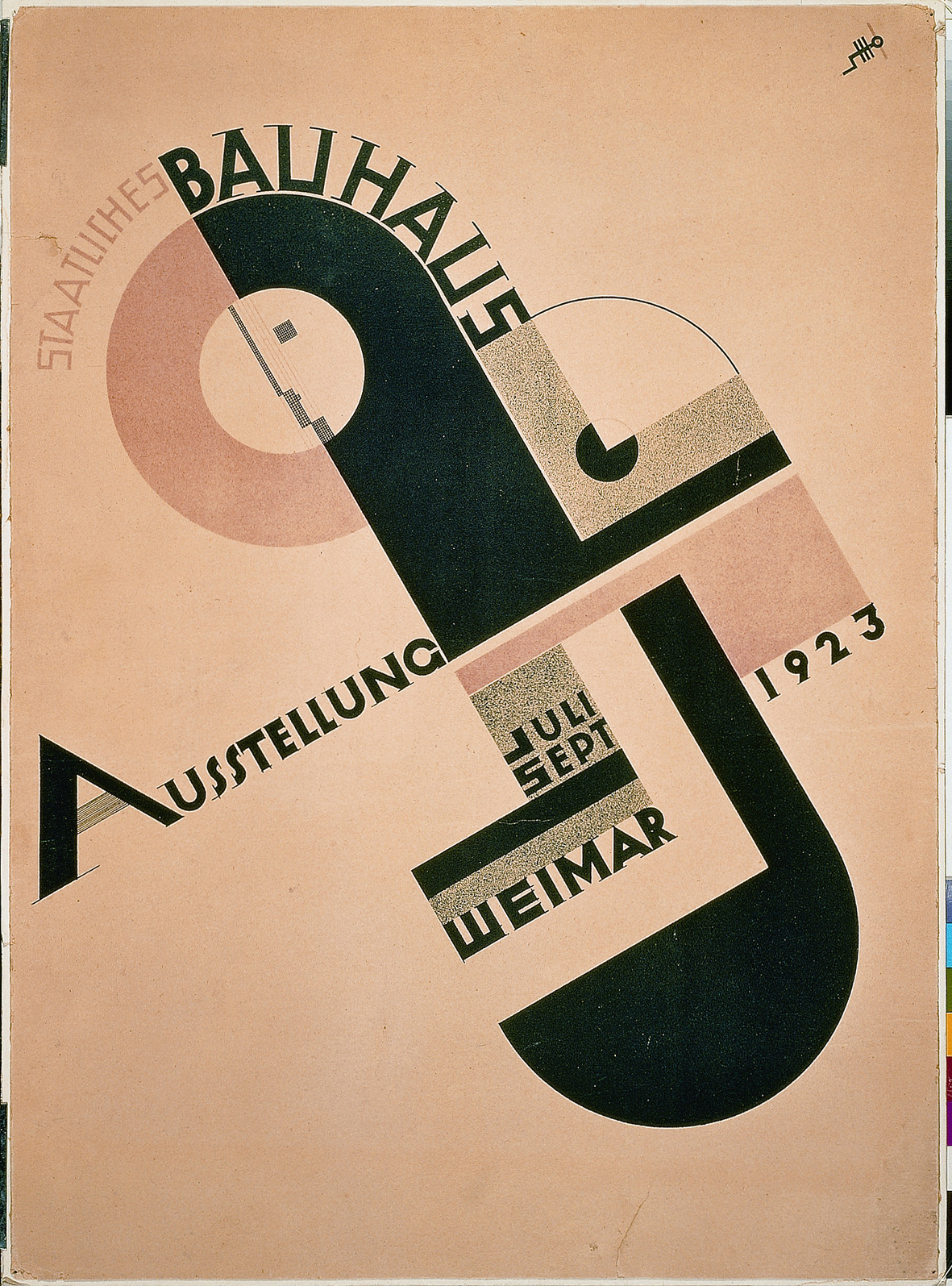

Bauhaus [bou-hous] is the common term for the Staatliches Bauhaus, an art and architecture school in Germany that operated from 1919 to 1933 in Germany and in the United States from 1937-1938. The most natural meaning for its name (related to the German verb for ‘build’) is Architecture House.
The Bauhaus school was founded by Walter Gropius in Weimar. In spite of its name, and the fact that its founder was an architect, the Bauhaus did not have an architecture department during the first years of its existence. Nonetheless it was founded with the idea of creating a ‘total’ work of art in which all arts, including architecture would eventually be brought together.
Germany’s defeat in World War I, the fall of the German monarchy and the abolition of censorship under the new, liberal Weimar Republic allowed an upsurge of radical experimentation in all the arts, previously suppressed by the old regime. Many Germans of left-wing views were influenced by the cultural experimentation that followed the Russian Revolution, such as constructivism. Such influences can be overstated: Gropius himself did not share these radical views, and said that Bauhaus was entirely apolitical.
Just as important was the influence of the 19th century English designer William Morris, who had argued that art should meet the needs of society and that there should be no distinction between form and function. Thus the Bauhaus style, also known as the International Style, was marked by the absence of ornamentation and by harmony between the function of an object or a building and its design.
However, the most important influence on Bauhaus was modernism, a cultural movement whose origins lay as far back as the 1880s, and which had already made its presence felt in Germany before the World War, despite the prevailing conservatism. The design innovations commonly associated with Gropius and the Bauhaus—the radically simplified forms, the rationality and functionality, and the idea that mass-production was reconcilable with the individual artistic spirit—were already partly developed in Germany before the Bauhaus was founded.
The Bauhaus was founded at a time when the German zeitgeist (‘spirit of the times’) had turned from emotional Expressionism to the matter-of-fact New Objectivity. An entire group of working architects turned away from fanciful experimentation, and turned toward rational, functional, sometimes standardized building.
Although neither the Nazi Party nor Hitler himself had a cohesive architectural policy before they came to power in 1933, Nazi writers had already labeled the Bauhaus ‘un-German’ and criticized its modernist styles, deliberately generating public controversy over issues like flat roofs. Increasingly through the early 1930s, they characterized the Bauhaus as a front for communists and social liberals.
Even before the Nazis came to power, political pressure on Bauhaus had increased. The Nazi movement, from nearly the start, denounced the Bauhaus for its ‘degenerate art,’ and the Nazi regime was determined to crack down on what it saw as the foreign, probably Jewish influences of ‘cosmopolitan modernism.’
The Bauhaus had a major impact on art and architecture trends in Western Europe, the United States, Canada and Israel (particularly in the White City of Tel Aviv) in the decades following its demise, as many of the artists involved fled, or were exiled, by the Nazi regime.
One of the main objectives of the Bauhaus was to unify art, craft, and technology. The machine was considered a positive element, and therefore industrial and product design were important components. There was no teaching of history in the school because everything was supposed to be designed and created according to first principles rather than by following precedent.
One of the most important contributions of the Bauhaus is in the field of modern furniture design. The ubiquitous Cantilever chair and the Wassily Chair designed by Marcel Breuer are two examples.
Vkhutemas, the Russian state art and technical school founded in 1920 in Moscow, has been compared to Bauhaus. Founded a year after the Bauhaus school Vkhutemas has close parallels to the German Bauhaus in its intent, organization and scope. The two schools were the first to train artist-designers in a modern manner.


 The Daily Omnivore
Leave a comment