May 18, 2011

In weaving cloth, the warp is the set of lengthwise yarns that are held in tension on a frame or loom. The yarn that is inserted over-and-under the warp threads is called the weft, woof, or filler. Each individual warp thread in a fabric is called a warp end or end. Warp means ‘that which is thrown across in Old English.’ Because the warp is held under extreme tension during the entire process of weaving, warp yarn must be strong.
Traditional fibers for warping are wool, linen and silk. With the improvements in spinning technology during the Industrial Revolution, it became possible to make cotton yarn of sufficient strength to be used as the warp in mechanized weaving. Later, artificial or man-made fibers such as nylon or rayon were employed.
Posted in Language, Technology |
Leave a Comment »
May 17, 2011

Iggy Pop (b. 1947), born James Newell Osterberg, is an American musician. He is considered an influential innovator of punk rock music. He began calling himself ‘Iggy’ after his first band in high school (for which he was drummer), The Iguanas. He was lead singer/songwriter of influential protopunk band The Stooges and became known for his outrageous and unpredictable stage antics. Inspired by the antagonism of Jim Morrison, Pop was the first performer to do a stage-dive, which he started at a concert in Detroit. Other exploits of Pop include rolling around in broken glass, exposing himself to the crowd and vomiting on stage.
Osterberg was raised in a trailer park in Ypsilanti, Michigan. He began his music career as a drummer in different high school bands in Ann Arbor, Michigan. He later moved to Chicago where he played drums in blues clubs, helped by Sam Lay (formerly of the Paul Butterfield Blues Band). In 1968, he and his new band, ‘The Stooges,’ signed with Elektra Records, again following in the footsteps of The Doors, who were Elektra’s biggest act at the time. Reportedly, Pop called Moe Howard to see if it was alright to call his band ‘The Stooges,’ to which Howard responded by merely saying ‘I don’t care what they call themselves, as long as they’re not the Three Stooges!’ and hung up the phone).
Posted in Art |
Leave a Comment »
May 17, 2011

Optogenetics is a neuromodulation technique employed in neuroscience where light pulses are used to activate and deactivate neurons which have been genetically sensitized to photons. It employs a combination of techniques from optics and genetics to control and monitor the activities of individual neurons in living tissue—even within freely-moving animals—and to precisely measure the effects of those manipulations in real-time. The key reagents used in optogenetics are light-sensitive proteins.
The earliest approaches were developed and applied in the lab of Gero Miesenböck, now Waynflete Professor of Physiology at the University of Oxford, and Richard Kramer and Ehud Isacoff at the University of California, Berkeley; these methods conferred light sensitivity but were never reported to be useful by other laboratories due to the multiple components these approaches required. A distinct single-component approach involving microbial opsin genes introduced in 2005 turned out to be widely applied. Optogenetics is known for the high spatial and temporal resolution that it provides in altering the activity of specific types of neurons to control a subject’s behavior.
Posted in Health, Science, Technology |
Leave a Comment »
May 17, 2011


Barbecue [bahr-bi-kyoo] (BBQ; ‘barbie’ in Australia and New Zealand; ‘braai’ in South Africa) is a special type of grill. It is also a way to prepare meat which is then cooked with that instrument. Barbecue cooking means to cook very slowly. It is not as hot or fast as standard grilling. Some meats must be cooked slowly to be tender, and easy to chew. Sometimes, meat may be slowly cooked for 8 to 24 hours in a barbecue. People in the United States barbecue chicken, beef and pork, depending on the part of the country.
Barbecuing is very popular in the Central and Southern U.S., especially in Texas with beef and Kansas City with pork. In the United States barbecued meat is usually covered in barbecue sauce, a type of thick, dark red sauce that often contains spices, tomatoes, and honey. Very often, American barbecue grills get heat from hickory wood. In California, it was common to barbecue beef in a hole in the ground rather than a grill. This is called a ‘pit barbecue.’
read more »
Posted in Food, Language, World |
Leave a Comment »
May 17, 2011
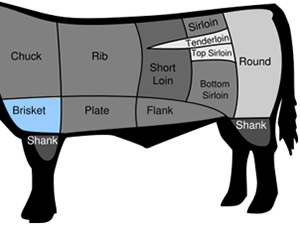

Brisket [bris-kit] is a cut of meat from the breast or lower chest of a cow. The beef brisket is one of the eight beef primal cuts. The brisket muscles include the superficial and deep pectorals. As cattle do not have collar bones, these muscles support about 60% of the body weight of standing/moving cattle. This requires a significant amount of connective tissue, so the resulting meat must be cooked thoroughly to tenderize the connective tissue.
The term derives from Old Norse ‘brjósk,’ meaning cartilage. The cut overlies the sternum, ribs and connecting costal cartilages. Popular brisket recipes in the Southern United States include rubbing with a spice rub or marinating the meat, then cooking slowly over indirect heat from charcoal or wood. This is a form of smoking the meat. Additional basting of the meat is often done during the cooking process.
read more »
Posted in Food, Language, World |
1 Comment »
May 17, 2011


Burnt ends are flavorful pieces of meat cut from the point half of a smoked brisket. A traditional part of Kansas City Barbecue, burnt ends are considered a delicacy in barbecue cooking. Either the entire brisket is cooked whole, then the point end removed and cooked further, or the point and flat are separated prior to cooking. Due to the higher fat content of the brisket point, it takes longer to fully cook to tender and render out fat and collagen. This longer cooking gave rise to the name. Sometimes when the flat is done, the point is returned to the smoker for further cooking. Some cooks re-season the point at this time.
Kansas City style burnt ends are usually served cubed with sauce either on top or on the side. A ‘proper’ burnt end should display a modest amount of ‘bark’ or char on at least one side. Burnt ends can be served alone (sometimes smothered in barbecue sauce) or in sandwiches, as well as in a variety of other dishes, including baked beans and gumbo.
Posted in Food |
Leave a Comment »
May 17, 2011

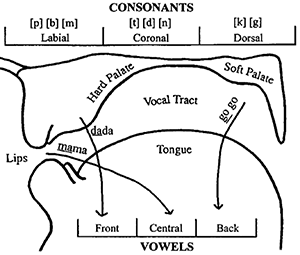
The International Phonetic Alphabet (IPA) is an alphabetic system of phonetic notation based primarily on the Latin alphabet. It was devised as a standardized representation of the sounds of all spoken languages. The IPA is designed to represent only those qualities of speech that are distinctive in spoken language: phonemes (‘a sound uttered,’ the smallest segmental unit of sound – e.g. the ‘k’ sound in ‘kite’), intonation (variation of pitch while speaking which is not used to distinguish words, unlike tone, which is), and the separation of words and syllables.
To represent additional qualities of speech such as tooth gnashing, lisping, and sounds made with a cleft palate, an extended set of symbols called the Extensions to the IPA may be used. The IPA currently contains 107 letters derived from thousands of languages.
Posted in Language, Science |
Leave a Comment »
May 16, 2011
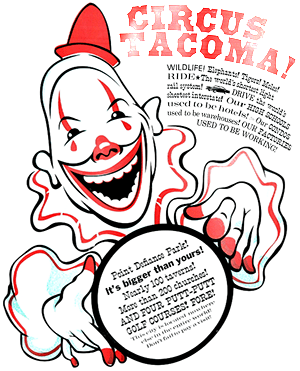
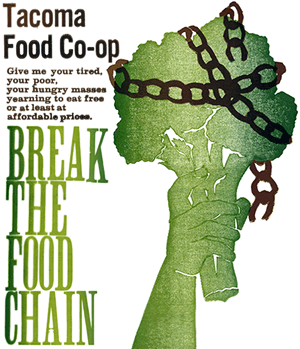
Beautiful Angle is a guerrilla arts poster project in Tacoma, Washington. Approximately once per month, graphic designer Lance Kagey and writer Tom Llewellyn create hand-crafted, letterpress posters and then distribute them around the city’s downtown core via wheat paste and staples.
The first poster, Swirl, was distributed on May 23, 2010. Beautiful Angle has a ‘strange, contradictory relationship with the city’; even though the posters are posted perhaps illegally, the group has won a Chamber of Commerce award of merit.
Posted in Art, Money, Politics |
2 Comments »
May 16, 2011

FAILE is a Brooklyn-based artistic collaboration between Patrick McNeil (b. 1975) and Patrick Miller (b. 1976). Since its inception in 1999, FAILE has been recognized for their pioneering use of wheatpasting and stenciling in the increasingly established arena of street art, and for their explorations of duality through a fragmented style of appropriation and collage.
During this time, FAILE adapted its signature mass culture-driven iconography to a wide array of media, from wooden boxes and window pallets to more traditional canvas, prints, sculptures, stencils, multimedia installation, and prayer wheels. While FAILE’s work is constructed from found visual imagery, and blurs the line between ‘high’ and ‘low’ culture, recent exhibitions demonstrate an emphasis on audience participation, a critique of consumerism, and the incorporation of religious media and architecture into their work.
Posted in Art, Money, Politics |
Leave a Comment »
May 16, 2011

Street poster art is a kind of graffiti, more specifically categorized as ‘street art.’ Posters are usually hand-made or printed graphics on thin paper.
Wallpaper glue or wheatpaste (an adhesive made from wheat flour or starch and water) are commonly used to adhere poster art to a surface. It can be understood as an art piece that is installed on the streets as opposed to in a gallery or museum, but by some it is not comprehended as a form of contemporary art.
Posted in Art, Politics |
Leave a Comment »
May 16, 2011

Flyposting is the act of placing advertising posters or flyers in illegal places. In the U.S., these posters are known as bandit signs, snipe signs, or street spam. In most areas, it is illegal to place such posters on private property without the consent of the property owner, or to post on public property without a sign permit from the local government. Some areas, however, have public bulletin boards where notices may be posted. It is an advertising tactic mostly used by small businesses promoting concerts and political activist groups, but there have been occasions where international companies subcontracted local advertising agencies for flyposting jobs as a form of guerrilla marketing.
Flyposting is commonly seen as a nuisance due to issues with property rights, visual appearance and littering and is a misdemeanor in many countries. A particularly noteworthy incident of this type occurred in Boston, Massachusetts. In the case of the 2007 Boston Mooninite Scare, advertisers had placed electronic signboards without notifying local authorities, prompting a costly reaction by the Boston Police Bomb Squad when the signs were mistaken for bombs.
Posted in Art, Money, Politics |
Leave a Comment »
May 16, 2011

Wheatpaste (also known as Marxist glue) is a liquid adhesive made from vegetable starch and water. It has been used since ancient times for various arts and crafts such as bookbinding and papier mache. It is also made for the purpose of adhering paper posters to walls and other surfaces (often in graffiti). Closely resembling wallpaper paste, it is often made by mixing roughly equal portions of flour and water and heating it until it thickens, or by smearing cooked rice into a paste.
The words paste, pasta, and pastry have a common heritage, deriving from the Late Latin pasta (dough or pastry cake), itself deriving from the ancient Greek pasta, meaning ‘barley porridge.’ In English, paste is used as would be ‘dough’ in the 12th century, or ‘glue’ in the 15th century.
read more »
Posted in Art, Language, Money |
Leave a Comment »





 The Daily Omnivore