May 16, 2011
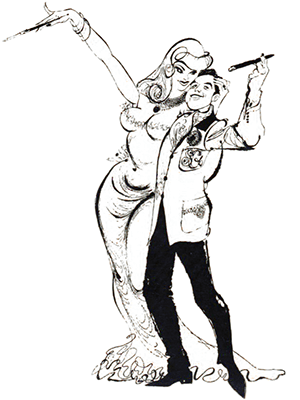
‘What Makes Sammy Run?‘ is a 1941 novel by Budd Schulberg. It is a rags to riches story chronicling the rise and fall of Sammy Glick, a Jewish boy born in New York’s Lower East Side who very early in his life makes up his mind to escape the ghetto and climb the ladder of success.
Reputedly, film mogul Samuel Goldwyn offered Schulberg money to not have the novel published, because Goldwyn felt that the author was perpetuating an anti-Semitic stereotype by making Glick so venal. It was later made into a long-running Broadway musical.
read more »
Posted in Art, Money |
Leave a Comment »
May 16, 2011

Dan Hicks (b. 1941) is an American singer-songwriter working at the intersection of cowboy folk, jazz, country, swing, bluegrass, pop, and gypsy music. His songs are frequently infused with humor, as evidenced by the title of his tune, ‘How Can I Miss You When You Won’t Go Away?’ Taking up the guitar in 1959, he became part of the San Francisco folk music scene, performing at local coffeehouses. Hicks joined the San Francisco band The Charlatans in 1965 as drummer.
In 1968, Hicks formed Dan Hicks and His Hot Licks, whose fourth album, 1973’s Last Train to Hicksville, gained the group critical and popular acclaim. Thus, it was a great surprise to many when he chose that moment to disband the Hot Licks. Asked why in 1974, he said, ‘I’m basically a loner… I like singing and stuff, but I didn’t necessarily want to be a bandleader. The thing had turned into a collective sort of thing — democracy, vote on this, do that. I conceived the thing. They wouldn’t be there if it wasn’t for me. My role as leader started diminishing, but it was my fault because I let it happen; I cared less as the thing went on.’
Posted in Art, Humor |
Leave a Comment »
May 12, 2011

‘Maggot Brain‘ is a song by the band Funkadelic. It appears as the lead track on their 1971 album of the same name. The original recording of the song, over ten minutes long, features little more than a spoken introduction and a much-praised extended guitar solo by Eddie Hazel. Reportedly, ‘Maggot Brain’ was Hazel’s nickname. Other sources say the title is a reference to band leader George Clinton finding his brother’s ‘decomposed dead body, skull cracked, in a Chicago apartment.
According to legend, George Clinton, under the influence of LSD, told Eddie Hazel during the recording session to imagine he had been told his mother was dead, but then learned that it was not true. The result was the 10-minute guitar solo for which Hazel is most fondly remembered by many music critics and fans. Though several other musicians began the track playing, Clinton soon realized the power of Hazel’s solo and faded them out so that the focus would be on Hazel’s guitar. The entire track was recorded in one take. The solo is mostly played in a pentatonic minor scale in the key of E over another guitar track of a simple arpeggio. Hazel’s solo was played through a fuzzbox (distortion pedal) and a Crybaby Wah wah pedal; some sections of the song utilize a delay effect.
Posted in Art, Drugs |
Leave a Comment »
May 12, 2011

Congo Square is an open space within Louis Armstrong Park, which is located in the Tremé neighborhood of New Orleans, just across Rampart Street north of the French Quarter. The Tremé neighborhood is famous for its history of African American music. In Louisiana’s French and Spanish colonial era of the 18th century, slaves were commonly allowed Sundays off from their work. They were allowed to gather in the ‘Place de Negres,’ or informally ‘Place Congo’ at the back of town (across Rampart Street from the French Quarter), where the slaves would set up a market, sing, dance, and play music.
The tradition continued after the city became part of the United States with the Louisiana Purchase. As African music had been suppressed in the Protestant colonies and states, the weekly gatherings at Congo Square became a famous site for visitors from elsewhere in the U.S. In addition, because of the immigration of refugees (some bringing slaves) from the Haitian Revolution, New Orleans received thousands of additional Africans and Creoles in the early years of 19th century. They reinforced African traditions in the city, in music as in other areas. Many visitors were amazed at the African-style dancing and music.
read more »
Posted in Art, World |
1 Comment »
May 11, 2011


A sleeper (called a Q-car in the UK) is a car that has high performance and an unassuming exterior. Sleeper cars are termed such because their exterior looks little or no different from a standard or economy-class car. In some cases the car appears worse due to seeming neglect on the owner’s part, typically referred to as ‘all go and no show.’ While appearing to be a standard or neglected car, internally they are modified to perform at higher performance levels. The American nomenclature comes from the term sleeper agent, while the British term derives from the Q-ships used by the Royal Navy.
American actor Paul Newman famously drove a 1963 VW Beetle convertible with a 300-horsepower engine, racing suspension and five-speed gearbox. The back seats were removed to make room for the 351-cubic-inch Ford engine.
read more »
Posted in Games, Language, Technology |
Leave a Comment »
May 11, 2011

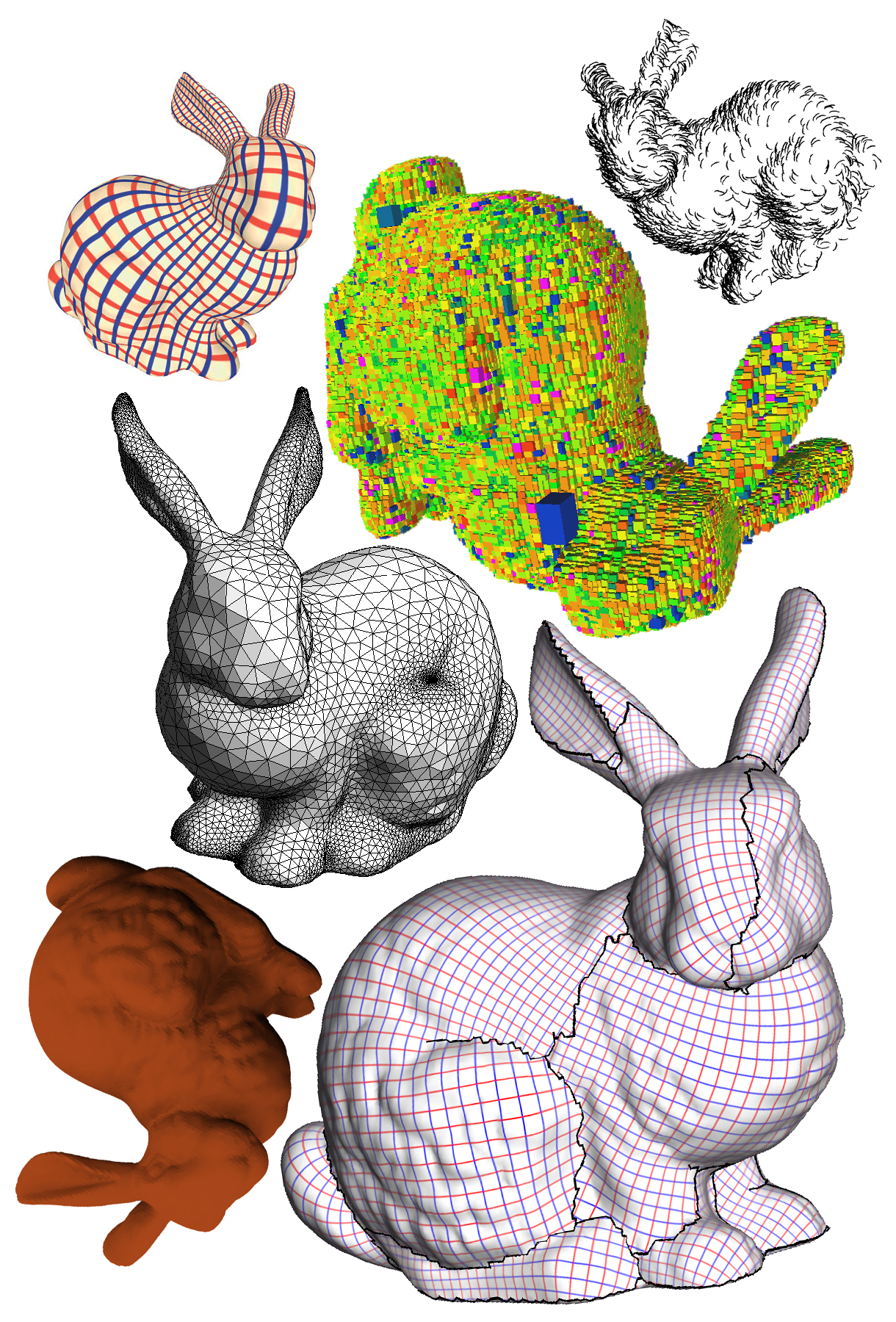
The Stanford Bunny is a computer graphics test model developed in 1994 at Stanford University. The Bunny consists of data describing 69,451 triangles determined by 3D scanning a ceramic figurine of a rabbit.
The data can be used to test various graphics algorithms; including polygonal simplification, compression, and surface smoothing. By today’s standards in terms of geometric complexity and triangle count, it is considered a simple model.
Posted in Art, Technology |
Leave a Comment »
May 11, 2011

The Stanford 3D Scanning Repository is a collection of freely usable 3d models scanned from real objects. The models tend to have very high polygon counts (the largest has almost 30 million). According to the repository, ‘In recent years, the number of range scanners and surface reconstruction algorithms has been growing rapidly. Many researchers, however, do not have access to scanning facilities or dense polygonal models. The purpose of this repository is to make some range data and detailed reconstructions available to the public.
The models in this archive are commonly used in the graphics, visualization, and vision communities. Things people have done with these models include simplification, multi-resolution representation, curved surface fitting, compression, texture mapping, modeling, deformation, animation, physically-based simulation, texture synthesis, and rendering. The Stanford Bunny is particularly widely used.
Posted in Art, Technology |
Leave a Comment »
May 11, 2011


The Rosetta Project is a global collaboration of language specialists and native speakers working to develop a contemporary version of the historic Rosetta Stone to last from 2000 to 12,000 CE; it is run by the Long Now Foundation. Its goal is a meaningful survey and near permanent archive of 1,500 languages. Some of these languages have fewer than one thousand speakers left in the world. Others are considered to be dying out because government centralization and globalization are increasing the prevalence of English and other major languages. The intention is to create a unique platform for comparative linguistic research and education, as well as a functional linguistic tool that might help in the recovery or revitalisation of lost languages in the future.
The Project is creating this broad language archive through an open contribution, open review process similar to the strategy that created the original Oxford English Dictionary. The resulting archive will be publicly available in three different media: a micro-etched nickel alloy disc three inches (7.62 cm) across with 2,000 year life expectancy; a single volume monumental reference book; and a growing online archive.
Posted in Language, Technology |
Leave a Comment »
May 11, 2011


The Long Now Foundation, established in 1996, is a private organization that seeks to become the seed of a very long-term cultural institution. It aims to provide a counterpoint to what it views as today’s ‘faster/cheaper’ mindset and to promote ‘slower/better’ thinking. The Long Now Foundation hopes to ‘creatively foster responsibility’ in the framework of the next 10,000 years, and so uses 5-digit dates to address the Year 10,000 problem (e.g. by writing 02011 rather than 2011).
The Foundation has several ongoing projects, including a 10,000-year clock known as the ‘Clock of the Long Now,’ the Rosetta Project, the Long Bet Project, the open source Timeline Tool (also known as Longviewer), the Long Server and a monthly seminar series.
read more »
Posted in Philosophy, Technology |
Leave a Comment »
May 11, 2011

Stephen Hawking (b. 1942) is an English theoretical physicist and cosmologist, whose scientific books and public appearances have made him an academic celebrity. He is known for his contributions to the fields of cosmology and quantum gravity, especially in the context of black holes (he first predicted that black holes emit radiation, which is today known as Hawking radiation).
He has also achieved success with works of popular science in which he discusses his own theories and cosmology in general. Hawking has a motor neurone disease that is related to ALS (Lou Gehrig’s disease), a condition that has progressed over the years and has left him almost completely paralyzed.
read more »
Posted in Language, Science |
Leave a Comment »
May 10, 2011

‘A Briefer History of Time‘ is a popular-science book published in 2005 from the English physicist Stephen Hawking and the American physicist Leonard Mlodinow. It is an update and rewrite of Hawking’s 1988 ‘A Brief History of Time.’
In this book Hawking and Mlodinow present quantum mechanics, string theory, the big bang theory, and other topics in a more accessible fashion to the general public. The book is updated with newly discovered topics, and informs of recurring subjects throughout the book in greater detail.
Posted in Education, Language, Science |
Leave a Comment »
May 10, 2011

‘A Brief History of Time: From the Big Bang to Black Holes’ is a 1988 popular science book written by English theoretical physicist Stephen Hawking, which attempts to explain a range of subjects in cosmology (e.g. the Big Bang, black holes, and light cones) to the nonspecialist reader.
Its main goal is to give an overview of the subject but, unusual for a popular science book, it also attempts to explain some complex mathematics. The author notes that an editor warned him that for every equation in the book the readership would be halved, hence it includes only a single equation: E=mc2.
read more »
Posted in Education, Language, Science |
Leave a Comment »



 The Daily Omnivore