July 5, 2011

Christopher Mercer (b. 1985), more commonly known as Rusko, is an English dubstep record producer and DJ. He made his production debut in 2006 on Dub Police with the song ‘SNES Dub.’
Steering away from the darker side of Dubstep, Rusko brought an upbeat sound to the scene that appealed to many outside the community. Rusko’s extremely successful hit ‘Cockney Thug’ has appeared on various DJ sets and mixes.
Posted in Art, Technology, World |
2 Comments »
July 5, 2011

Anonymous is an Internet meme that originated in 2003 on the imageboard 4chan, representing the concept of many online community users simultaneously existing as an anarchic, digitized global hive mind. It is also generally considered to be a blanket term for members of certain Internet subcultures, a way to refer to the actions of people in an environment where their actual identities are not known.
In its early form, the concept has been adopted by a decentralized online community acting anonymously in a coordinated manner, usually toward a loosely self-agreed goal, and primarily focused on entertainment. Beginning with 2008, the Anonymous collective has become increasingly associated with collaborative, international hacktivism, undertaking protests and other actions, often with the goal of promoting internet freedom and freedom of speech. Actions credited to ‘Anonymous’ are undertaken by unidentified individuals who apply the Anonymous label to themselves as attribution.
read more »
Posted in Language, Politics, Technology |
Leave a Comment »
July 5, 2011

Lulz Security, commonly abbreviated as LulzSec, was a computer hacker group that claimed responsibility for several high profile attacks, including the compromise of user accounts from Sony Pictures in 2011. The group has been described as a ‘cyber terrorism group’ by the Arizona Department of Public Safety after their systems were compromised and information leaked.
It has gained attention due to its high profile targets and the sarcastic messages it has posted in the aftermath of its attacks. LulzSec released a statement claiming to to disband on June 26, 2011. The ’50 days of lulz’ statement, which they claimed to be their final release, confirming that LulzSec consisted of six members, and that their website is to be taken down.
read more »
Posted in Money, Politics, Technology |
Leave a Comment »
July 4, 2011
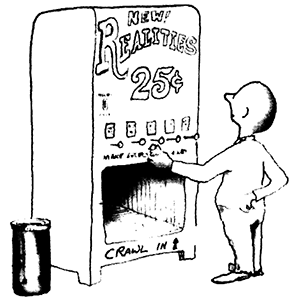

Robert Anton Wilson (1932 – 2007) was a futurist thinker, libertarian, and writer. He held a Ph.D in Psychology. At one time he was a writer for Playboy magazine. Wilson was the author of the ‘Schrödinger’s Cat’ trilogy (1979). He also co-wrote (with Robert Shea) the ‘Illuminatus!’ trilogy (1975), which took a humorous look at the American fear of conspiracies. These books mix true facts with fiction. In ‘The Cosmic Trigger’ (1976), he introduced Discordianism, Sufism, futurism, the Illuminati and other unusual subjects to the general public. He also worked with Timothy Leary to promote futurist ideas of space migration, life extension, and intelligence enhancement.
Recognized as an episkopos, pope, and saint of Discordianism, Wilson helped publicize the group. He described his work as an ‘attempt to break down conditioned associations, to look at the world in a new way, with many models recognized as models or maps, and no one model elevated to the truth.’ His goal being ‘to try to get people into a state of generalized agnosticism, not agnosticism about God alone but agnosticism about everything.’
read more »
Posted in Humor, Language, Philosophy |
Leave a Comment »
July 4, 2011

The Noid was an advertising character for Domino’s Pizza in the 1980s. He was a villainous red-suited imp, with red rabbit ears who attempted to ruin Domino’s pizza but was constantly thwarted. Commercials that featured the character used the slogan ‘Avoid the Noid!’ As part of the advertising campaign, a computer game was released in 1989 called Avoid the Noid. The object of the game is to deliver a pizza within a half-hour time limit, in an apartment building swarming with Noids. In 1990, Capcom released a different video game, Yo! Noid, for the NES.
In early 1989, Kenneth Lamar Noid, a mentally ill customer who thought the ads were a personal attack on him, held two employees of an Atlanta Domino’s restaurant hostage for over five hours. After forcing them to make him a pizza and making demands for $100,000, getaway transportation, and a copy of ‘The Widow’s Son,’ a conspiracy theory novel by Robert Anton Wilson. Noid surrendered to the police. After the incident had ended, police Chief Reed Miller offered a memorable assessment to reporters: ‘He’s paranoid.’ Noid was charged with kidnapping, aggravated assault, extortion, and possession of a firearm during a crime. He was found not guilty by reason of insanity.
Posted in Food, Humor, Money |
Leave a Comment »
July 4, 2011

In endurance sports such as cycling and running, hitting the wall (or the bonk) describes a condition caused by the depletion of glycogen stores in the liver and muscles, which manifests itself by sudden fatigue and loss of energy. Milder instances can be remedied by brief rest and the ingestion of food or drinks containing carbohydrates. The condition can usually be avoided by ensuring that glycogen levels are high when the exercise begins, maintaining glycogen levels during exercise by eating or drinking carbohydrate-rich substances, or by reducing exercise intensity.
The term bonk for cycling fatigue is presumably derived from the original meaning ‘to hit,’ and dates back at least half a century. The term is used colloquially both as a noun (‘hitting the bonk’) and a verb (‘to bonk halfway through the race’). The British may refer to it as ‘hunger knock,’ while ‘hunger bonk’ or ‘bunger honk’ was used by South African cyclists in the 1960s.
Posted in Food, Games, Health |
Leave a Comment »
July 4, 2011


‘Keeping up with the Joneses’ is an idiom in many parts of the English-speaking world referring to the comparison to one’s neighbor as a benchmark for social caste or the accumulation of material goods. To fail to ‘keep up with the Joneses’ is perceived as demonstrating socio-economic or cultural inferiority. The phrase was popularized when a comic strip of the same name was created by cartoonist Arthur R. ‘Pop’ Momand. The strip debuted in 1913, and ran in American newspapers for 26 years, and was eventually adapted into books, films, and musical comedies. The ‘Joneses’ of the title were neighbors of the strip’s main characters, and were unseen characters spoken of but never actually seen in person.
The philosophy of ‘keeping up with the Joneses’ has widespread effects on some societies. According to this philosophy, conspicuous consumption occurs when people care about their standard of living in relation to their peers. The term was re-coined or re-introduced into US narrative in 1976 when a small article was written about current parenting style. Social status once depended on one’s family name; however, the rise of consumerism in the United States gave rise to social mobility. With the increasing availability of goods, people became more inclined to define themselves by what they possessed and the subtle quest for higher status accelerated. The upward mobility over the past few decades in America is due in part to the large number of women joining the labor force.
Posted in Language, Money |
Leave a Comment »
July 4, 2011

La Malinche (c. 1496 – 1529) was an indigenous woman from the Mexican Gulf Coast, who played a role in the Spanish conquest of Mexico, acting as interpreter, advisor, lover and intermediary for Hernán Cortés. She was one of twenty slaves given to Cortés by the natives of Tabasco in 1519. Later she became a mistress to Cortés and gave birth to his first son, Martín, who is considered one of the first Mestizos (people of mixed European and indigenous American ancestry).
The historical figure of Marina has been intermixed with Aztec legends. Her reputation has been altered over the years according to changing social and political perspectives, especially after the Mexican Revolution, when she was portrayed in dramas, novels, and paintings as an evil or scheming temptress. In Mexico today, La Malinche remains iconically potent. She is understood in various and often conflicting aspects, as the embodiment of treachery, the quintessential victim, or simply as symbolic mother of the new Mexican people. Her sexual relationship to Cortés gave rise to the pejorative term La Chingada (‘the fucked one’). The term ‘malinchista’ refers to a disloyal Mexican.
read more »
Posted in Language, Politics, World |
Leave a Comment »
July 4, 2011

Cultural cringe, in cultural studies and social anthropology, is an internalized inferiority complex which causes people in a country to dismiss their own culture as inferior to the cultures of other countries.
It is closely related, although not identical, to the concept of colonial mentality, and is often linked with the display of anti-intellectual attitudes towards thinkers, scientists and artists who originate from a colonial or post-colonial nation. It can also be manifested in individuals in the form of ‘cultural alienation.’ In many cases, cultural cringe, or an equivalent term, is an accusation made by a fellow-national, who decries the inferiority complex and asserts the merits of the national culture.
read more »
Posted in Politics, Science, World |
Leave a Comment »
July 4, 2011


Subvertising is a portmanteau of subvert and advertising. It refers to the practice of making spoofs or parodies of corporate and political advertisements. Subvertisements may take the form of a new image or an alteration to an existing image or icon, often in a satirical manner. A subvertisement can also be referred to as a meme hack and can be a part of social hacking or culture jamming.
According to AdBusters, a Canadian magazine and a proponent of counter-culture and subvertising, ‘A well produced ‘subvert’ mimics the look and feel of the targeted ad, promoting the classic ‘double-take’ as viewers suddenly realize they have been duped. Subverts create cognitive dissonance. It cuts through the hype and glitz of our mediated reality and, momentarily, reveals a deeper truth within.’
Posted in Humor, Money, Politics |
2 Comments »
July 4, 2011


Since the 1970s, cuteness, in Japanese the noun kawaisa (literally, ‘lovability,’ ‘cuteness’ or ‘adorableness’), has become a prominent aspect of Japanese popular culture, entertainment, clothing, food, toys, personal appearance, behavior, and mannerisms. The term kawaii has taken on the secondary meanings of ‘cool,’ ‘groovy,’ ‘charming,’ ‘non-threatening.’ As a cultural phenomenon, cuteness is increasingly accepted in Japan as a part of Japanese culture and national identity.
Japanese women who perform cute behaviors that could be viewed as forced or fake are called ‘burikko’ and this is considered a gender performance. In Japan, cuteness is expected of men and women. There is a trend of men shaving their legs to mimic the ‘asexual’ look. The original definition of kawaii came from Lady Murasaki’s ‘The Tale of Genji’ where it referred to pitiable qualities. During the Shogunate period under the ideology of neo-Confucianism, women came to be included under the term kawaii as the perception of women from being animalistic was replaced with the conception of women as docile.
read more »
Posted in Art, Language, World |
Leave a Comment »
July 4, 2011

Netnews is a kind of online service that shares articles between a group of computers over a network. A popular type of netnews is called usenet, which was in use before the World Wide Web, and is still very active today. Usenet provided a way for people to write articles on many different topics and share them with people all over the world.
It is different from the web because articles are sent to all the computers in the community; whereas, an article on a webserver stays on one computer until a person requests it with their web browser.
read more »
Posted in Technology |
2 Comments »



 The Daily Omnivore