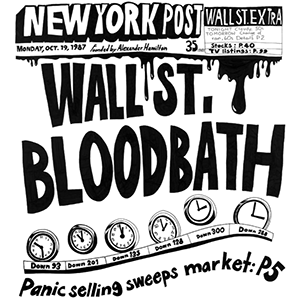
A stock market crash is a sudden dramatic decline of stock prices across a significant cross-section of a stock market, resulting in a significant loss of paper wealth. Crashes are driven by panic as much as by underlying economic factors. They often follow speculative stock market bubbles.
Stock market crashes are social phenomena where external economic events combine with crowd behavior and psychology in a positive feedback loop where selling by some market participants drives more market participants to sell. Generally speaking, crashes usually occur under the following conditions: a prolonged period of rising stock prices and excessive economic optimism, a market where P/E ratios exceed long-term averages, and extensive use of margin debt and leverage by market participants.
There is no numerically specific definition of a stock market crash but the term commonly applies to steep double-digit percentage losses in a stock market index over a period of several days. Crashes are often distinguished from bear markets by panic selling and abrupt, dramatic price declines. Bear markets are periods of declining stock market prices that are measured in months or years. While crashes are often associated with bear markets, they do not necessarily go hand in hand. The crash of 1987, for example, did not lead to a bear market. Likewise, the Japanese Nikkei bear market of the 1990s occurred over several years without any notable crashes.
The economy had been growing robustly for most of the so-called Roaring Twenties. It was a technological golden age as innovations such as radio, automobiles, aviation, telephone and the power grid were deployed and adopted. Companies that had pioneered these advances, like Radio Corporation of America (RCA) and General Motors, saw their stocks soar. Financial corporations also did well as Wall Street bankers floated mutual fund companies (then known as investment trusts) like the Goldman Sachs Trading Corporation. Investors were infatuated with the returns available in the stock market especially with the use of leverage through margin debt.
On August 24, 1921, the Dow Jones Industrial Average stood at a value of 63.9. By September 3, 1929, it had risen more than sixfold, touching 381.2. It would not regain this level for another twenty-five years. By the summer of 1929, it was clear that the economy was contracting and the stock market went through a series of unsettling price declines. These declines fed investor anxiety and events soon came to a head on October 24 (known as Black Thursday) and October 29 (known as Black Tuesday).
On Black Tuesday, the Dow Jones Industrial Average fell 38 points to 260, a drop of 12.8%. The deluge of selling overwhelmed the ticker tape system that normally gave investors the current prices of their shares. Telephone lines and telegraphs were clogged and were unable to cope. This information vacuum only led to more fear and panic. The technology of the New Era, much celebrated by investors previously, now served to deepen their suffering.
Black Tuesday was a day of chaos. Forced to liquidate their stocks because of margin calls, overextended investors flooded the exchange with sell orders. The glamour stocks of the age saw their values plummet. Across the two days, the Dow Jones Industrial Average fell 23%.
By the end of the weekend of November 11, the index stood at 228, a cumulative drop of 40 percent from the September high. The markets rallied in succeeding months but it would be a false recovery that led unsuspecting investors into the worst economic crisis of modern times. The Dow Jones Industrial Average would lose 89% of its value before finally bottoming out in July 1932.
On September 16, 2008, failures of massive financial institutions in the United States, due primarily to exposure of securities of packaged subprime loans and credit default swaps issued to insure these loans and their issuers, rapidly devolved into a global crisis resulting in a number of bank failures in Europe and sharp reductions in the value of equities (stock) and commodities worldwide.
The failure of banks in Iceland resulted in a devaluation of the Icelandic Krona and threatened the government with bankruptcy. Iceland was able to secure an emergency loan from the IMF in November. In the United States, 15 banks failed in 2008, while several others were rescued through government intervention or acquisitions by other banks. On October 11, 2008, the head of the International Monetary Fund (IMF) warned that the world financial system was teetering on the ‘brink of systemic meltdown.’
The meltdown was being called the Crash of 2008 and older traders were comparing it with Black Monday in 1987. The fall that week of 21 percent was not as large a drop as the 28.3 percent fall 21 years earlier, but some traders were saying it was worse. ‘At least then it was a short, sharp, shock on one day. This has been relentless all week.’
The Black Week: Beginning October 6 and lasting all week the Dow Jones Industrial Average closed lower for all 5 sessions. Volume levels were also record breaking. The Dow Jones industrial average fell over 1,874 points, or 18%, in its worst weekly decline ever on both a point and percentage basis. The S&P 500 fell more than 20%.
It has been noted that recent daily stock market drops are overall nowhere near the severity experienced during the last stock market crash in 1987. Others have suggested that the media is manipulating and over-inflating stock market drops and calling them ‘crashes’ in order to create the perception of a great depression.
On October 24, many of the world’s stock exchanges experienced the worst declines in their history, with drops of around 10% in most indices. Both the US Dollar and Japanese Yen soared against other major currencies, particularly the British Pound and Canadian Dollar, as world investors sought safe havens.
By March 6, 2009 the DJIA had dropped 54% to 6469 (before beginning to recover) from its peak of 14164 on October 9, 2007, a span of 17 months.
Trading curbs, also known as ‘circuit breakers,’ are a trading halt in the cash market and the corresponding trading halt in the derivative markets triggered by the halt in the cash market, all of which are affected based on substantial movements in a broad market indicator.
The mathematical characterization of stock market movements has been a subject of intense interest. The conventional assumption has been that stock markets behave according to a random Gaussian or ‘normal’ distribution. Among others, mathematician Benoît Mandelbrot suggested as early as 1963 that the statistics prove this assumption incorrect. Mandelbrot observed that large movements in prices (i.e. crashes) are much more common than would be predicted in a normal distribution. Mandelbrot and others suggest that the nature of market moves is generally much better explained using non-linear analysis and concepts of chaos theory. This has been expressed in non-mathematical terms by George Soros in his discussions of what he calls reflexivity of markets and their non-linear movement.
Research at the Massachusetts Institute of Technology suggests that there is evidence the frequency of stock market crashes follows an inverse cubic power law. This suggest that stock market crashes are a sign of self-organized criticality in financial markets.
Research at the New England Complex Systems Institute has found warning signs of crashes using new statistical analysis tools of complexity theory. This work suggests that the panics that lead to crashes come from increased mimicry in the market. A dramatic increase in market mimicry occurred during the whole year before each market crash of the past 25 years, including the recent financial crisis. When investors closely follow each other’s cues, it is easier for panic to take hold and affect the market. This work is a mathematical demonstration of a significant advance warning sign of impending market crashes.


 The Daily Omnivore