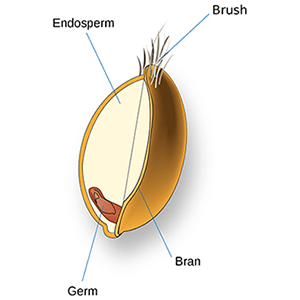
Whole grains are cereal grains that contain cereal germ, endosperm, and bran, in contrast to refined grains, which retain only the endosperm. Whole Grains can generally be sprouted while refined grains generally will not sprout. Wholemeal products are made by grinding whole grains in order to make whole grain flour. Whole grains are a natural source of protein as well as a source of carbohydrates and are made into many different kinds of foods.
There are multiple grains such as cereal grains (e.g. wheat, brown rice, oats, barley, corn, and rye) as well as pseudocereals (e.g. quinoa and buckwheat) that may be labeled whole grains. Common whole grain products include: whole wheat bread, whole wheat pasta, rolled oats, and popcorn. By contrast, common refined-grain products include: white rice, white bread, hominy, and pasta.
Whole grain products can be identified by the ingredients list. Typically, if the ingredient lists ‘wholewheat,’ ‘wholemeal,’ or ‘whole corn’ as the first ingredient, the product is a wholegrain food item. On the other hand, terms such as ‘enriched’ and ‘bromated,’ among others, could indicate that the food lacks wholegrain.
‘Wheat flour’ (as opposed to ‘wholegrain wheat flour’ or ‘wholewheat flour’) as the first ingredient is not a clear indicator of the product’s wholegrain content. If two ingredients are listed as grain products but only the second is listed as wholegrain, the entire product may contain between 1% and 49% whole grain. Many breads are colored brown (often with molasses or caramel color) and made to look like wholegrain, but are not. Contrary to popular belief, fiber is not indicative of wholegrains. The amount of fiber varies from grain to grain, and some products may have things like bran, peas, or other foods added to boost the fiber content.
Similar to the distinction between whole and refined grains is that between whole pulses (peas, beans, and other related vegetables) and refined dal (a preparation of pulses or the thick stew prepared from these).
Any products made with flour can have the same effect on blood sugar, whether the flour is produced from whole grains or not. For example, wholegrain wheat bread and white bread can have the same glycemic index. Grinding grains into flour increases the surface area upon which enzymes work to more quickly convert starch into glucose. Keeping grains as close to their original form as possible slows or prevents the digestion of starch, and a slower digestion is responsible for preventing spikes in blood sugar (which over time may lead to insulin resistance).
In a 2002 study, consumption of whole grains was found to be associated with lower fasting insulin concentrations when compared to those associated with the consumption of refined grains, suggesting whole grain consumption to be an important component of reducing risk factors for type II diabetes when only compared to the consumption of refined grains. Consumption of whole grains has also been consistently linked with a significant decrease in risk factors for cardiovascular disease. Regular wholegrain consumption lowers LDL (‘bad’ cholesterol) and triglyceride levels, which contributes to an overall reduction in coronary heart disease risk factors. In addition, wholegrain consumption is inversely related to hypertension, diabetes, and obesity when compared to refined grains, all of which are negative indicators in total cardiovascular health.


 The Daily Omnivore
Leave a comment