August 11, 2011

Pinko is a term for a person regarded as sympathetic to communism, though not necessarily a Communist Party member. The term has its origins in the notion that pink is a lighter shade of red, the color associated with communism. The word was coined by Time magazine in 1925 as a variant on the noun and adjective pink, which had been used along with ‘parlor pink’ since the beginning of the 20th century to refer to those of leftish sympathies, usually with an implication of ‘effeteness.’
In the 1920s, for example, a Wall Street Journal editorial described supporters of the progressive politician Robert La Follette as ‘visionaries, ne’er do wells, parlor pinks, reds, hyphenates [Americans with divided allegiance], soft handed agriculturalists and working men who have never seen a shovel.’
read more »
Posted in Language, Politics |
Leave a Comment »
August 10, 2011

Since its premiere in 1968, 2001: A Space Odyssey has been analyzed and interpreted by multitudes of people ranging from professional movie critics to amateur writers and science fiction fans. The director of the film, Stanley Kubrick, wanted to leave the film open to philosophical and allegorical interpretation, purposely presenting the final sequences of the film without the underlying thread being apparent; a concept illustrated by the final frame of the film, which contains the image of the embryonic ‘Starchild.’
Kubrick encouraged people to explore their own interpretations of the film, and refused to offer an explanation of ‘what really happened’ in the movie, preferring instead to let audiences embrace their own ideas and theories. In a 1968 interview with Playboy magazine, Kubrick stated: ‘You’re free to speculate as you wish about the philosophical and allegorical meaning of the film—and such speculation is one indication that it has succeeded in gripping the audience at a deep level—but I don’t want to spell out a verbal road map for ‘2001’ that every viewer will feel obligated to pursue or else fear he’s missed the point.’
read more »
Posted in Art, Philosophy, Technology |
Leave a Comment »
August 9, 2011

Taqwacore [tok-wah-kor] is a genre of punk music dealing with Islam and its culture, originally conceived in Michael Muhammad Knight’s 2003 novel, ‘The Taqwacores.’ The name is a portmanteau of hardcore and the Arabic word Taqwa, which is usually translated as ‘piety’ or the quality of being ‘God-fearing,’ and thus roughly denotes fear and love of the divine. The scene is composed mainly of young Muslim artists living in the US and other western countries, many of whom openly reject traditionalist interpretations of Islam.
Although Muslim punk music dates at least to the 1979 founding of British band Alien Kulture, and in the 90’s, Nation Records act Fun-Da-Mental and Asian Dub Foundation, this is the first example of US Muslim generated punk. Knight’s novel was instrumental in encouraging the growth of a contemporary North American Muslim punk movement. There is not a definitive ‘taqwacore sound,’ and the scene is much more diverse now than the fictional one portrayed in Knight’s novel, with artists incorporating various styles, ranging from punk to hip-hop, and musical traditions from the Muslim world; the Kominas describe their sound as ‘Bollywood punk,’ Sagg Taqwacore Syndicate is rap and techno inspired, and Al-Thawra uses the term ‘raicore,’ based on Arabic Raï music.
Posted in Art, Philosophy, Politics |
Leave a Comment »
August 9, 2011

Moombahton is a genre of electronic dance music that was created by American dj/producer Dave Nada (aka Dave Villegas) at a high school homecoming ‘skipping party’ for his younger cousin in Washington, D.C., in the fall of 2009.
The specific event that stimulated NADA’s development of the Moombahton genre was his slowing the Afrojack remix of the Silvio Ecomo and DJ Chuckie song ‘Moombah’ to 108 beats per minute. Because that tempo nears that of the reggaeton, Nada created the neologism ‘Moombahton.’
Posted in Art, Technology |
Leave a Comment »
August 9, 2011

Keynesian economics is a school of macroeconomic thought based on the ideas of 20th-century English economist John Maynard Keynes. Most economists today are primarily Keynesian-influenced. According to the theory, there exists a cycle in the economy, in which there are years of growth, followed by years of depression or recession, called the business cycle. Keynes′ theory suggested that active government policy could be effective in managing the economy.
Rather than seeing unbalanced government budgets as wrong, Keynes advocated what has been called countercyclical fiscal policies, that is, policies that acted against the tide of the business cycle: deficit spending when a nation’s economy suffers from recession or when recovery is long-delayed and unemployment is persistently high—and the suppression of inflation in boom times by either increasing taxes or cutting back on government outlays.
read more »
Posted in Money, Politics |
Leave a Comment »
August 8, 2011

Hipster is a slang term that first appeared in the 1940s, was revived in the 1990s, and continued to be used in the 2000s and 2010s, to describe young, recently settled urban middle class adults and older teenagers with musical interests mainly in indie rock. Other interests in media would include independent film, magazines such as Vice and Clash, and websites like Pitchfork Media. In some contexts, hipsters are also called scenesters.
‘Hipster’ has been used in sometimes contradictory ways, making it difficult to precisely define ‘hipster culture,’ which has been described as a ‘mutating, trans-Atlantic melting pot of styles, tastes and behavior.’ Hipsterism fetishizes the authentic elements of all of the ‘fringe movements of the postwar era—beat, hippie, punk, even grunge,’ and draws on the ‘cultural stores of every unmelted ethnicity,’ and ‘regurgitates it with a winking inauthenticity.’ Others, like Arsel and Thompson, argue that hipster signifies a cultural mythology, a crystallization of a mass-mediated stereotype generated to understand, categorize, and marketize indie consumer culture, rather than an objectified group of people.
read more »
Posted in Art, Language, Money |
Leave a Comment »
August 8, 2011

In psychogeography, a dérive is an unplanned journey through a landscape, usually urban, in which an individual travels where the subtle aesthetic contours of the surrounding architecture and geography subconsciously direct them with the ultimate goal of encountering an entirely new and authentic experience. Situationist theorist Guy Debord defines the dérive as ‘a mode of experimental behavior linked to the conditions of urban society: a technique of rapid passage through varied ambiances.’ He also notes that ‘the term also designates a specific uninterrupted period of dériving.’ The term is literally translated into English as ‘drift.’
The concept of the dérive has its origins in the Letterist International of the 1940s, an artistic and political collective based in Paris, where it was a critical tool for understanding and developing the theory of psychogeography, defined as the ‘specific effects of the geographical environment (whether consciously organized or not) on the emotions and behavior of individuals.’ The dérive, an unplanned tour through an urban landscape directed entirely by the feelings evoked in the individual by their surroundings, served as the primary means for mapping and investigating the psychogeography of these different areas.
read more »
Posted in Games, Science |
Leave a Comment »
August 7, 2011

A false awakening is a vivid dream about awakening from sleep. After a false awakening, subjects often dream they are performing daily morning rituals such as cooking, cleaning and eating. The experience is sometimes called a double dream, or a dream within a dream. A false awakening may occur following an ordinary dream or following a lucid dream (one in which the dreamer has been aware of dreaming). Particularly if the false awakening follows a lucid dream, the false awakening may turn into a ‘pre-lucid dream,’ that is, one in which the dreamer may start to wonder if they are really awake and may or may not come to the correct conclusion.
In a study by Harvard psychologist Deirdre Barrett, 2,000 dreams from 200 subjects were examined and it was found that false awakenings and lucidity were significantly more likely to occur within the same dream or within different dreams of the same night. False awakenings often preceded lucidity as a cue, but they could also follow the realization of lucidity, often losing it in the process.
read more »
Posted in Health, Philosophy, Science |
Leave a Comment »
August 7, 2011
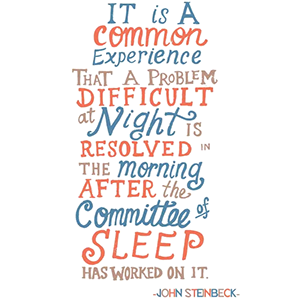
Dream incubation is a practiced technique of learning to ‘plant a seed’ in the mind, in order for a specific dream topic to occur, either for recreation or to attempt to solve a problem. For example, a person might go to bed repeating to themselves that they will dream about a presentation they have coming up, or a vacation they recently took, or a person they are interested in. While somewhat similar to lucid dreaming, dream incubation is simply focusing attention on a specific issue when going to sleep. Several studies have shown this method to be successful over a period of time.
For example, in a study at Harvard Medical School, Dr. Deirdre Barrett had her students focus on a problem, such as an unsolved homework assignment or other objective problem, before going to sleep each night for a week. She found that it was possible to develop novel solutions in dreams that were both satisfactory to the dreamer and rated as objectively solving the problem by an outside observer. In her study, two-thirds of participants had dreams that addressed their chosen problem, and one-third reached some form of solution within their dreams.
read more »
Posted in Science |
Leave a Comment »
August 6, 2011

Aposematism [app-uh-sem-uh-tizm], perhaps most commonly known in the context of warning coloration, describes a family of antipredator adaptations where a warning signal is associated with the unprofitability of a prey item to potential predators. It is one form of ‘advertising’ signal, with many others existing such as the bright colors of flowers which lure pollinators. The warning signal may take the form of conspicuous colors, sounds, odors, or other perceivable characteristics. Aposematic signals are beneficial for both the predator and prey, who both avoid potential harm.
This tendency to become highly noticeable and distinct from harmless organisms is the antithesis of crypsis, or avoidance of detection. Aposematism has been such a successful adaptation that harmless organisms have repeatedly evolved to mimic aposematic species, a pattern known as Batesian mimicry. Another related pattern is Müllerian mimicry, where aposematic species come to resemble one another.
read more »
Posted in Science |
Leave a Comment »
August 5, 2011

The handicap principle is a hypothesis originally proposed in 1975 by biologist Amotz Zahavi to explain how evolution may lead to ‘honest’ or reliable signaling between animals who have an obvious motivation to bluff or deceive each other. The handicap principle suggests that reliable signals must be costly to the signaler, costing the signaler something that could not be afforded by an individual with less of a particular trait.
For example, in the case of sexual selection, the theory suggests that animals of greater biological fitness signal this status through handicapping behavior or morphology that effectively lowers this quality. The central idea is that sexually selected traits function like conspicuous consumption, signalling the ability to afford to squander a resource simply by squandering it. Receivers know that the signal indicates quality because inferior quality signalers cannot afford to produce such wastefully extravagant signals.
read more »
Posted in Money, Science, Sex |
Leave a Comment »
August 5, 2011

Beef aging is the process of preparing beef for consumption, mainly by breaking down the connective tissue. Dry-aged beef has been hung to dry for several weeks. After the animal is slaughtered and cleaned, either an entire half will be hung, or prime cuts will be placed in a cooler, also known as a ‘hot box.’ This process involves considerable expense, as the beef must be stored near freezing temperatures. Also, only the higher grades of meat can be dry aged, as the process requires evenly distributed fat. For these reasons one seldom sees dry-aged beef outside of steak restaurants and upscale butcher shops. The process changes beef by two means. First, moisture is evaporated from the muscle, concentrating flavor. Second, the beef’s natural enzymes break down the connective tissue in the muscle, which leads to more tender beef.
Dry-aging can promote the growth of certain mold species on the external surface of the meat. This doesn’t cause spoilage, but actually forms an external ‘crust,’ which is trimmed off when the meat is prepared for cooking. These fungal species complement the natural enzymes in the beef by helping to tenderize and increase the flavor of the meat. The genus Thamnidia, in particular, is known to produce collagenolytic enzymes which greatly contribute to the tenderness and flavor of dry-aged meat. Wet-aged beef is beef that has typically been aged in a vacuum-sealed bag to retain its moisture. This is the dominant mode of aging beef in the United States today. Wet-aging is popular because it takes less time (typically only a few days) and none of the weight is lost in the process. In contrast, dry-aging can take 15–28 days, and will see up to a third or more of the weight lost as moisture.
Posted in Food, Money |
Leave a Comment »


 The Daily Omnivore