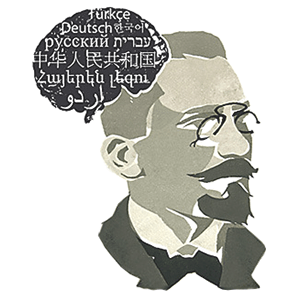
A polyglot [pol-ee-glot] is someone with a high degree of proficiency in several languages. A bilingual person can speak two languages fluently, whereas a trilingual three; above that the term multilingual may be used. A hyperpolyglot is one who can speak six or more languages fluently. The term was coined by the linguist Richard Hudson in 2003. One notable hyperpolyglot was Emil Krebs (1867-1930) who mastered 68 languages in speech and writing.
There are several theories as to why some people learn many languages with relative ease, while others struggle learning even one foreign language. One theory is that a spike in testosterone levels in the womb can increase a brain’s asymmetry. Neuroscientist Katrin Amunts studied the brain of Emil Krebs and determined that the area of Krebs’ brain responsible for language—Broca’s area—was organized differently than in monolingual men. However, neurolinguist Loraine Obler has suggested a link with the Geschwind–Galaburda cluster, which shows a high coincidence of left-handedness, auto-immune disorders, learning disorders and talents in art, mathematics and, possibly, languages.


 The Daily Omnivore
Leave a comment