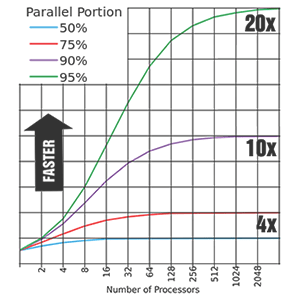
Amdahl’s law, named after computer architect Gene Amdahl, is used to find the maximum expected improvement to an overall system when only part of the system is improved. It is often used in parallel computing to predict the theoretical maximum speedup using multiple processors. The speedup of a program using multiple processors in parallel computing is limited by the time needed for the sequential fraction of the program. For example, if a program needs 20 hours using a single processor core, and a particular portion of 1 hour cannot be parallelized, while the remaining promising portion of 19 hours (95%) can be parallelized, then regardless of how many processors we devote to a parallelized execution of this program, the minimum execution time cannot be less than that critical 1 hour. Hence the speedup is limited up to 20x.
Amdahl’s law is often conflated with the law of diminishing returns (the tendency for a continuing application of effort or skill toward a particular project or goal to decline in effectiveness after a certain level of result has been achieved). Amdahl’s law does represent the law of diminishing returns if you are considering what sort of return you get by adding more processors to a machine, if you are running a fixed-size computation that will use all available processors to their capacity. Each new processor you add to the system will add less usable power than the previous one. Each time you double the number of processors the speedup ratio will diminish, as the total throughput heads toward the limit. This analysis neglects other potential bottlenecks such as memory bandwidth and I/O bandwidth, if they do not scale with the number of processors; however, taking into account such bottlenecks would tend to further demonstrate the diminishing returns of only adding processors.


 The Daily Omnivore
Leave a comment