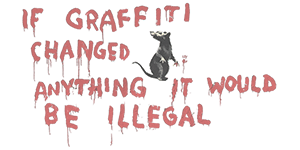
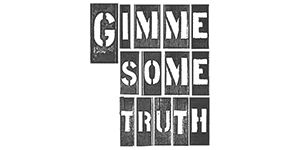
Street art is art, specifically visual art, developed in public spaces — that is, ‘in the streets’ — though the term usually refers to unsanctioned art, as opposed to government sponsored initiatives. The term can include traditional graffiti artwork, sculpture, stencil graffiti, sticker art, wheatpasting and street poster art, video projection, art intervention, guerrilla art, and street installations.
Typically, the term street art or the more specific post-graffiti is used to distinguish contemporary public-space artwork from territorial graffiti, vandalism, and corporate art. Artists have challenged art by situating it in non-art contexts. ‘Street’ artists do not aspire to change the definition of an artwork, but rather to question the existing environment with its own language. They attempt to have their work communicate with everyday people about socially relevant themes in ways that are informed by aesthetic values without being imprisoned by them. NYC based artist John Fekner defines street art as ‘all art on the street that’s not graffiti.’
Whereas traditional graffiti artists have primarily used free-hand aerosol paints to produce their works, ‘street art’ encompasses many other media and techniques, including: LED art, mosaic tiling, murals, stencil art, sticker art, street installations, wheatpasting, woodblocking, video projection, and yarn bombing. Also, traditional graffiti has increasingly been adopted as a method for advertising; its trajectory has even in some cases led its artists to work on contract as graphic artists for corporations. Nevertheless, street art is a label often adopted by artists who wish to keep their work unaffiliated and strongly political. Street artists are those whose work is still largely done without official approval in public areas. For these reasons street art is sometimes considered ‘post-graffiti’ and sometimes even ‘neo-graffiti.’ Street art can be found around the world and street artists often travel to other countries foreign to them so they can spread their designs.
The motivations and objectives that drive street artists are as varied as the artists themselves. There is a strong current of activism and subversion in urban art. Street art can be a powerful platform for reaching the public, and frequent themes include adbusting, subvertising, and other culture jamming, the abolishment of private property, and reclaiming the streets. Some street artists use ‘smart vandalism’ as a way to raise awareness of social and political issues. Other street artists simply see urban space as an untapped format for personal artwork, while others may appreciate the challenges and risks that are associated with installing illicit artwork in public places. However the universal theme in most, if not all street art, is that adapting visual artwork into a format which utilizes public space, allows artists who may otherwise feel disenfranchised, to reach a much broader audience than traditional artwork and galleries normally allow.
In 1981, Washington Project for the Arts held an exhibition entitled ‘Street Works,’ which included John Fekner, Fab Five Freddy, and Lee Quinones working directly on the streets. Fekner, a pioneer in urban art, is included in Cedar Lewisohn’s book ‘Street Art: The Graffiti Revolution,’ which accompanied the 2008 Street Art exhibition at the Tate Modern in England, of which Lewisohn was the curator. The 1990 book ‘Soho Walls – Beyond Graffiti’ by David Robinson documents the paradigm shift in New York from the text-based precedents established by graffiti artists toward art in the streets such as the shadow figures by Richard Hambleton and the group of five young New York artists working collectively under the moniker AVANT.
While practically all large cities in the world, and some of the larger regional towns, host some form of urban art or graffiti, there are a few locations that are considered to harbor forerunners of particular mediums or foster a pioneering street art culture in general. Such locations often attract internationally known artists who travel to these locations to exhibit their works: Berlin, Paris, Moscow, Barcelona, London, Toronto, Atlanta, Los Angeles, New York City, Cairo, Buenos Aires, São Paulo, Melbourne, Auckland, Bristol (UK), Stavanger (Norway), Łódź (Poland), Sofia (Bulgaria).


 The Daily Omnivore
Leave a comment