March 24, 2012
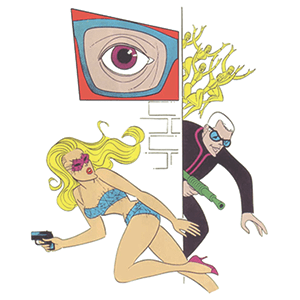
The 10th Victim (Italian: ‘La decima vittima’) is a 1965 Italian/French international co-production science fiction film directed by Elio Petri. It is based on Robert Sheckley’s 1953 short story ‘Seventh Victim.’ Sheckley later published a novelization of the film in 1966. In the near future, big wars are avoided by giving individuals with violent tendencies a chance to kill in the ‘Big Hunt.’ The Hunt is the most popular form of entertainment in the world and also attracts participants who are looking for fame and fortune. It includes ten rounds for each competitor, five as the hunter and five as the victim. The survivor of ten rounds becomes extremely wealthy and retires.
Scenes switch between the pursuit, romance between the hunter and the victim, and a narrator explaining the rules and justification of the Hunt. Caroline Meredith (Ursula Andress) is the huntress armed with a high caliber Bosch shotgun looking for her tenth victim. Marcello Poletti (Marcello Mastroianni) is the victim. He is reluctant to kill Meredith as he is not sure whether she is his hunter, but then later because they become romantically involved. To maximize financial gain, Meredith wants to get a perfect kill in front of the cameras as she has negotiated a major sponsor from the Ming Tea Company.
Posted in Art, Games, Money |
Leave a Comment »
March 24, 2012
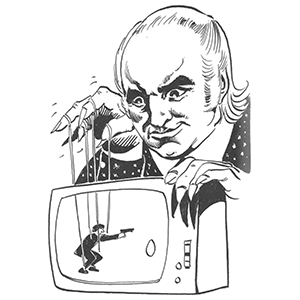
The Prize of Peril is a science fiction short-story by Robert Sheckley, written in 1958 and first published in the collection ‘Store of Infinity’ in 1960 by Bantam Books. The short story is noted for its plot’s anticipation of Reality television shows such as Survivor and Fear Factor by several decades. The screenplay for the fake German reality show ‘Das Millionenspiel’ (‘The Million Game’) was based on the story, as was the French film version of ‘Das Millionenspiel,’ ‘Le prix du danger.’ The protagonist of the story is Jim Raeder, a man only notable due to his normality, who has been a participant in many reality television-shows (given the name ‘thrill shows’) and thus become a celebrity.
In all the shows the risk of dying has been a part of the concept; he has fought a real bull in Spain, he has driven a Formula 1-car, and fought with other divers while trying to escape sharks and other sea monsters. In the story he partakes in the greatest of all reality shows; he is to be hunted by professional gangland murderers. As he is hunted, his journey is shown all over the US on TV and he receives help from the viewers; the so called Good Samaritans and the commentator, Mike Terry, makes a point of this during the show: ‘All of America is ready to help Jim!,’ but Raeder soon finds out that things are not what he expected them to be and that maybe his survival is not the main priority among the public. The story ends with Raeder winning The Prize of Peril, but being dragged away after presumably having a mental breakdown, not being ‘himself’ at the moment according to Terry.
Posted in Art, Games, Language |
Leave a Comment »
March 24, 2012

The Running Man is a science fiction novel by Stephen King, first published under the pseudonym Richard Bachman in 1982 as a paperback original. It was collected in 1985 in the hardcover omnibus ‘The Bachman Books.’ The novel is set in a dystopian United States during the year 2025, in which the nation’s economy is in ruins and world violence is rising.
The story follows protagonist Ben Richards as he participates in the game show ‘The Running Man’ in which contestants, allowed to go anywhere in the world, are chased by ‘Hunters,’ employed to kill them. ‘The Running Man’ was loosely adapted into a film with the same name, which was released five years after the book in 1987. The film starred Arnold Schwarzenegger as Richards.
read more »
Posted in Art, Death, Language |
Leave a Comment »
March 24, 2012
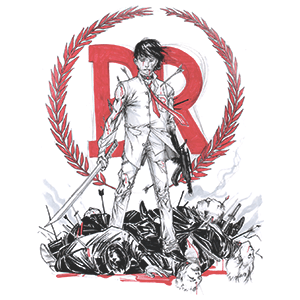
Battle Royale is a 2000 Japanese thriller film based on the novel of the same name by Koushun Takami. It was directed by Kinji Fukasaku. The film tells the story of a high-school student struggling with the death of his father who is forced by the government to compete in a deadly game, where the students must kill each other in order to win. The film aroused international controversy and was either banned or excluded from distribution in many countries, but was a domestic blockbuster, and is one of the 10-highest grossing films in Japan.
Kinji Fukasaku stated that he decided to direct the film because the novel it was adapted from reminded him of his time as a 15-year-old munitions factory worker during World War II. At that time, his class was made to work in a munitions factory. In July 1945, the factory came under artillery fire. The children could not escape so they dived under each other for cover. The surviving members of the class had to dispose of the corpses. At that point, Fukasaku realized that the Japanese government was lying about World War II, and he developed a burning hatred of adults in general that he maintained for a long time afterwards.
Posted in Art, Death, World |
1 Comment »
March 24, 2012

Battle Royale is a 1999 Japanese novel written by Koushun Takami about schoolchildren who are forced to fight each other to the death. The novel has been adapted into a 2000 film and a manga series. The story takes place in an alternate timeline—Japan is a member region of a totalitarian state known as the Republic of Greater East Asia. Under the guise of a ‘study trip,’ a group of students are gassed on a bus. They awaken in the Okishima Island School on an isolated, evacuated island (modeled after the island of Ogijima). They learn that they have been placed in an event called the Program.
Officially a military research project, it is a means of terrorizing the population, of creating such paranoia as to make organized insurgency impossible. The Program began in 1947. According to the rules fifty third-year high school classes are selected (prior to 1950, forty-seven classes were selected) annually to participate in the Program for research purposes. The students from a single class are isolated and are required to fight the other members from their class to the death. The Program ends when only one student remains, with that student being declared the winner.
Posted in Art, Death, Language |
Leave a Comment »
March 24, 2012
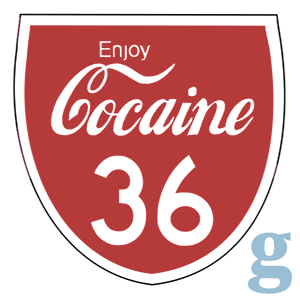
Route 36 is an illegal after-hours lounge in La Paz, Bolivia, and, according to ‘The Guardian,’ the world’s first cocaine bar. Although cocaine, an addictive stimulant derived from the coca plant, is illegal in Bolivia, political corruption and affordability of locally produced cocaine have resulted in Route 36 becoming a popular destination for thousands of drug tourists each year.
Many customers learn about the bar’s existence through travel websites and by word of mouth promotion. To avoid complaints from nearby business owners or residents, Route 36 does not operate in the same location for more than a few weeks at a time. Its location can only be found by word of mouth information.
Posted in Drugs, Money, World |
Leave a Comment »
March 23, 2012
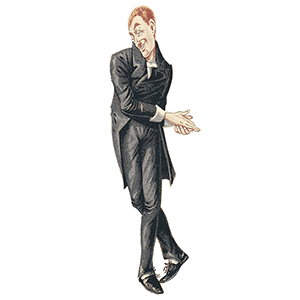
Confirmation bias is a tendency of people to favor information that confirms their beliefs or hypotheses. People display this bias when they gather or remember information selectively, or when they interpret it in a biased way. The effect is stronger for emotionally charged issues and for deeply entrenched beliefs. For example, in reading about gun control, people usually prefer sources that affirm their existing attitudes. They also tend to interpret ambiguous evidence as supporting their existing position.
Biased search, interpretation and memory have been invoked to explain attitude polarization (when a disagreement becomes more extreme even though the different parties are exposed to the same evidence), belief perseverance (when beliefs persist after the evidence for them is shown to be false), the irrational primacy effect (a greater reliance on information encountered early in a series), and illusory correlation (when people falsely perceive an association between two events or situations).
read more »
Posted in Money, Politics, Science |
1 Comment »
March 23, 2012
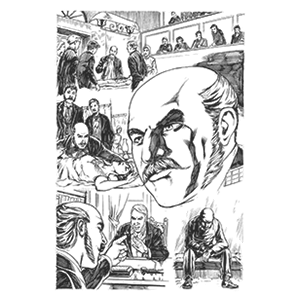
The Semmelweis reflex is a metaphor for the reflex-like tendency to reject new evidence or new knowledge because it contradicts established norms, beliefs or paradigms.
The term originated from Ignaz Semmelweis, who discovered that childbed fever mortality rates could be reduced ten-fold if doctors would wash their hands (we would now say disinfect) with a chlorine solution between having contact with infected patients and non-infected patients. His hand-washing suggestions were rejected by his contemporaries.
Posted in Health, Science |
2 Comments »
March 23, 2012
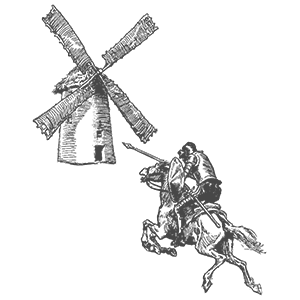
Tilting at windmills is an English idiom which means attacking imaginary enemies. The word ’tilt,’ in this context, comes from jousting. The phrase is sometimes used to describe confrontations where adversaries are incorrectly perceived, or courses of action that are based on misinterpreted or misapplied heroic, romantic, or idealistic justifications.
The phrase derives from an episode in the novel ‘Don Quixote’ by Miguel de Cervantes. In the novel, Don Quixote fights windmills that he imagines to be giants. Quixote sees the windmill blades as the giant’s arms, for instance.
read more »
Posted in Humor, Language, Politics |
Leave a Comment »
March 23, 2012


Tilt is a poker term for a state of mental or emotional confusion or frustration in which a player adopts a less than optimal strategy, usually resulting in the player becoming over-aggressive. This term is closely associated with ‘steam’ and some consider the terms equivalent, but ‘steam’ typically indicates more anger and intensity. Placing an opponent on tilt or dealing with being on tilt oneself is an important aspect of poker. It is a relatively frequent occurrence due to frustration, animosity against other players, or simply bad luck. Experienced players recommend learning to recognize that one is experiencing tilt and avoid allowing it to influence one’s play.
The most likely origin of the word ’tilt’ is as a reference to tilting a pinball machine. The frustration from seeing the ball follow a path towards the gap between the flippers can lead to the player physically tilting the machine (in an attempt to guide the ball towards the flippers). However, in doing so, some games will flash the word ‘TILT’ and freeze the flippers, causing the ball to be lost. The metaphor here being over-aggression due to frustration leads to severely detrimental gameplay.
read more »
Posted in Games, Language, Money |
Leave a Comment »
March 23, 2012

Selective Perception is a broad term to identify behavior where people tend to ‘see things’ based on their particular frame of reference. Selective perception may refer to any number of cognitive biases in psychology related to the way expectations affect perception.
For instance, several studies have shown that students who were told they were consuming alcoholic beverages (which in fact were non-alcoholic) perceived themselves as being ‘drunk,’ exhibited fewer physiological symptoms of social stress, and drove a simulated car similarly to other subjects who had actually consumed alcohol. The result is somewhat similar to the placebo effect.
read more »
Posted in Humor, Politics, Science |
Leave a Comment »
March 23, 2012

The hostile media effect refers to the finding that people with strong biases toward an issue (partisans) perceive media coverage as biased against their opinions, regardless of the reality.
Proponents of the hostile media effect argue that this finding cannot be attributed to the presence of bias in the news reports, since partisans from opposing sides of an issue rate the same coverage as biased against their side and biased in favor of the opposing side. The phenomenon was first proposed and studied experimentally by Robert Vallone, Lee Ross and Mark Lepper.
read more »
Posted in Language, Money, Politics |
Leave a Comment »


 The Daily Omnivore