June 19, 2012

A credit boom-bust cycle is an episode characterized by a sustained increase in several economics indicators followed by a sharp and rapid contraction. Commonly the boom is driven by a rapid expansion of credit to the private sector accompanied with rising prices of commodities and stock market index.
Following the boom phase, asset prices collapse and a credit crunch arises, where access to financing opportunities are sharply reduced below levels observed during normal times. The unwinding of the boom phase brings a considerably large reduction in investment and fall in consumption and an economic recession may follow. The recession following the burst of the episode is oftentimes short-lived, GDP and consumption growth usually resume within a year.
read more »
Posted in Money, Politics, World |
Leave a Comment »
June 19, 2012

A Malthusian catastrophe [mal-thoo-zee-uhn] would be a forced return to subsistence-level conditions due to population growth outpacing agricultural production. Population and growth size has a negative impact on the environment. Later formulations consider economic growth limits as well. The term is also commonly used in discussions of oil depletion. Based on the work of political economist Thomas Malthus (1766–1834), theories of Malthusian catastrophe are very similar to the Iron Law of Wages (real wages always tend toward the minimum wage necessary to sustain the life of the worker).
The main difference is that the Malthusian theories predict what will happen over several generations or centuries, whereas the Iron Law of Wages predicts what will happen in a matter of years and decades. The Industrial Revolution enabled the modern world to break out of the Malthusian growth model, however, various limited resources which may soon limit human population growth because of a widespread belief in the importance of prosperity for every individual and the rising consumption trends of large developing nations such as China and India.
read more »
Posted in Food, Money, World |
Leave a Comment »
June 19, 2012

The Iron Law of Wages is a proposed law of economics that asserts that real wages always tend, in the long run, toward the minimum wage necessary to sustain the life of the worker. The theory was first named by Ferdinand Lassalle in the mid-nineteenth century.
Karl Marx attributed the doctrine to Lassalle (notably in ‘Critique of the Gotha Programme’), crediting the idea to Thomas Malthus in his work, ‘An Essay on the Principle of Population,’ and the terminology to Goethe’s ‘great, eternal iron laws’ in ‘Das Göttliche’ (‘On the Divine’).
read more »
Posted in Money, Politics |
Leave a Comment »
June 19, 2012

The Malthusian trap [mal-thoo-zee-uhn], named after political economist Thomas Robert Malthus, suggests that for most of human history, income was largely stagnant because technological advances and discoveries only resulted in more people, rather than improvements in the standard of living.
It is only with the onset of the Industrial Revolution in about 1800 that the income per person dramatically increased, and they broke out of the Trap; it has been shown, however, that the escape from the Malthusian trap can also generate serious political upheavals.
read more »
Posted in Money, Technology, World |
Leave a Comment »
June 18, 2012
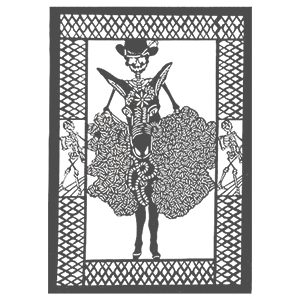
Papel picado (‘perforated paper’) is a decorative craft made out of paper cut into elaborate designs. Although it is a Mexican folk art, papel picado is used as a holiday decoration in many countries. The designs are commonly cut from tissue paper using a guide and small chisels, creating as many as forty banners at a time. Common themes includes birds, floral designs, and skeletons.
They are commonly displayed for both secular and religious occasions, such as Easter, Christmas, the Day of the Dead, as well as during weddings, quinceañeras, baptisms, and christenings. In Mexico, papel picado is especially incorporated into altars during the Day of the Dead.
read more »
Posted in Art, World |
Leave a Comment »
June 18, 2012
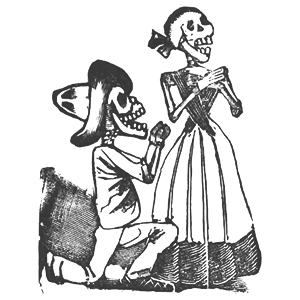
La Calavera Catrina (‘The Elegant Skull’) is a 1910 zinc etching by Mexican printmaker José Guadalupe Posada, part of his series of calaveras (humorous images of contemporary figures depicted as skeletons, which often were accompanied by a poem). The image has since become a staple of Mexican imagery, and often is incorporated into artistic manifestations of the Day of the Dead in November, such as altars and calavera costumes. Although these holy days have a long cultural history reaching into the prehistoric traditions of several European cultures, many aspects of the Mexican festival have indigenous origins in an Aztec festival dedicated to the goddess Mictecacihuatl. After the conquest of Mexico, the Spanish superimposed their cultural traditions upon the similar Aztec festival and a synthesis occurred.
‘La Catrina,’ as it is commonly known, was a popular print in Posada’s day, but soon faded from the popular memory. Along with the rest of Posada’s prints, it was revived by French artist and art historian Jean Charlot shortly after the Mexican Revolution in the 1920s. ‘La Catrina’ soon gained iconic status as a symbol of uniquely Mexican art and was reproduced en masse. The image was incorporated into Diego Rivera’s mural ‘Dream of a Sunday’in Alameda Park,’ which also includes images of his wife Frida Kahlo, Posada, and a self-portrait of Rivera. Notable paper cutter Marcelino Bautista Sifuentes has also recreated the famous ‘La Calavera Catrina’ in papel picado (a decorative craft made out of paper cut into elaborate designs).
Posted in Death, Philosophy, World |
Leave a Comment »
June 18, 2012

A calaca [kal-ah-kuh] (a colloquial Mexican Spanish name for skeleton) is a figure of a skull or skeleton (usually human) commonly used for decoration during the Mexican Day of the Dead festival, although they are made all year round. Tracing their origins from Aztec imagery, calacas are frequently shown with marigold flowers and foliage. As with other aspects of the Day of the Dead festival, calacas are generally depicted as joyous rather than mournful figures. They are often shown wearing festive clothing, dancing, and playing musical instruments to indicate a happy afterlife. This draws on the Mexican belief that no dead soul likes to be thought of sadly, and that death should be a joyous occasion. This goes back to Aztec beliefs, one of the few traditions to remain after the Spanish conquest.
Calacas used in the festival include carved skull masks worn by revelers, small figures made out of carved wood or fired clay, and sweet treats in the form of skulls or skeletons. Calacas are sometimes made of wood, stone, or even candy. A popular phrase among Mexicans and those Latinos that personally know some is ‘se lo (la) llevo la calaca’ after someone has died, literally meaning ‘the Calaca took him (her)’ or ‘death took him (her).’ In Guatemala, ‘calaca’ is understood as ‘death’ and implies fear of death. Thus, it is not depicted as a joyful image. Calaca-like figures can be seen in the Tim Burton films ‘The Nightmare Before Christmas’ and ‘Corpse Bride,’ the 2008 PlayStation 3 game ‘LittleBigPlanet,’ and the 1998 Tim Schafer computer game ‘Grim Fandango.’
Posted in Death, Philosophy, World |
Leave a Comment »
June 18, 2012

Transculturation [trans-kuhl-chuh-rey-shuhn] is a term coined by Cuban anthropologist Fernando Ortiz in 1940 to describe the phenomenon of merging and converging cultures. Transculturation encompasses more than transition from one culture to another; it does not consist merely of acquiring another culture (acculturation) or of losing or uprooting a previous culture (deculturation).
Rather, it merges these concepts and additionally carries the idea of the consequent creation of new cultural phenomena (neoculturation). Ortiz also referred to the devastating impact of Spanish colonialism on Cuba’s indigenous peoples as a ‘failed transculturation.’ Transculturation can often be the result of colonial conquest and subjugation, especially in a postcolonial era as native peoples struggle to regain their own sense of identity.
read more »
Posted in Philosophy, Politics, World |
Leave a Comment »
June 18, 2012

Cosmopolitanism [koz-muh-pol-i-tn-iz-uhm] is the ideology that all kinds of human ethnic groups belong to a single community based on a shared morality. This is contrasted with communitarianism, which emphasizes the need to balance individual rights and interests with that of the community as a whole, and argues that individual people are shaped by the cultures and values of their communities.
Cosmopolitanism may entail some sort of world government or it may simply refer to more inclusive moral, economic, and/or political relationships between nations or individuals of different nations. The word derives from Greek ‘cosmos’ (‘the Universe’) and ‘polis’ (‘city’).
read more »
Posted in Philosophy, Politics, World |
Leave a Comment »
June 17, 2012


IBZL (Infinite Bandwidth Zero Latency) is a thought experiment that asks: what will happen when bandwidth (the maximum speed of a connection) is so great, and latency (delays) so small, that it no longer matters? What will be the applications and services that would most benefit from an IBZL connection to the Internet?
The IBZL program was started in the UK by the Open University (a distance learning and research university) and Manchester Digital (a digital media trade organization). ‘Infinite bandwidth’ and ‘zero latency’ are not meant literally; they are a shorthand for networks where bandwidth and latency cease to be limiting factors.
read more »
Posted in Games, Technology |
Leave a Comment »
June 15, 2012
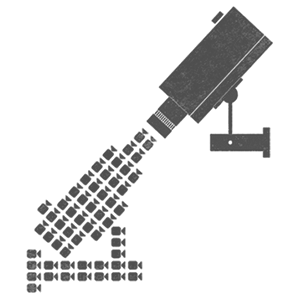
Equiveillance is a state of equilibrium, or a desire to attain a state of equilibrium, between surveillance (third-person recording) and sousveillance (first-person recording). This balance allows the individual to construct their own case from evidence they gather themselves, rather than merely having access to surveillance data that could possibly incriminate them. It is sometimes confused with transparency (accessibility and understandability of information). Sousveillance, in addition to transparency, can be used to preserve the contextual integrity of surveillance data.
For example, a lifelong capture of personal experience could provide ‘best evidence’ over external surveillance data, to prevent the surveillance-only data from being taken out of context. Equiveillance also represents a situation where all parties of a society or economy are empowered to be able to use the tools of accountability to make beneficial decisions. Humanity has always sought to establish authority relationships: the increasing trend to record information from our environment, and of ourselves creates the need to delineate the relationships between privacy, surveillance, and sousveillance.
read more »
Posted in Politics, Technology |
Leave a Comment »
June 15, 2012

Technological utopianism is the belief that advances in science and technology will eventually bring about a utopia, or at least help to fulfill one or another utopian ideal. A techno-utopia is therefore a hypothetical ideal society, in which laws, government, and social conditions are solely operating for the benefit and well-being of all its citizens, set in the near- or far-future, when advanced science and technology will allow these ideal living standards to exist; for example, post scarcity, transformations in human nature, the abolition of suffering, and even the end of death.
In the late 20th and early 21st centuries, several ideologies and movements, such as the cyberdelic counterculture, the Californian Ideology, transhumanism, and singularitarianism, have emerged promoting a form of techno-utopia as a reachable goal. Cultural critic Imre Szeman argues technological utopianism is an irrational social narrative because there is no evidence to support it. He concludes that what it shows is the extent to which modern societies place a lot of faith in narratives of progress and technology overcoming things, despite all evidence to the contrary.
read more »
Posted in Philosophy, Politics, Technology |
Leave a Comment »


 The Daily Omnivore