October 9, 2012

Edupunk is an approach to teaching and learning practices that result from a do it yourself (DIY) attitude. ‘The New York Times’ called it ‘an approach to teaching that avoids mainstream tools like PowerPoint and Blackboard, and instead aims to bring the rebellious attitude and D.I.Y. ethos of ’70s bands like The Clash to the classroom.’
The term was first used in 2008 by Jim Groom in his blog, and covered less than a week later in the ‘Chronicle of Higher Education.’ Edupunk arose in objection to the efforts of government and corporate interests in reframing and bundling emerging technologies into cookie-cutter products with pre-defined application—somewhat similar to traditional punk ideologies.
Posted in Education, Money, Politics |
Leave a Comment »
October 8, 2012


The free culture movement is a social movement that promotes the freedom to distribute and modify creative works in the form of free content by using the Internet and other forms of media. The movement objects to overly-restrictive copyright laws. Many members of the movement argue that such laws hinder creativity. They call this system ‘permission culture.’ ‘Creative Commons’ is a well-known website which was started by legal activist Lawrence Lessig. It lists licenses that permit sharing under various conditions, and also offers an online search of various creative-commons-licensed productions.
The free culture movement, with its ethos of free exchange of ideas, is of a whole with the free software movement. Richard Stallman, the founder of the GNU project (a free UNIX competitor, and free software activist, advocates free sharing of information. He famously stated that free software means free as in ‘free speech,’ not ‘free beer.’ Today, the term stands for many other movements, including hacker computing, the access to knowledge movement, and the copyleft movement. The term ‘free culture’ was originally the title of a 2004 book by Lawrence Lessig, a founding father of the free culture movement.
read more »
Posted in Money, Politics, Technology |
2 Comments »
October 8, 2012

Information wants to be free is a slogan of technology activists invoked against limiting access to information. According to criticism of intellectual property rights, the system of governmental control of exclusivity is in conflict with the development of a public domain of information. The iconic phrase is attributed to American writer Stewart Brand who, in the late 1960s, founded the ‘Whole Earth Catalog’ and argued that technology could be liberating rather than oppressing.
The earliest recorded occurrence of the expression was at the first ‘Hackers’ Conference’ in 1984. Brand told Steve Wozniak: ‘On the one hand information wants to be expensive, because it’s so valuable. The right information in the right place just changes your life. On the other hand, information wants to be free, because the cost of getting it out is getting lower and lower all the time. So you have these two fighting against each other.’
read more »
Posted in Money, Politics, Technology |
Leave a Comment »
October 8, 2012

Evergreening refers to a variety of legal and business strategies by which technology producers with patents over products that are about to expire retain rent from them by either taking out new patents or by buying out or frustrating competitors, for longer periods of time than would normally be permissible under the law.
Evergreening is not a formal concept of patent law; it is best understood as a social idea used to refer to the myriad ways in which pharmaceutical patent owners use the law and related regulatory processes to extend their high rent-earning intellectual property rights, otherwise known as intellectual monopoly privileges, particularly over highly profitable ‘blockbuster’ drugs.
read more »
Posted in Drugs, Money, Politics |
Leave a Comment »
October 8, 2012

Patent troll is a pejorative term used for a person or company who enforces patents against one or more alleged infringers in a manner considered aggressive or opportunistic with no intention to manufacture or market the patented invention.
The Patent Troll was originally depicted in ‘The Patents Video,’ which was released in 1994 and sold to corporations, universities, and governmental entities. The metaphor was popularized in 2001 by Peter Detkin, former assistant general counsel of Intel, who chose the term from among a number of suggestions during a discussion with Anne Gundelfinger, Vice President and Associate General Counsel at Intel.
read more »
Posted in Money, Politics, Technology |
Leave a Comment »
October 8, 2012

A patent war is a ‘battle’ between corporations or individuals to secure patents for litigation, whether offensively or defensively. There are ongoing patent wars between the world’s largest technology and software corporations. Patent wars are not a new phenomenon. The Wright brothers, attributed with the invention of the airplane, sought to prevent competitors from manufacturing airplanes through litigation, stifling the development of the American airline industry. Alexander Graham Bell, credited with inventing the telephone, was dragged into a patent war against his rivals, which involved, in just 11 years, 600 lawsuits.
One notable case was Bell’s lawsuit against Western Union, a telegraph company backed by Elisha Gray (also credited with inventing the telephone). In the digital age, the rapid pace of innovation makes much of the patent system obsolete. In the 1980s, technology corporations in the United States and Japan engaged in a patent war, creating a scenario where companies were forced to ‘fight patent with patent.’ This bilateral patent war, partly exaggerated by the media, subsided by the mid 1990s.
read more »
Posted in Money, Politics, Technology |
3 Comments »
October 7, 2012

‘An Army of Davids: How Markets and Technology Empower Ordinary People to Beat Big Media, Big Government, and Other Goliaths’ is a2006 book by Glenn Reynolds, a law professor at the University of Tennessee also known as the blogger ‘Instapundit’.
The book looks at modern American society through the lens of individuals versus social institutions, and Reynolds concludes that technological change has allowed more freedom of action for people in contrast to the ‘big’ establishment organizations that used to function as gatekeepers. Thus, he argues that the balance of power between individuals and institutions is ‘flatting out,’ which involves numerous decentralized networks rising up. Reynolds divides the book into two distinct sections. The first focuses on trends currently taking place. The latter describes upcoming trends.
read more »
Posted in Money, Politics, Technology |
Leave a Comment »
October 7, 2012
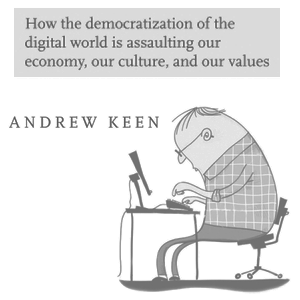
‘The Cult of the Amateur: How Today’s Internet Is Killing Our Culture’ is a 2007 book written by entrepreneur and Internet critic Andrew Keen; it is a critique of the enthusiasm surrounding user generated content, peer production, and other Web 2.0-related phenomena.
The book was written after Keen wrote a controversial essay in ‘The Weekly Standard’ criticizing Web 2.0 for being similar to Marxism, for destroying professionalism and for making it impossible to find high quality material amidst all the user-generated web content. The book was based in part on that essay. Keen argues against the idea of a ‘read-write culture’ in media, stating that ‘most of the content being shared— no matter how many times it has been linked, cross-linked, annotated, and copied— was composed or written by someone from the sweat of their creative brow and the disciplined use of their talent.’
read more »
Posted in Language, Technology |
Leave a Comment »
October 7, 2012


Deletionism and inclusionism are opposing philosophies that largely developed and came to public notice within the context of the community of editors of the online encyclopedia Wikipedia. The terms are connected to views on the appropriate scope of the encyclopedia, and the appropriate point for a topic to be allowed to ‘include’ an encyclopedia article (i.e., ‘inclusion’) or ‘delete’ the article (i.e., ‘deletion’).
Inclusionism and deletionism are broad terms falling within a spectrum of views. The concepts are closely related to the concept of notability, with deletionists and inclusionists taking a strong or relaxed stance on ‘notability’ accordingly. Many users do not identify strongly with either position. ‘Deletionists’ are proponents of selective coverage and removal of articles seen as unnecessary or highly substandard. Deletionist viewpoints are commonly motivated by a desire that Wikipedia be focused on and cover significant topics – along with the desire to place a firm cap upon proliferation of promotional use (seen as abuse of the website), trivia, and articles which are of no general interest, lack suitable source material for high quality coverage, or are too short or otherwise unacceptably poor in quality.
read more »
Posted in Language, Politics, Technology |
Leave a Comment »
October 7, 2012


The reliability of Wikipedia (primarily of the English-language edition), compared to other encyclopedias and more specialized sources, is assessed in many ways, including statistically, through comparative review, analysis of the historical patterns, and strengths and weaknesses inherent in the editing process unique to Wikipedia.
Several studies have been done to assess the reliability of Wikipedia. A notable early study in the journal ‘Nature’ said that in 2005, ‘Wikipedia scientific articles came close to the level of accuracy in Encyclopædia Britannica and had a similar rate of ‘serious errors.’ The study was disputed by ‘Encyclopædia Britannica,’ and later ‘Nature’ responded to this refutation with both a formal response and a point-by-point rebuttal of Britannica’s main objections.
read more »
Posted in Education, Language, Technology |
2 Comments »
October 7, 2012


In a 2006 episode of the satirical news show ‘The Colbert Report,’ Stephen Colbert announced the neologism ‘Wikiality‘ (a portmanteau of the words ‘Wiki’ and ‘reality’) defined as ‘truth by consensus’ (rather than fact), modeled after the approval-by-consensus format of Wikipedia. He ironically praised Wikipedia for following his philosophy of ‘truthiness,’ in which intuition and consensus is a better reflection of reality than fact:
‘You see, any user can change any entry, and if enough other users agree with them, it becomes true. … If only the entire body of human knowledge worked this way. And it can, thanks to tonight’s word: ‘Wikiality.’ Now, folks, I’m no fan of reality, and I’m no fan of encyclopedias. I’ve said it before. Who is Britannica to tell me that George Washington had slaves? If I want to say he didn’t, that’s my right. And now, thanks to Wikipedia, it’s also a fact. We should apply these principles to all information. All we need to do is convince a majority of people that some factoid is true. … What we’re doing is bringing democracy to knowledge.’
read more »
Posted in Humor, Language, Technology |
Leave a Comment »
October 7, 2012

Project A119, also known as ‘A Study of Lunar Research Flights,’ was a top-secret plan developed in the late 1950s by the United States Air Force. The aim of the project was to detonate a nuclear bomb on the Moon to boost public morale in the United States after the Soviet Union took an early lead in the Space Race. The existence of the project was revealed in 2000 by a former NASA executive, Leonard Reiffel, who led the project in 1958.
A young Carl Sagan was part of the team responsible for predicting the effects of a nuclear explosion in low gravity. Project A119 was never carried out, primarily because a moon landing would be a much more acceptable achievement in the eyes of the American public. The project documents remained secret for nearly 45 years, and despite Reiffel’s revelations, the US government has never officially recognized its involvement in the study.
read more »
Posted in Politics, Science, War |
Leave a Comment »


 The Daily Omnivore