October 29, 2012


Chicago-style pizza refers to a deep-dish pizza, with a crust up to three inches tall at the edge, slightly higher than the ingredients, which include large amounts of cheese and chunky tomato sauce, acting as a large bowl. Besides deep-dish, the term also refers to stuffed pizza, another Chicago style. Both styles of pizza are usually eaten with a knife and fork. There is also a style of thin-crust pizza found in Chicago and throughout the rest of the Midwest.
The crust is thin and firm enough to have a noticeable crunch, unlike a New York-style pizza. Most Chicago pizzerias offer both thin-crust and deep-dish pizzas. The Chicago-style ‘deep-dish’ pizza was invented at Pizzeria Uno, in Chicago, in 1943, reportedly by Uno’s founder Ike Sewell, a former University of Texas football star. However, a 1956 article from the ‘Chicago Daily News’ asserts that Uno’s original pizza chef Rudy Malnati developed the recipe. Another deep-dish restaurant is Uno’s companion restaurant Due, opened down the block by Sewell in 1955.
read more »
Posted in Food |
Leave a Comment »
October 28, 2012
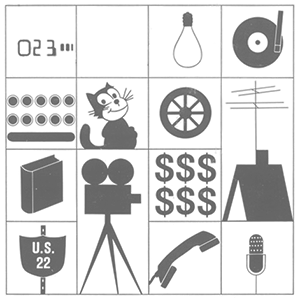
‘Understanding Media: The Extensions of Man’ is a 1964 book by Marshall McLuhan. A pioneering study in media theory, it proposes that media themselves, not the content they carry, should be the focus of study. McLuhan suggests that a medium affects the society in which it plays a role not by the content delivered through it, but by the characteristics of the medium itself.
McLuhan pointed to the light bulb as an example. A light bulb does not have content in the way that a newspaper has articles or a television has programs, yet it is a medium that has a social effect; that is, a light bulb enables people to create spaces during nighttime that would otherwise be enveloped by darkness. He describes the light bulb as a medium without any content. McLuhan states that ‘a light bulb creates an environment by its mere presence.’
read more »
Posted in Education, Language, Technology |
Leave a Comment »
October 28, 2012

Global Village is a term closely associated with Marshall McLuhan, popularized in his books ‘The Gutenberg Galaxy: The Making of Typographic Man’ (1962) and ‘Understanding Media’ (1964). McLuhan described how the globe has been contracted into a village by electric technology and the instantaneous movement of information from every quarter to every point at the same time. In bringing all social and political functions together in a sudden implosion, electric speed heightened human awareness of responsibility to an intense degree.
The Hindu concept of Vasudhaiva Kutumbakam (the whole world is one single family) is a similar thought, according to which: ‘Only small men discriminate saying: One is a relative; the other is a stranger. For those who live magnanimously the entire world constitutes but a family.’ The same concept is to be found in an ancient Tamil poem as, ‘every country is my own and all the people are my kinsmen.’
read more »
Posted in Language, Technology, World |
Leave a Comment »
October 28, 2012

‘The Gutenberg Galaxy: The Making of Typographic Man’ is a book by Marshall McLuhan, in which he analyzes the effects of mass media, especially the printing press, on European culture and human consciousness.
It popularized the term ‘global village,’ which refers to the idea that mass communication allows a village-like mindset to apply to the entire world; and ‘Gutenberg Galaxy,’ which we may regard today to refer to the accumulated body of recorded works of human art and knowledge, especially books. McLuhan studies the emergence of what he calls ‘Gutenberg Man,’ the subject produced by the change of consciousness wrought by the advent of the printed book.
read more »
Posted in Language, Technology, World |
Leave a Comment »
October 28, 2012

Die Glocke (‘The Bell’) was a purported top secret Nazi scientific technological device, secret weapon, or ‘Wunderwaffe.’ First described by Polish journalist Igor Witkowski in 2000, it was later popularized by military journalist and author Nick Cook as well as by writers such as Joseph P. Farrell, who associates it with Nazi occultism and antigravity or free energy research.
According to Patrick Kiger writing in ‘National Geographic,’ Die Glocke has become a ‘popular subject of speculation’ and a following similar to science fiction fandom exists around it and other alleged Nazi ‘miracle weapons.’ Mainstream reviewers such as former aerospace scientist David Myhra express skepticism that such a device ever actually existed.
read more »
Posted in Philosophy, War |
Leave a Comment »
October 28, 2012

‘Vril, the Power of the Coming Race’ is an 1871 novel by Edward Bulwer-Lytton, originally printed as ‘The Coming Race.’ Many readers believe that its account of a superior subterranean master race and the energy-form called ‘Vril’ is accurate, to the extent that some theosophists accepted the book as truth. A popular book, ‘The Morning of the Magicians’ (1960) suggested that a secret Vril Society existed in pre-Nazi Berlin.
The novel centers on a young, independently wealthy traveler (the narrator), who accidentally finds his way into a subterranean world occupied by beings who seem to resemble angels and call themselves Vril-ya. The hero soon discovers that the Vril-ya are descendants of an antediluvian civilization who live in networks of subterranean caverns linked by tunnels.
read more »
Posted in Philosophy, Politics, War |
Leave a Comment »
October 28, 2012
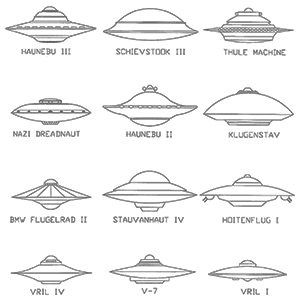
In science fiction, conspiracy theory, and underground comic books, stories or claims circulate linking UFOs to Nazi Germany.
These German UFO theories describe supposedly successful attempts to develop advanced aircraft or spacecraft prior to and during World War II, and further assert the post-war survival of these craft in secret underground bases in Antarctica, South America, or the United States, along with their creators.
read more »
Posted in Humor, Technology, War |
Leave a Comment »
October 28, 2012

Alt porn tends to involve members of such subcultures as goths, punks, or ravers and is often produced by small and independent websites or filmmakers. It often features models with body modifications such as tattoos, piercings, or scarifications, or temporary modifications such as dyed hair.
The term indie porn is also sometimes used, though this term is more generally used as a synonym for independent pornography, regardless of affinity with any kind of alternative subculture. While pornography specifically oriented toward alternative culture did not arise until the 1990s, the work of Gregory Dark, David Aaron Clark, Michael Ninn, and Stephen Sayadian are seen by some as predecessors of alt porn. ‘The Cinema of Transgression’ of Richard Kern and Nick Zedd (as well as Kern’s later photographic work) can also be viewed as early examples of alt porn.
read more »
Posted in Language, Sex |
2 Comments »
October 28, 2012


Psychedelia [sahy-ki-deel-yuh] is a name given to the subculture of people who use psychedelic drugs, and a style of psychedelic artwork and psychedelic music derived from the experience of altered consciousness that uses highly distorted and surreal visuals, sound effects and reverberation, and bright colors and full spectrums and animation (including cartoons) to evoke and convey to a viewer or listener the artist’s experience while using such drugs.
A psychedelic experience is characterized by the striking perception of aspects of one’s mind previously unknown, or by the creative exuberance of the mind liberated from its ostensibly ordinary fetters.
read more »
Posted in Art, Drugs, Language |
Leave a Comment »
October 27, 2012
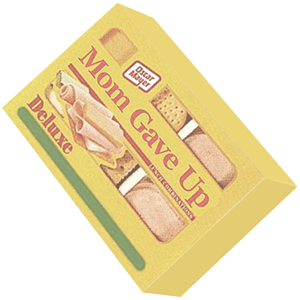
Lunchables is a line of lunch combinations manufactured by Kraft Foods, Inc, beginning in 1988. They are marketed under the Oscar Mayer brand in the United States and Dairylea in the United Kingdom. Many Lunchables products are produced at Kraft Foods, Inc.’s Fullerton factory in Fullerton, California, and are then distributed across the nation.
A typical Lunchables meal combination includes crackers, small slices of meat, and an equal number of slices of cheese. Other varieties include pizza, small hot dogs, small burgers, nachos, subs, and wraps. Overall there are 25 different kinds of Lunchables meals. ‘Deluxe’ versions, which were originally developed for adults, included two types of meats and two types of cheeses. Deluxe versions usually also contained a sauce and a mint.
read more »
Posted in Food, Health, Money |
Leave a Comment »
October 27, 2012
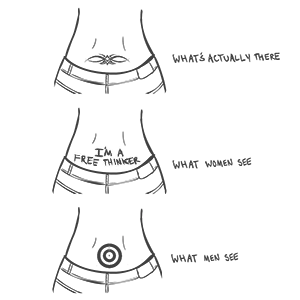
Lower-back tattoos (often referred to as tramp stamps) are a form of body art that became popular among women in the 2000s and gained a reputation as a feminine type of tattoo. Although historically men comprised the majority of tattoo recipients, in the early 1990s, the practice gained popularity among women. In the early to mid-20th century, women with tattoos were heavily stigmatized, and were rarely found in middle-class society. Lower-back tattoos were popularized in the early 2000s, in part owing to the influence of celebrities, including Britney Spears, Christina Ricci, and Pamela Anderson. The popularity of low-rise jeans and crop tops may have also spurred the increase in lower-back tattoos.
Another appeal of tattooing the lower back is that there is little fat there, lessening the chance that images will become misshapen over time. Also, the lower back is often concealed, providing women the choice of when to reveal their tattoo. Medical practitioners who administer anesthesia have questioned whether epidural analgesia should be provided to women with lower-back tattoos. Concerns have emerged that epidural catheters may cause tattoo pigment to enter interspinous ligaments and other areas, potentially leading to health problems. There is general consensus that epidural catheters should not be placed through irritated or infected tattoos. However, harm has not been clearly documented when placing epidural catheters through healthy tattooed skin.
Posted in Art, Health, Sex |
Leave a Comment »
October 27, 2012

The cocktail party effect is the phenomenon of being able to focus one’s auditory attention on a particular stimulus while filtering out a range of other stimuli, much the same way that a party-goer can focus on a single conversation in a noisy room. This effect is what allows most people to ‘tune in’ to a single voice and ‘tune out’ all others. It may also describe a similar phenomenon that occurs when one may immediately detect words of importance originating from unattended stimuli, for instance hearing one’s name in another conversation.
The cocktail party effect works best as a binaural effect, which requires hearing with both ears. People with only one functional ear seems much more disturbed by interfering noise. However, even without binaural location information, individuals can selectively attend to one particular speaker if the pitch of their voice or the topic of their speech is sufficiently distinctive (albeit with greater difficulty). This phenomenon is still very much a subject of research, in humans as well as in computer implementations (where it is typically referred to as source separation or blind source separation).
read more »
Posted in Health, Science, Technology |
Leave a Comment »


 The Daily Omnivore