October 26, 2012

Reality tunnel is a term coined by Timothy Leary and popularized by Robert Anton Wilson, akin to the idea of representative realism (equivalent to the accepted view of ‘perception’ in natural science that states that we do not and cannot perceive the external world as it really is but know only our ideas and interpretations of the way the world is). The theory states that, with a subconscious set of mental ‘filters’ formed from their beliefs and experiences, every individual interprets the same world differently, hence ‘Truth is in the eye of the beholder.’ According to Wilson, ‘Every kind of ignorance in the world all results from not realizing that our perceptions are gambles.
We believe what we see and then we believe our interpretation of it, we don’t even know we are making an interpretation most of the time. We think this is reality.’ The idea does not necessarily imply that there is no objective truth; rather that our access to it is mediated through our senses, experience, conditioning, prior beliefs, and other non-objective factors. The implied individual world each person occupies is said to be their reality tunnel. The term can also apply to groups of people united by beliefs: we can speak of the fundamentalist Christian reality tunnel or the ontological naturalism reality tunnel.
read more »
Posted in Philosophy, Science |
Leave a Comment »
October 25, 2012

Consensus reality is that which is generally agreed to be reality, based on a consensus view. However, human beings do not fully understand or agree upon the nature of knowledge or knowing, and therefore (it is often argued) it is not possible to be certain beyond doubt what is real. Accordingly, this line of logic concludes, we cannot in fact be sure beyond doubt about the nature of reality. We can, however, seek to obtain some form of consensus, with others, of what is real.
We can use this consensus as a pragmatic guide, either on the assumption that it seems to approximate some kind of valid reality, or simply because it is more ‘practical’ than perceived alternatives. Consensus reality therefore refers to the agreed-upon concepts of reality which people in the world, or a culture or group, believe are real (or treat as real), usually based upon their common experiences as they believe them to be; anyone who does not agree with these is sometimes stated to be ‘in effect… living in a different world.’
read more »
Posted in Philosophy, Science |
Leave a Comment »
October 25, 2012
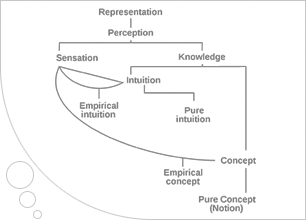

The noumenon [noo-muh-non] is a posited object or event that is known (if at all) without the use of the senses. The term is generally used in contrast with, or in relation to ‘phenomenon,’ which refers to anything that appears to, or is an object of, the senses. In Ancient philosophy, the noumenal realm was equated with the world of ideas known to the philosophical mind, in contrast to the phenomenal realm, which was equated with the world of sensory reality, known to the uneducated mind.
Modern philosophy has generally denied the possibility of knowledge independent of the senses, and Immanuel Kant gave this point of view its classical version, saying that the noumenal world may exist, but it is completely unknowable to humans. In Kantian philosophy the unknowable noumenon is often linked to the unknowable ‘thing per se’ (‘Ding an sich’), although how to characterize the nature of the relationship is a question yet open to some controversy.
read more »
Posted in Language, Philosophy |
Leave a Comment »
October 25, 2012

Generation Z (also known as iGeneration) is a common name for the group of people born from a currently undefined point, defined variously as between 1989 and 2010, through to recent years, as distinct from the preceding ‘Generation Y’ (also referred to as ‘Millennials’). Generation Z is also known as the ‘Pluralist Generation.’ If Generation Z is considered to begin in 1989, it would make Gen Y a very brief generation born from 1977-1988. This flies in the face of the traditional definition of Generation Y beginning at some point in the 1980s and ending in the late 1990s or early 2000s.
However, due to recent cultural developments such as the rise of social networking and the differences in attitudes created by the Great Recession a divide has appeared which suggests an earlier cutoff date between 1989 and 1994 might be warranted. For example, as of 2012 half the users of Facebook are 22 years old or younger, compared to 2008 when the median age peaked at 26 years old. If the traditional definition of Generation Z beginning in the early 2000s is used, Generation Y is a group larger than the baby boomers and spanning a full 20 years.
read more »
Posted in Technology, World |
1 Comment »
October 25, 2012

High speed photography is the science of taking pictures of very fast phenomena. In 1948, the Society of Motion Picture and Television Engineers defined high-speed photography as any set of photographs captured by a camera capable of 128 frames per second or greater, and of at least three consecutive frames. High speed photography can be considered to be the opposite of time-lapse photography (extremely long exposures).
In common usage, high speed photography may refer photographs taken in a way as to appear to freeze the motion, especially to reduce motion blur, or to a series of photographs taken at a high sampling frequency or frame rate. The former requires a sensor with good sensitivity and either a very good shuttering system or a very fast strobe light. The latter requires some means of capturing successive frames, either with a mechanical device or by moving data off electronic sensors very quickly.
read more »
Posted in Art, Technology |
1 Comment »
October 25, 2012

A freeze frame shot is used when one shot is printed in a single frame several times, in order to make an interesting illusion of a still photograph.
‘Freeze frame’ is also a drama medium term used in which, during a live performance, the actors/actresses will freeze at a particular, pre-meditated time, to enhance a particular scene, or to show an important moment in the play/production like a celebration. The image can then be further enhanced by spoken word, in which each character tells their personal thoughts regarding the situation, giving the audience further insight into the meaning, plot or hidden story of the play/production/scene. This is known as ‘thought tracking,’ another Drama Medium (e.g. costumes).
read more »
Posted in Art, Technology |
Leave a Comment »
October 24, 2012

Harm reduction refers to a range of public health policies designed to reduce the harmful consequences associated with human behaviors, even if those behaviors are risky or illegal. Examples of behaviors targeted for harm reduction policies include recreational drug use and prostitution. Criticism of harm reduction typically centers on concerns that tolerating risky or illegal behavior sends a message to the community that these behaviors are acceptable.
In the case of recreational drug use, harm reduction is put forward as a useful perspective alongside the more conventional approaches of demand and supply reduction. Many advocates argue that prohibitionist laws criminalize people for suffering from a disease and cause harm, for example by obliging drug addicts to obtain drugs of unknown purity from unreliable criminal sources at high prices, increasing the risk of overdose and death.
read more »
Posted in Drugs, Politics, Sex |
Leave a Comment »
October 24, 2012

‘The Influence of Sea Power Upon History: 1660-1783′ is a history of naval warfare written in 1890 by US Navy flag officer Alfred Thayer Mahan. It details the role of sea power throughout history and discusses the various factors needed to support and achieve sea power, with emphasis on having the largest and most powerful fleet.
Scholars consider it the single most influential book in naval strategy; its policies were quickly adopted by most major navies, ultimately causing the World War I naval arms race. Mahan formulated his concept of sea power while reading a history book in Lima, Peru. The book was published by Mahan while he was President of the US Naval War College, and was a culmination of his ideas regarding naval warfare.
read more »
Posted in War, World |
Leave a Comment »
October 24, 2012

The orgasmatron is a fictional device that appears in the 1973 movie ‘Sleeper,’ which also shows the effects of a related device, an orgasmic orb. Similar devices have appeared in other fictional works. The term has also been applied to a non-fictional device capable of triggering an orgasm-like sensation using electrodes implanted at the lower spine. Author Christopher Turner has suggested that the orgasmatron was a parody of Wilhelm Reich’s ‘orgone accumulator,’ a device which claims to concentrate ‘orgone,’ a bioenergy theorized by Reich.
The orgasmatron is a fictional device in the fictional future society of 2173 in the Woody Allen movie ‘Sleeper.’ It is a large cylinder big enough to contain one or two people. The orgasmatron was made by decorating an elevator in the home where the movie was filmed. Once entered, it contains some (otherwise undescribed) future technology that rapidly induces orgasms. This is required, as almost all people in the ‘Sleeper’ universe are impotent or frigid, although males of Italian descent are considered the least impotent of all groups.
read more »
Posted in Humor, Sex, Technology |
Leave a Comment »
October 24, 2012


Orgone [awr-gohn] energy was a hypothetical universal life force originally proposed in the 1930s by Austrian psychiatrist Wilhelm Reich. In its final conception, developed by Reich’s student Charles Kelly after Reich’s death, Orgone was conceived as the anti-entropic principle of the universe, a creative substratum in all of nature comparable to Mesmer’s animal magnetism, the Odic force of Carl Reichenbach and Henri Bergson’s élan vital.
Orgone was seen as a massless, omnipresent substance, similar to luminiferous aether, but more closely associated with living energy than inert matter. It could coalesce to create organization on all scales, from the smallest microscopic units—called bions in orgone theory—to macroscopic structures like organisms, clouds, or even galaxies. Reich’s theories held that deficits or constrictions in bodily orgone were at the root of many diseases—including cancer—much as deficits or constrictions in the libido could produce neuroses in Freudian theory.
read more »
Posted in Health, Science, Sex |
Leave a Comment »
October 24, 2012

Within the work of the Austrian psychoanalyst Wilhelm Reich (1897–1957), the term orgastic potency referred to the ability to experience an orgasm with specific psychosomatic characteristics. Reich described it as ‘the real emotional experience of the loss of your ego, of your whole spiritual self,’ and believed it was essential for the capacity to love.
For Reich, ‘orgastic impotence,’ or failure to attain orgastic potency (not to be confused with anorgasmia, the inability to reach orgasm), meant that the undischarged libido, which he saw as a physical energy, might cause illness. This he defined as neurosis, arguing that ‘not a single neurotic individual possesses orgastic potency.’ According to one of his followers, Elsworth Baker, someone who can attain orgastic potency ‘cannot maintain a neurosis.’
read more »
Posted in Health, Science, Sex |
Leave a Comment »
October 24, 2012

The quarterlife crisis is a period of life following the major changes of adolescence, usually ranging from the late teens to the early thirties, in which a person begins to feel doubtful about their own lives, brought on by the stress of becoming an adult. The term was coined by analogy with mid-life crisis. It occurs shortly after a young person enters the ‘real world.’ Austrian psychologist Erik H. Erikson, who described eight crises that humans face during their development, proposed the existence of a life crisis occurring at this age.
The conflict he associated with young adulthood is the ‘Intimacy vs. Isolation’ crisis. According to him, after establishing a personal identity in adolescence, young adults seek to form intense, usually romantic relationships with other people. The notion of the quarter-life crisis is explored by the 1967 film ‘The Graduate,’ one of the first film depictions of this issue. Other notable films that also do so are ‘Garden State,’ ‘High Fidelity,’ and ‘Lost in Translation.’ The 2008 web series ‘Quarterlife’ was so named for the phenomenon.
Posted in Education, Health |
Leave a Comment »


 The Daily Omnivore