October 24, 2012

Identity crisis, according to psychologist Erik Erikson, is the failure to achieve ego identity during adolescence. Erikson coined the term. The stage of psychosocial development in which identity crisis may occur is called the ‘Identity Cohesion versus Role Confusion’ stage. During this stage (adolescence), we are faced with physical growth, sexual maturation, and integrating our ideas of ourselves and about what others think of us. We therefore form our self-image and endure the task of resolving the crisis of our basic ego identity.
Successful resolution of the crisis depends on one’s progress through previous developmental stages, centering on issues such as trust, autonomy, and initiative. Those who emerge from the adolescent stage of personality development with a strong sense of identity are well equipped to face adulthood with confidence and certainty. This sort of unresolved crisis leaves individuals struggling to ‘find themselves.’ They may go on to seek a negative identity, which may involve crime or drugs or the inability to make defining choices about the future. ‘The basic strength that should develop during adolescence is fidelity, which emerges from a cohesive ego identity.’
read more »
Posted in Health |
Leave a Comment »
October 24, 2012
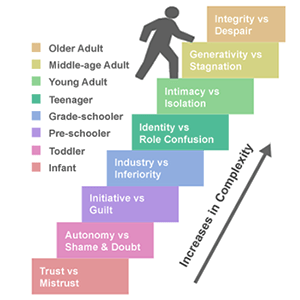
Erikson’s stages of psychosocial development are eight stages through which a healthily developing human should pass from infancy to late adulthood, according to neo-Freudian psychologist Erik Erikson. In each stage the person confronts, and hopefully masters, new challenges. Each stage builds on the successful completion of earlier stages. The challenges of stages not successfully completed may be expected to reappear as problems in the future. However, mastery of a stage is not required to advance to the next stage.
Erikson’s stage theory characterizes an individual advancing through the eight life stages as a function of negotiating his or her biological forces and sociocultural forces. Each stage is characterized by a psycho social crisis of these two conflicting forces. If an individual does indeed successfully reconcile these forces (favoring the first mentioned attribute in the crisis), he or she emerges from the stage with the corresponding virtue. For example, if an infant enters into the toddler stage (autonomy vs. shame & doubt) with more trust than mistrust, he or she carries the virtue of hope into the remaining life stages.
read more »
Posted in Health, Philosophy, Science |
Leave a Comment »
October 24, 2012
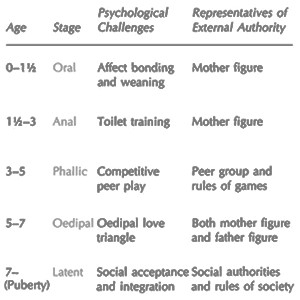
In Freudian psychology, psychosexual development is a central element of the psychoanalytic sexual drive theory, that human beings, from birth, possess an instinctual libido (sexual appetite) that develops in five stages.
Each stage — the oral, the anal, the phallic, the latent, and the genital — is characterized by the erogenous zone that is the source of the libidinal drive. Sigmund Freud proposed that if the child experienced sexual frustration in relation to any psychosexual developmental stage, s/he would experience anxiety that would persist into adulthood as a neurosis, a functional mental disorder.
read more »
Posted in Health, Sex |
Leave a Comment »
October 23, 2012

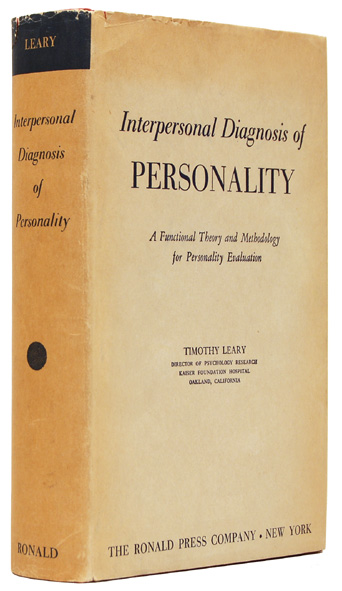
Interpersonal reflex is a term created by Timothy Leary and explained in the book, ‘Interpersonal Diagnosis of Personality: A functional theory and methodology for personality evaluation’ (1957). While examining recorded protocols of communications in adults, Leary discovered that typical patterns of interaction existed. Individual units of these behaviors were called interpersonal mechanisms or interpersonal reflexes: ‘They are defined as the observable, expressive units of face-to-face social behavior.’ These reflexes are automatic and involuntary responses to interpersonal situations. They are independent of the content of the communication. They are the individual’s spontaneous methods of reacting to others.
Leary states, ‘The reflex manner in which human beings react to others and train others to respond to them in selective ways is, I believe, the most important single aspect of personality. The systematic estimates of a patient’s repertoire of interpersonal reflexes is a key factor in functional diagnosis.’ Examining interpersonal reflexes helps to explain communication and behavioral patterns in healthy and unhealthy relationships. For example, tender, supportive operations tend to train others to agree, conciliate, and depend. Rigid autocratic individuals seek out docile admiring followers. Competitive, self-enhancing behavior pulls envy, distrust, inferiority feelings, and at times respectful admiration from others.
Posted in Health, Philosophy, Science |
Leave a Comment »
October 23, 2012

The interpersonal circumplex is a model for conceptualizing, organizing, and assessing interpersonal behavior, traits, and motives. It is defined by two orthogonal axes: a vertical axis (of status, dominance, power, or control) and a horizontal axis (of solidarity, friendliness, warmth, or love).
In recent years, it has become conventional to identify the vertical and horizontal axes with the broad constructs of agency and communion. Thus, each point in the interpersonal circumplex space can be specified as a weighted combination of agency and communion.
read more »
Posted in Health, Philosophy, Science |
Leave a Comment »
October 23, 2012

Indra’s net (also called ‘Indra’s jewels’ or ‘Indra’s pearls’) is a metaphor used to illustrate the concepts of emptiness, dependent origination (all things arise in dependence upon multiple causes and conditions), and interpenetration (all phenomena are intimately connected — and mutually arising) in Buddhist philosophy. The metaphor of Indra’s net was developed by the Mahayana Buddhist school in the 3rd century scriptures of the ‘Avatamsaka Sutra,’ and later by the Chinese Huayan school between the 6th and 8th century.
For the Huayan school, Indra’s net symbolizes a universe where infinitely repeated mutual relations exist among all members of the universe. This idea is communicated in the image of the interconnectedness of the universe as seen in the net of the Vedic god Indra, which hangs over his palace on Mount Meru, the axis mundi of Vedic cosmology and Vedic mythology. Indra’s net has a multifaceted jewel at each vertex, and each jewel is reflected in all of the other jewels.
read more »
Posted in Philosophy |
Leave a Comment »
October 23, 2012

The eight-circuit model of consciousness is a transhuman (an intermediary form between the human and a hypothetical posthuman) theory proposed by Timothy Leary and expanded on by Robert Anton Wilson and Antero Alli. The model describes eight circuits of information (eight ‘brains’) that operate within the human nervous system.
Each circuit is concerned with a different sphere of activity. The lower four, the ‘larval circuits,’ deal with normal psychology, while the upper four, the ‘stellar circuits,’ deal with psychic, mystical, enlightened and psychedelic states of mind.
read more »
Posted in Drugs, Health, Philosophy |
Leave a Comment »
October 23, 2012

Mind at Large is a concept from ‘The Doors of Perception’ and ‘Heaven and Hell’ by Aldous Huxley. This philosophy was influenced by the ideas of philosopher and historian C. D. Broad. Psychedelic drugs are thought to disable filters which block or suppress signals related to mundane functions from reaching the conscious mind.
In this book, Huxley explores the idea that the human mind filters reality, partly because handling the details of all of the impressions and images coming in would be unbearable, partly because it has been taught to do so. He believes that psychotropic drugs can partly remove this filter, which leaves the drug user exposed to ‘Mind at Large.’
read more »
Posted in Drugs, Philosophy |
1 Comment »
October 23, 2012

Hallucinogens [huh-loo-suh-nuh-juhns] are drugs which can cause hallucinations (seeing, hearing, or otherwise perceiving things that are not real). They are a general group of pharmacological agents that can be divided into three broad categories: psychedelics (drugs with perception-altering effects), dissociatives (drugs that produce feelings of detachment – dissociation – from the environment and self), and deliriants (drugs that induce a state of delirium in the user).
These classes of psychoactive drugs have in common that they can cause subjective changes in perception, thought, emotion and consciousness. Unlike other psychoactive drugs, such as stimulants and opioids, these drugs do not merely amplify familiar states of mind, but rather induce experiences that are qualitatively different from those of ordinary consciousness. These experiences are often compared to non-ordinary forms of consciousness such as trance, meditation, dreams, or insanity.
read more »
Posted in Drugs, Health, Philosophy |
Leave a Comment »
October 23, 2012


Psychedelic therapy refers to therapeutic practices involving the use of psychedelic drugs, particularly serotonergic psychedelics such as LSD, psilocybin, DMT, and 2C-B. As an alternative to synonyms such as ‘hallucinogen,’ ‘entheogen,’ ‘psychotomimetic’ and other functionally constructed names, the use of the term ‘psychedelic’ (‘mind-manifesting’) emphasizes that those who use these drugs as part of a therapeutic practice believe these drugs can facilitate beneficial exploration of the psyche.
Proponents of psychedelic therapy also believe psychedelics enhance or unlock key psychoanalytic abilities, and so make it easier for conventional psychotherapy to take place. Psychedelic therapy, in the broadest possible sense of the term, undoubtedly dates from prehistoric knowledge of hallucinogenic plants. Though usually viewed as predominantly spiritual in nature, elements of psychotherapeutic practice can be recognized in the entheogenic or shamanic rituals of many cultures. Shamans have historically been well known throughout the world to mix two or more substances to produce synergistic effects.
read more »
Posted in Drugs, Health, Politics |
Leave a Comment »
October 22, 2012

The Thule Society (originally the ‘Study Group for Germanic Antiquity’) was a German occultist and völkisch (popularist) group in Munich, named after a mythical northern country from Greek legend. The Society is notable chiefly as the organization that sponsored the Deutsche Arbeiterpartei (DAP), which was later reorganized by Adolf Hitler into the National Socialist German Workers’ Party (Nazi).
According to Hitler biographer Ian Kershaw, the organization’s ‘membership list…reads like a ‘Who’s Who’ of early Nazi sympathizers and leading figures in Munich,’ including Rudolf Hess, Alfred Rosenberg, Hans Frank, Julius Lehmann, Gottfried Feder, Dietrich Eckart, and Karl Harrer. However, Nicholas Goodrick-Clarke, an expert on the Thule Society, finds that while Hans Frank and Rudolf Hess had been Thule members, other leading Nazis had only been guests of the Thule or entirely unconnected with it. There is no evidence that Hitler ever attended the Thule Society. It is quite clear that Hitler himself had little interest in, and made little time for, ‘esoteric matters.’
read more »
Posted in Philosophy, War |
Leave a Comment »
October 22, 2012

In photography and cinematography, a multiple exposure is the superimposition of two or more exposures to create a single image, and double exposure has a corresponding meaning in respect of two images. The exposure values may or may not be identical to each other. Ordinarily, cameras have a sensitivity to light that is a function of time. For example, a one second exposure is an exposure in which the camera image is equally responsive to light over the exposure time of one second. The criterion for determining that something is a double exposure is that the sensitivity goes up and then back down.
The simplest example of a multiple exposure is a double exposure without flash, i.e. two partial exposures are made and then combined into one complete exposure. Some single exposures, such as ‘flash and blur’ use a combination of electronic flash and ambient exposure. Multiple exposures are sometimes used as an artistic visual effect or to create ghostly images (it is frequently used in photographic hoaxes).
Posted in Art, Technology |
2 Comments »


 The Daily Omnivore