
The Closing of the American Mind is a 1987 book by American philosopher Allan Bloom. It describes ‘how higher education has failed democracy and impoverished the souls of today’s students.’ He focuses especially upon the ‘openness’ of relativism as leading paradoxically to the great ‘closing’ referenced in the book’s title.
Bloom argues that ‘openness’ and absolute understanding undermines critical thinking and eliminates the ‘point of view’ that defines cultures. According to Bloom: ‘Education in our times must try to find whatever there is in students that might yearn for completion, and to reconstruct the learning that would enable them autonomously to seek that completion.’
read more »
October 21, 2012
The Closing of the American Mind
October 20, 2012
Food Microbiology
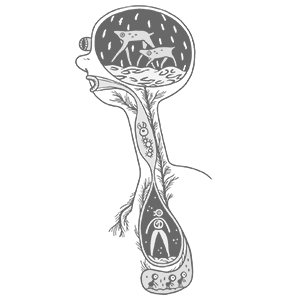
Food microbiology is the study of the microorganisms that inhabit, create, or contaminate food. Including the study of microorganisms causing food spoilage. ‘Good’ bacteria, however, such as probiotics, are becoming increasingly important in food science. In addition, microorganisms are essential for the production of foods such as cheese, yogurt, other fermented foods, bread, beer and wine. Food safety is a major focus of food microbiology. Pathogenic bacteria, viruses, and toxins produced by microorganisms are all possible contaminants of food.
However, microorganisms and their products can also be used to combat these pathogenic microbes. Probiotic bacteria, including those that produce bacteriocins (toxins created by bacteria to kill rival bacteria), can inhibit pathogens. Alternatively, purified bacteriocins such as nisin can be added directly to food products. Finally, bacteriophages, viruses that only infect bacteria, can be used to kill bacterial pathogens. Thorough preparation of food, including proper cooking, eliminates most bacteria and viruses. However, toxins produced by contaminants may not be heat-labile, and some are not eliminated by cooking
read more »
October 19, 2012
Century Egg

Century egg (‘pidan,’ also known as preserved egg and millennium egg) is a Chinese cuisine ingredient made by preserving fowl eggs in a mixture of clay, ash, salt, quicklime (calcium oxide), and rice hulls for several weeks to several months, depending on the method of processing. Through the process, the yolk becomes a dark green to gray color with a creamy consistency and an odor of sulfur and ammonia, while the white becomes a dark brown, translucent jelly with little flavor.
The transforming agent in the century egg is its alkaline material, which gradually raises the pH of the egg to around 9, 12, or more during the curing process. This chemical process breaks down some of the complex, flavorless proteins and fats, which produces a variety of smaller flavorful compounds. Some eggs have fungal patterns near the surface of the egg white that are likened to pine branches, and that gives rise to one of its Chinese names, the ‘pine-patterned egg.’
read more »
October 19, 2012
Pickling

Pickling, also known as ‘brining’ or ‘corning,’ is the process of preserving food with acid. Pickling began 4000 years ago using cucumbers native to India. It is called ‘achar’ in northern India. This was used as a way to preserve food for out-of-season use and for long journeys, especially by sea. Salt pork and salt beef were common staples for sailors before the days of steam engines. Although the process was invented to preserve foods, pickles are also made and eaten because people enjoy the resulting flavors.
Pickling may also improve the nutritional value of food by introducing B vitamins produced by bacteria (when pickled in a process utilizing fermentation). The term ‘pickle’ is derived from the Dutch word ‘pekel,’ meaning ‘brine’ (salt water). In the U.S. Canada, and Australia the word ‘pickle’ alone almost always refers to a pickled cucumber (other types of pickles will be described as ‘pickled onion,’ ‘pickled cauliflower,’ etc.), except when it is used figuratively. In the UK, ‘pickle’ refers to Ploughman’s pickle, a kind of chutney; a pickled cucumber is referred to as a ‘gherkin.’
read more »
October 19, 2012
Fermentation

Fermentation [fur-men-tey-shuhn] is when a living cell uses sugar for energy without requiring oxygen. Yeast is an organism that ferments. When yeast ferments sugar, the yeast eats sugar and makes alcohol. Other organisms (such as bacteria) make vinegar (acetic acid) or lactic acid when they ferment sugar. Fermentation is used to make beer, some types of fuel, and to make bread rise. When yeast ferments, it breaks down the glucose into ethanol and carbon dioxide.
Ethanol fermentation always produces ethanol and carbon dioxide. It is important in bread-making, brewing, and winemaking. Lactic acid fermentation produces lactic acid. It happens in muscles of animals when they need lots of energy fast, and is also used to preserve foods in pickling. The word ‘fermentation’ is derived from the Latin verb ‘fervere,’ which means ‘to boil’ (same root as ‘effervescence’). It is thought to have been first used in the late fourteenth century in alchemy, but only in a broad sense. It was not used in the modern scientific sense until around 1600.
read more »
October 18, 2012
Recapitulation Theory

The theory of recapitulation [ree-kuh-pich-uh-ley-shuhn] is often known as ‘ontogeny recapitulates phylogeny.’ It was an idea of French physician Étienne Serres in 1824. In 1886 German biologist Ernst Haekel proposed that the embryonic development of an individual organism (its ontogeny) followed the same path as the evolutionary history of its species (its phylogeny). It is also called the ‘biogenetic law’ or ’embryological parallelism.’
It was a theory that tied evolution (change in organisms over time) with embryology (the way organisms develop before they are born). The theory basically stated that before they are born, organisms pass through developmental stages that look like adult animals of other species, in roughly the same order that these other species split off during evolution. Although there is something to this idea, it is no longer thought to be such a useful way to look at development.
read more »
October 18, 2012
Phylogeny
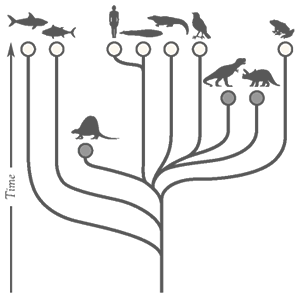
In biology, phylogeny [fahy-loj-uh-nee] refers to the evolutionary relationships among groups of organisms (e.g. species, populations). The term ‘phylogenetics’ derives from the Greek terms ‘phyle’ and ‘phylon,’ denoting ‘tribe’ and ‘race’; and the term ‘genetikos,’ denoting ‘relative to birth,’ from ‘genesis’ (‘origin’). The result of phylogenetic studies is a hypothesis about the evolutionary history of taxonomic groups. Phylogenetic analyses have become essential in researching the evolutionary tree of life. The overall goal of National Science Foundation’s Assembling the Tree of Life activity (AToL) is to resolve evolutionary relationships for large groups of organisms throughout the history of life, with the research often involving large teams working across institutions and disciplines.
Taxonomy, the classification, identification, and naming of organisms, is usually richly informed by phylogenetics, but remains methodologically and logically distinct. The degree to which taxonomy depends on phylogenies differs between schools of taxonomy: ‘numerical taxonomy’ ignored phylogeny altogether, trying to represent the similarity between organisms instead; ‘phylogenetic systematics’ tries to reproduce phylogeny in its classification without loss of information; ‘evolutionary taxonomy’ tries to find a compromise between them in order to represent stages of evolution.
read more »
October 18, 2012
Calvinball

Calvinball is a game played by Calvin and Hobbes as a rebellion against organized team sports; according to Hobbes, ‘No sport is less organized than Calvinball!’ The game was first introduced to the readers at the end of a 1990 storyline involving Calvin reluctantly joining recess baseball. It quickly became a staple of the comic afterwards.
The only hint at the true creation of the sport ironically comes from the last Calvinball strip, in which a game of football quickly devolves into a game of Calvinball. Calvin remarks that ‘sooner or later, all our games turn into Calvinball,’ Calvin and Hobbes usually play by themselves, although in one storyline Rosalyn (Calvin’s babysitter) plays in return for Calvin doing his homework, and plays very well once she realizes that the rules are made up on the spot.
read more »
October 18, 2012
Nomic

Nomic is a game created in 1982 by philosopher Peter Suber in which the rules of the game include mechanisms for the players to change those rules, usually beginning through a system of democratic voting. According to Suber, the primary activity of Nomic is proposing changes in the rules, debating the wisdom of changing them in that way, voting on the changes, deciding what can and cannot be done afterwards, and doing it. Even this core of the game, of course, can be changed.’
The term ‘nomic’ actually refers to a large number of games based on the initial ruleset laid out by Suber in his book ‘The Paradox of Self-Amendment. The game is in some ways modeled on modern government systems. It demonstrates that in any system where rule changes are possible, a situation may arise in which the resulting laws are contradictory or insufficient to determine what is in fact legal. Because the game models (and exposes conceptual questions about) a legal system and the problems of legal interpretation, it is named after ‘nomos,’ the Greek word for ‘law.’
read more »
October 18, 2012
Metagaming

Metagaming is a broad term usually used to define any strategy, action or method used in a game which transcends a prescribed ruleset, uses external factors to affect the game, or goes beyond the supposed limits or environment set by the game. Another definition refers to the game universe outside of the game itself. In simple terms, it is the use of out-of-game information or resources to affect one’s in-game decisions.
The term metagame arose in mathematics, passed to military use, and then to politics to describe actions or events that may have been originally thought of as outside the bounds of the situation in question, but that in fact play an important role in its outcome. For example, a specific military operation could be thought of as a game, with the political ramifications of that operation on the war in general as the metagame.
read more »
October 18, 2012
Cheating in Video Games

Cheating in video games involves a player using non-standard methods for creating an advantage beyond normal gameplay, usually to make the game easier. Cheats sometimes may take the form of ‘secrets’ placed by game developers themselves. Cheats may be activated from within the game itself (‘cheat code’ implemented by the original game developers); or created by third-party software (‘game trainer’) or hardware (‘cheat cartridge’).
They can also be realized by exploiting software bugs. Cheating in video games has existed for almost their entire history. The first cheat codes were put in place for play testing purposes. Playtesters had to rigorously test the mechanics of a game and introduced cheat codes to make this process easier. An early cheat code can be found in ‘Manic Miner,’ where typing ‘6031769’ (based on developer Matthew Smith’s driving licence) enables the cheat mode.
read more »
October 18, 2012
Gaming Etiquette

Gaming etiquette refers to the norms adopted while playing multi-player video games. While specific genres and games have their own accepted rules of conduct, some of these rules are universal across almost all games. Regardless of the game, certain behaviors are universally encouraged or discouraged.
Cheating is almost never acceptable unless all players agree it should be allowed, as it causes the game to become unfair and detracts from the enjoyment of legitimate players.
read more »


 The Daily Omnivore