October 14, 2012

The Kill A Watt is an electricity usage monitor marketed by P3 International. It features a large LCD display and it enables cost forecasting.
It measures the energy used by individual appliances plugged into the meter, as opposed to in-home energy use displays, which display the energy used by an entire household. The name is a play on the word kilowatt. The device can give an indication of the standby power used by appliances.
Posted in Money, Technology |
Leave a Comment »
October 13, 2012

The music for Law & Order is composed by veteran composer Mike Post. The music is deliberately designed to be minimalist to match the abbreviated style of the series. Post wrote the theme song using electric piano, guitar, and clarinet. In addition, scene changes are accompanied by a tone generated by Post. He refers to the tone as ‘The Clang,’ while ‘Entertainment Weekly’ critic Ken Tucker has referred to the sound as the ‘ominous chung CHUNG,’ actor Dann Florek (in a promo) as the ‘doink doink,’ and Richard Belzer as ‘the Dick Wolf Cash Register Sound.’
The tone moves the viewer from scene to scene, jumping forward in time with all the importance and immediacy of a judge’s gavel – which is exactly what composer Mike Post was aiming for when he created it. ‘The Clang’ is an amalgamation of nearly a dozen sounds, including an actual gavel, a jail door slamming, and five hundred Japanese monks walking across a hardwood floor. The sound has become so associated with the ‘Law & Order’ brand that it was also carried over to other series of the franchise.
Posted in Art |
Leave a Comment »
October 13, 2012

Fallibilism [fal-uh-buhl-iz-uhm] (‘liable to err’) is the philosophical principle that human beings could be wrong about their beliefs, expectations, or their understanding of the world. In the most commonly used sense of the term, this consists in being open to new evidence that would disprove some previously held position or belief, and in the recognition that ‘any claim justified today may need to be revised or withdrawn in light of new evidence, new arguments, and new experiences.’
This position is taken for granted in the natural sciences. In another sense, it refers to the consciousness of ‘the degree to which our interpretations, valuations, our practices, and traditions are temporally indexed’ and subject to (possibly arbitrary) historical flux and change. Such ‘time-responsive’ fallibilism consists in an openness to the confirmation of a possibility that one anticipates or expects in the future.
read more »
Posted in Philosophy, Science |
1 Comment »
October 12, 2012

Perfecto is a brand of ‘lancer fronted’ leather motorcycle jackets designed by Irving Schott and manufactured by American clothing company Schott NYC. The company was founded in 1913, and was the first company to put a zipper on a jacket. In 1928 Irving Schott designed and produced the first ever leather motorcycle jacket, he named it the ‘Perfecto’ after his favorite cigar.
The jackets were made out of horsehide, had a belted front, D-pocket, flap change pocket, zippered sleeve cuffs and shoulder epaulets This classic motorcycle jacket was a double riders jacket design which meant that one part of the front zipper was located a couple of inches in. When zipped up this created a seal where no air would pass through when riding a motorcycle.
read more »
Posted in Money |
Leave a Comment »
October 11, 2012
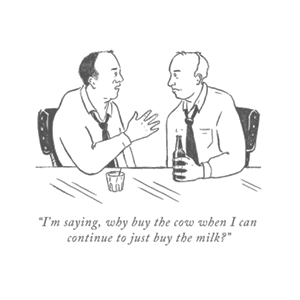
Sexual economy refers to the resources men offer to women in order to acquire sex. In this sense the heterosexual community is considered as a marketplace where sex is bought and sold. The marketplace is defined by gender roles, and in the sex economy men are the buyers, and women are the sellers.
Couples and their sexual activities are loosely interrelated by a marketplace; the decisions made regarding sex by each couple may be influenced by conditions in the market. As with all economic principles, price is determined by supply and demand, product variety, complicity among sellers, competition between sellers, as well as other factors. The price of sex is not limited to money, it has a wide conception of resources including, respect, love, time, gifts, affection, or commitment.
read more »
Posted in Love, Money, Sex |
1 Comment »
October 11, 2012

In Marxist theory, human society consists of two parts: the base and superstructure; the base comprehends the forces and relations of production — employer-employee work conditions, the technical division of labor and property relations — into which people enter to produce the necessities and amenities of life.
These relations determine society’s other relationships and ideas, which are described as its superstructure: its culture, institutions, political power structures, roles, rituals, and state. The base determines (conditions) the superstructure, yet their relation is not strictly causal, because the superstructure often influences the base; the influence of the base, however, predominates. In Orthodox Marxism, the base determines the superstructure in a one-way relationship. However, in more advanced forms and variations of Marxist thought their relationship is not strictly one-way, as some theories claim that just as the base influences the superstructure, the superstructure also influences the base.
read more »
Posted in Money, Politics |
Leave a Comment »
October 11, 2012

In sociology, articulation labels the process by which particular classes appropriate cultural forms and practices for their own use. The term appears to have originated from the work of Italian political theorist Antonio Gramsci, specifically from his conception of ‘superstructure’ (culture, institutions, political power structures, roles, rituals, and state, which are supported by the ‘base,’ the forces and relations of production). In this theory, cultural forms and practices have relative autonomy; socio-economic structures of power do not determine them, but rather they relate to them.
‘The theory of articulation recognizes the complexity of cultural fields. It preserves a relative autonomy for cultural and ideological elements (…) but also insists that those combinatory patterns that are actually constructed do mediate deep, objective patterns in the socio-economic formation, and that the mediation takes place in struggle: the classes fight to articulate together constituents of the cultural repe[r]toire in particular ways so that they are organized in terms of principles or sets of values determined by the position and interests of the class in the prevailing mode of production.’
read more »
Posted in Politics, Science, World |
1 Comment »
October 10, 2012

Rockism is a term referring to perceived biases in popular music criticism, coined by UK singer songwriter Pete Wylie in the early 1980s. The fundamental tenet of rockism is that some forms of popular music, and some musical artists, are more authentic than others. While there are many vague interpretations of it, rockism is essentially believed to treat rock music as normative.
From a rockist view, rock is the standard state of popular music. Interestingly, it is not entirely rockist to love rock, or to write about it. One may also care about R&B or norteño or bubblegum pop, but discuss them in a rockist way. The idea is built into the way people talk informally about what kinds of popular music interest them. Rockism is often suspicious of the use of computer-based production systems.
read more »
Posted in Art, Language, Money |
1 Comment »
October 10, 2012

Assemblage [uh-sem-blij] refers to a text ‘built primarily and explicitly from existing texts in order to solve a writing or communication problem in a new context.’ The concept was first proposed by Johndan Johnson-Eilola (author of ‘Datacloud’) and Stuart Selber in the journal, ‘Computers & Composition,’ in 2007. The notion of assemblages builds on remix practices, which blur distinctions between invented and borrowed work.
Johnson-Eilola and Selber discuss the intertextual nature of writing, and they assert that participation in existing discourse necessarily means that composition cannot occur separate from that discourse. They state that ‘productive participation involves appropriation and re-appropriation of the familiar’ in a manner that conforms to existing discourse and audience expectations.
read more »
Posted in Art, Education, Language |
Leave a Comment »
October 10, 2012

The Adventures of Tintin: Breaking Free is an anarchist parody of the popular Tintin series of comics. An exercise in detournement (turning expressions of the capitalist system and its media culture against itself), the book was written under the pseudonym J. Daniels and published by Attack International in 1988. It has recently been re-printed by anarchist publishers Freedom Press which includes for the first time Tintin’s earlier adventures during the Wapping dispute as told in ‘The Scum,’ a 1986 pamphlet which was produced in solidarity with the printworkers.
The story features a number of characters based on those from the original series by Hergé, notably Tintin himself and Captain Haddock (referred to only as ‘the Captain’ and depicted here as being Tintin’s uncle), but not the original themes or plot. Snowy is featured on the cover – being especially visible on the first edition’s cover – but not in the narrative. The story tracks Tintin’s development from a disaffected, shoplifting youth to a revolutionary leader.
read more »
Posted in Humor, Money, Politics |
Leave a Comment »
October 10, 2012
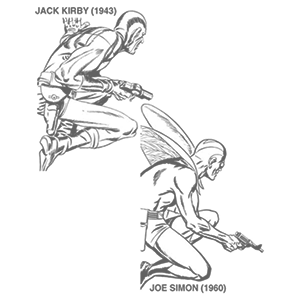
Swipe is a comics term that refers to the intentional copying of a cover, panel, or page from an earlier comic book or graphic novel without crediting the original artist.
Artists Jack Kirby, Neal Adams, Hergé, and Jim Lee are common targets of swipes (though even ‘The King’ is not above reproach: Kirby was known to have swiped from Hal Foster early in his career, as were many Golden Age artists — many of whom kept ‘swipe files’ of material to be copied as needed).
read more »
Posted in Art, Language, Money |
Leave a Comment »
October 10, 2012
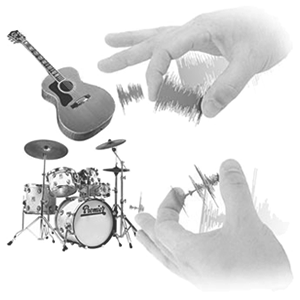
In music, sampling is the act of taking a portion, or sample, of one sound recording and reusing it as an instrument or a sound recording in a different song or piece. Sampling was originally developed by experimental musicians working with musique concrète and electroacoustic music, who physically manipulated tape loops or vinyl records on a phonograph.
In the late 1960s, the use of tape loop sampling influenced the development of minimalist music and the production of psychedelic rock and jazz fusion. In the 1970s, DJs manipulating vinyl on turntables gave birth to hip hop music, the first popular music genre based originally around the art of sampling.
read more »
Posted in Money, Politics, Technology |
Leave a Comment »


 The Daily Omnivore