October 10, 2012

Beatboxing is a form of vocal percussion primarily involving the art of producing drum beats, rhythm, and musical sounds using one’s mouth, lips, tongue, and voice. It may also involve singing, vocal imitation of turntablism, and the simulation of horns, strings, and other musical instruments.
Beatboxing today is connected with hip-hop culture, being one of ‘the elements,’ although it is not limited to hip-hop music.
read more »
Posted in Art, Language |
Leave a Comment »
October 10, 2012

Freestyle is a style of a cappella rap, with instrumental beats, in which rap lyrics are improvised, i.e. performed with no previously composed lyrics, or ‘off the top of the head.’ It is similar to other improvisational music such as jazz – Myka 9 of Freestyle Fellowship describes it as being ‘like a jazz solo’ where there is a lead saxophonist acting as the improviser and the rest of the band providing the beat. Rap battles are sometimes improvised in this way.
It is similar in both form and function to the ancient practice of flyting (contest consisting of the exchange of insults). Originally, in old school hip hop of the 1980s, the term ‘freestyle’ referred to a pre-written rap verse that was not on any particular subject matter, but rather was written for the purpose of demonstrating skill. The term is still occasionally used in this way, though since the 1990s, the majority of today’s artists use it to mean improvised rapping.
read more »
Posted in Art, Games, Language |
Leave a Comment »
October 10, 2012

The Dozens is a game of spoken words between two contestants, common in Hip-hop/Urban communities, where participants insult each other until one gives up or violence erupts. It is customary for the Dozens to be played in front of an audience of bystanders, who encourage the participants to reply with more egregious insults to heighten the tension and consequently, to be more interesting to watch. It is also known as ‘sounding,’ ‘joning,’ ‘woofing,’ ‘sigging,’ or ‘signifying,’ while the insults themselves are known as ‘snaps.’
The origin of the game is unclear, but it has roots in Africa: similar contests are held in Nigeria among the Igbo people, and in Ghana. Comments in the game focus on the opposite player’s intelligence, appearance, competency, social status, financial situation, and disparaging remarks about the other player’s family members—mothers in particular (‘yo′ mama…’)—are common. Commentary is often related to sexual issues, where the game is then referred to as the ‘Dirty Dozens.’
read more »
Posted in Games, Humor, Language |
Leave a Comment »
October 10, 2012

A roast is an event, almost exclusively in the United States, in which an individual is subjected to a public presentation of comedic insults, praise, outlandish true and untrue stories, and heartwarming tributes, the implication being that the roastee is able to take the jokes in good humor and not as serious criticism or insult, and therefore, show their good nature.
It is seen by some as a great honor to be roasted, as the individual is surrounded by friends, fans, and well-wishers, who can receive some of the same treatment as well during the course of the evening. The party and presentation itself are both referred to as a ‘roast.’ The host of the event is called the ‘roastmaster.’ Anyone who is honored in such a way is said to have been ‘roasted.’
read more »
Posted in Games, Humor, Language |
Leave a Comment »
October 10, 2012

Mustard is a condiment made from the seeds of a mustard plant (white or yellow mustard, brown or Indian mustard, or black mustard). The whole, ground, cracked, or bruised mustard seeds are mixed with water, salt, lemon juice, or other liquids, and sometimes other flavorings and spices, to create a paste or sauce ranging in color from bright yellow to dark brown. English mustard is among the strongest, made from only mustard flour, water, salt and, sometimes, lemon juice; but not with vinegar.
French-style Dijon mustard has added vinegar, and is milder. Bavarian sweet mustard is milder still. Homemade mustards are often far hotter and more intensely flavored than commercial preparations. A strong mustard can cause the eyes to water, sting the palate, and inflame the nasal passages and throat. Mustard can also cause allergic reactions. As a cream or a seed, mustard is used in the cuisine of India, the Mediterranean, northern Europe, the Balkan States, Asia, North America, and Africa, making it one of the most popular and widely used spices and condiments in the world.
read more »
Posted in Food, World |
Leave a Comment »
October 9, 2012

A powered exoskeleton, also known as powered armor, or exoframe, is a powered mobile machine consisting primarily of an exoskeleton-like framework worn by a person and a power supply that supplies at least part of the activation-energy for limb movement. Powered exoskeletons are designed to assist and protect the wearer. They may be designed, for example, to assist and protect soldiers and construction workers, or to aid the survival of people in other dangerous environments. A wide medical market exists in the future of prosthetics to provide mobility assistance for aged and infirm people.
Other possibilities include rescue work, such as in collapsed buildings, in which the device might allow a rescue worker to lift heavy debris, while simultaneously protecting the worker from falling rubble. A fictional ‘mech’ is different from a powered exoskeleton in that the mecha is typically much larger than a normal human body, and does not directly enhance the motion or strength of the physical limbs. Instead the human operator occupies a cabin or pilot’s control seat inside a small portion of the larger system. Within this cabin the human may wear a small lightweight exoskeleton that serves as a haptic control interface for the much larger exterior appendages.
read more »
Posted in Health, Technology, War |
Leave a Comment »
October 9, 2012

‘Conversion therapy‘ (also known as ‘Reparative therapy’) is a pseudo-scientific therapy that aims to change sexual orientation. Mainstream American medical and scientific organizations have expressed concern over conversion therapy and consider it potentially harmful. The advancement of conversion therapy may cause social harm by disseminating inaccurate views about sexual orientation. As a result, conversion therapy on minors is illegal in California.
The American Psychiatric Association has condemned psychiatric ‘treatment’ which is ‘based upon the assumption that homosexuality per se is a mental disorder or based upon the a priori assumption that a patient should change his/her sexual homosexual orientation.’ It states that, ‘Ethical practitioners refrain from attempts to change individuals’ sexual orientation.’ And that political and moral debates over the integration of gays and lesbians into the mainstream of American society have obscured scientific data about changing sexual orientation ‘by calling into question the motives and even the character of individuals on both sides of the issue.’
read more »
Posted in Health, Philosophy, Sex |
1 Comment »
October 9, 2012
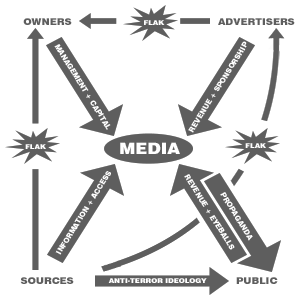
The propaganda model is a conceptual model in political economy advanced by Edward S. Herman and Noam Chomsky that states how propaganda, including systemic biases, function in mass media. The model seeks to explain how populations are manipulated and how consent for economic, social and political policies is ‘manufactured’ in the public mind due to this propaganda. The theory posits that the way in which news is structured (through advertising, media ownership, government sourcing and others) creates an inherent conflict of interest which acts as propaganda for undemocratic forces.
First presented in their 1988 book ‘Manufacturing Consent: The Political Economy of the Mass Media,’ the ‘propaganda model’ views the private media as businesses interested in the sale of a product—readers and audiences—to other businesses (advertisers) rather than that of quality news to the public. Describing the media’s ‘societal purpose,’ Chomsky writes, ‘… the study of institutions and how they function must be scrupulously ignored, apart from fringe elements or a relatively obscure scholarly literature.’
read more »
Posted in Language, Money, Politics |
3 Comments »
October 9, 2012
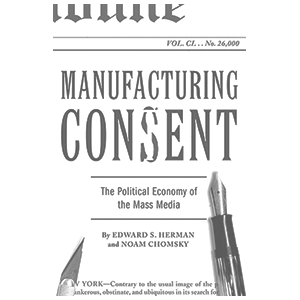
‘Manufacturing Consent: The Political Economy of the Mass Media’ (1988), by Edward S. Herman and Noam Chomsky, is an analysis of the news media, arguing that the mass media of the United States ‘are effective and powerful ideological institutions that carry out a system-supportive propaganda function by reliance on market forces, internalized assumptions, and self-censorship, and without overt coercion.’
The title derives from the phrase ‘the manufacture of consent’ that essayist–editor Walter Lippmann employed in the book ‘Public Opinion’ (1922). Chomsky has said that Australian social psychologist Alex Carey, to whom the book was dedicated, was in large part the impetus of his and Herman’s work. The book introduced the propaganda model of the media. A film, ‘Manufacturing Consent: Noam Chomsky and the Media,’ was later released based on the book.
read more »
Posted in Language, Money, Politics |
1 Comment »
October 9, 2012

Repressive desublimation [dih-suhb-luh-mey-shuhn] is a term first coined by philosopher and sociologist Herbert Marcuse in his 1964 work ‘One-Dimensional Man, ‘that refers to the way in which, in advanced capitalism, ‘sexuality is liberated (or rather liberalized) in socially constructive forms’ so as to serve, rather than to challenge, forms of social control.
Instead of acting against the social order (as the repressive hypothesis would suggest), sexual liberation was thus co-opted to support the status quo, through the undoing of sublimations (the conversion of negative impulses into positive behavior) and the release of pleasure in socially approved forms.
read more »
Posted in Politics |
Leave a Comment »
October 9, 2012
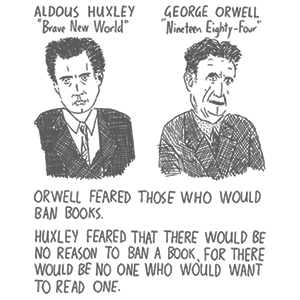
‘Amusing Ourselves to Death: Public Discourse in the Age of Show Business’ (1985) is a book by educator Neil Postman. The book’s origins lie in a talk Postman gave to the Frankfurt Book Fair in 1984. He was participating in a panel on Orwell’s ‘1984’ and the contemporary world. In the introduction to his book Postman said that the contemporary world was better reflected by Aldous Huxley’s ‘Brave New World,’ whose public was oppressed by their addiction to amusement, than by Orwell’s ‘Nineteen Eighty-Four,’ where they were oppressed by state control. It is regarded as one of the most important texts of media ecology (the study of how communication processes affect human perception).
Postman distinguishes the Orwellian vision of the future, in which totalitarian governments seize individual rights, from that offered by Aldous Huxley in ‘Brave New World,’ where people medicate themselves into bliss, thereby voluntarily sacrificing their rights. Drawing an analogy with the latter scenario, Postman sees television’s entertainment value as a present-day ‘soma,’ by means of which the consumers’ rights are exchanged for entertainment. (Note that there is no contradiction between an intentional ‘Orwellian’ conspiracy using ‘Huxleyan’ means)
read more »
Posted in Language, Money |
Leave a Comment »
October 9, 2012
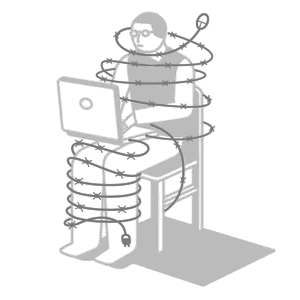
‘Technopoly: The Surrender of Culture to Technology’ is a book by Neil Postman published in 1992 that describes a society in which technology is deified, meaning ‘the culture seeks its authorization in technology, finds its satisfactions in technology, and takes its orders from technology.’ It is characterized by a surplus of information generated by technology, which technological tools are in turn employed to cope with, in order to provide direction and purpose for society and individuals. Postman considers technopoly to be the most recent of three kinds of cultures distinguished by shifts in their attitude towards technology – tool-using cultures, technocracies, and technopolies.
Each, he says, is produced by the emergence of new technologies that ‘compete with old ones…mostly for dominance of their worldviews.’ According to Postman, a tool-using culture employs technologies only to solve physical problems, as spears, cooking utensils, and water mills do, and to ‘serve the symbolic world’ of religion, art, politics and tradition, as tools used to construct cathedrals do. He claims that all such cultures are either theocratic or ‘unified by some metaphysical theory,’ which forced tools to operate within the bounds of a controlling ideology and made it ‘almost impossible for technics to subordinate people to its own needs.’
read more »
Posted in Language, Philosophy, Technology |
Leave a Comment »


 The Daily Omnivore
