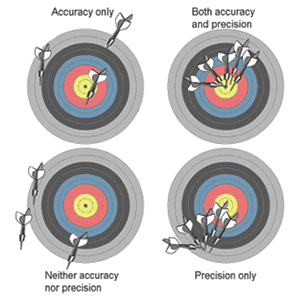
The accuracy of a measurement system is the degree of closeness of measurements of a quantity to that quantity’s actual value. The precision of a measurement system, also called reproducibility or repeatability, is the degree to which repeated measurements under unchanged conditions show the same results. Although the two words reproducibility and repeatability can be synonymous in colloquial use, they are deliberately contrasted in the context of the scientific method.
A measurement system can be accurate but not precise, precise but not accurate, neither, or both. For example, if an experiment contains a systematic error, then increasing the sample size generally increases precision but does not improve accuracy. The result would be a consistent yet inaccurate string of results from the flawed experiment. Eliminating the systematic error improves accuracy but does not change precision.


 The Daily Omnivore
Leave a comment