June 10, 2013

Chilling Effects is a collaborative archive created by Wendy Seltzer and founded along with several law school clinics and the Electronic Frontier Foundation (a digital rights group) to protect lawful online activity from legal threats.
Its website, ‘Chilling Effects Clearinghouse,’ allows recipients of cease-and-desist notices to submit them to the site and receive information about their legal rights and responsibilities. The archive was founded in 2001 by Internet activists who were concerned that the unregulated private practice of sending cease-and-desist letters seemed to be increasing and was having an unstudied, but potentially significant, ‘chilling effect’ on speech.
read more »
Posted in Money, Politics, Technology |
Leave a Comment »
June 10, 2013

There are a number of disputes relating to the Church of Scientology’s efforts to suppress material critical of Scientology on the Internet through the use of lawsuits and legal threats. In late 1994, the Church of Scientology began using various legal tactics to stop distribution of unpublished documents written by L. Ron Hubbard.
The Church of Scientology is often accused of barratry (litigation for the purpose of harassment or profit) through the filing of SLAPP suits (lawsuits intended to censor, intimidate, and silence critics by burdening them with the cost of a legal defense until they abandon their criticism or opposition). The official church response is that its litigious nature is solely to protect its copyrighted works and the unpublished status of certain documents.
read more »
Posted in Philosophy, Politics, Technology |
Leave a Comment »
June 10, 2013

‘Going Clear: Scientology, Hollywood, and the Prison of Belief’ is a 2013 non-fiction book about Scientology written by American journalist Lawrence Wright. The book contains interviews from current and former Scientologists, the history of founder L. Ron Hubbard and current leader David Miscavige, and analysis of the relationships of Tom Cruise and John Travolta to the organization.
In an interview with the ‘New York Times’ Wright said that ‘There are a lot of people out there who were very high up in the church and know a lot about it who have become outspoken…I’m very lucky to come along at a time when a lot of these people are ready to talk.’ Wright also disclosed that he has received ‘innumerable’ letters threatening legal action from lawyers representing the church and celebrities who belong to it.
read more »
Posted in Language, Money, Philosophy |
Leave a Comment »
June 10, 2013
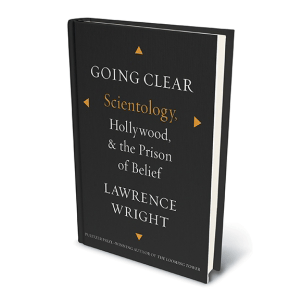
Recruiting Scientologist celebrities and getting them to endorse Scientology to the public at large has always been very important to the Church of Scientology. According to founder L. Ron Hubbard: ‘Celebrities are very Special people and have a very distinct line of dissemination. They have comm[unication] lines that others do not have and many medias [sic] to get their dissemination through.’
Scientology has had a written program governing celebrity recruitment since at least 1955, when Hubbard created ‘Project Celebrity,’ offering rewards to Scientologists who recruited targeted celebrities. Early interested parties included former silent-screen star Gloria Swanson and jazz pianist Dave Brubeck. A Scientology policy letter of 1976 states that ‘rehabilitation of celebrities who are just beyond or just approaching their prime’ enables the ‘rapid dissemination’ of Scientology.
read more »
Posted in Money, Philosophy |
1 Comment »
June 10, 2013

Celebrity Centres are Church of Scientology facilities that are open to the public but serve mostly artists and celebrities and other ‘professionals, leaders and promising new-comers in the fields of the arts, sports, management and government,’ as ‘those are the people who are sculpting the present into the future.’ The Celebrity Centre International was established in Hollywood, California, in 1969 by Yvonne Gillham, a Sea Org member who worked with L. Ron Hubbard. Since then, other centres have been established in New York, London, Paris and a number of other cities across the world.
The Church often quotes L. Ron Hubbard saying that, ‘A culture is only as great as its dreams and its dreams are dreamed by artists,’ citing this as the reason that Celebrity Centres were established — to create a good environment for ‘artists.’ Critics of Scientology point to Hubbard’s launch of ‘Project Celebrity’ in 1955 to recruit celebrities into the church, and that the centres were established as an extension of this initial purpose. The church denies the existence of policy to actively recruit high-ranking celebrities.
Posted in Health, Money, Philosophy |
Leave a Comment »
June 10, 2013

Ice-nine is a fictional material appearing in Kurt Vonnegut’s novel ‘Cat’s Cradle.’ Ice-nine is supposedly a polymorph of water more stable than common ice; instead of melting at 0 °C (32 °F), it melts at 45.8 °C (114.4 °F). When ice-nine comes into contact with liquid water below 45.8 °C (thus effectively becoming supercooled), it acts as a seed crystal and causes the solidification of the entire body of water, which quickly crystallizes as more ice-nine.
In the story, it is developed by the Manhattan Project for use as a weapon, but abandoned when it becomes clear that any quantity of it would have the power to destroy all life on earth. As people are mostly water, ice-nine kills nearly instantly when ingested or brought into contact with soft tissues exposed to the bloodstream, such as the eyes. A global catastrophe involving freezing the world’s oceans with ice-nine is used as a plot device in Vonnegut’s novel.
read more »
Posted in Science, War |
Leave a Comment »
June 8, 2013
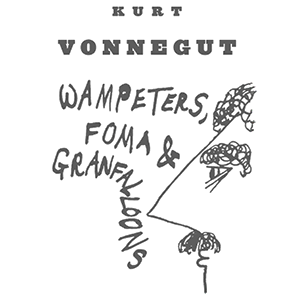
A granfalloon, in the fictional religion of Bokononism (created by Kurt Vonnegut in his 1963 novel ‘Cat’s Cradle’), is defined as a ‘false karass.’ That is, it is a group of people who outwardly choose or claim to have a shared identity or purpose, but whose mutual association is actually meaningless. ‘If you wish to examine a granfalloon, just remove the skin of a toy balloon.’ — Bokonon
The most commonly purported granfalloons are associations and societies based on a shared but ultimately fabricated premise. As examples, Vonnegut cites: ‘the Communist Party, the Daughters of the American Revolution, the General Electric Company —and any nation, anytime, anywhere.’ A more general and oft-cited quote defines a granfalloon as ‘a proud and meaningless association of human beings.’ Another granfalloon example illustrated in the book were Hoosiers, of which the narrator (and Vonnegut himself) was a member.
read more »
Posted in Humor, Philosophy |
Leave a Comment »
June 7, 2013

David Lynch (b. 1946) is an American filmmaker known for his surrealist films. He has developed his own unique cinematic style, which has been dubbed ‘Lynchian,’ characterized by dream imagery and meticulous sound design. The surreal, and in many cases, violent, elements contained within his films have been known to ‘disturb, offend or mystify’ audiences.
His work often exposes dark undercurrents in seemingly mundane people and places: ‘My childhood was elegant homes, tree-lined streets, the milkman, building backyard forts, droning airplanes, blue skies, picket fences, green grass, cherry trees. Middle America as it’s supposed to be. But on the cherry tree there’s this pitch oozing out – some black, some yellow, and millions of red ants crawling all over it. I discovered that if one looks a little closer at this beautiful world, there are always red ants underneath. Because I grew up in a perfect world, other things were a contrast.’
read more »
Posted in Art |
Leave a Comment »
June 7, 2013

Eraserhead is a 1977 surrealist body horror film written and directed by American filmmaker David Lynch. Shot in black-and-white, Eraserhead is Lynch’s first feature-length film, coming after several short works.
The film was produced with the assistance of the American Film Institute (AFI) during the director’s time studying there. It tells the story of Henry Spencer who is left to care for his deformed child in a desolate industrial landscape. Throughout the film, Spencer experiences dreams or hallucinations, featuring his child and the Lady in the Radiator.
read more »
Posted in Art |
1 Comment »
June 7, 2013

A coloring book is a type of book containing line art to which a child may add color using crayons (however, adult coloring products exist as well, including pornograhic, horror, and medical books).
Some coloring books have perforated edges so their pages can be removed from the books and used as individual sheets. Others may include a storyline and so are intended to be left intact. Coloring books may also incorporate other activities such as connect the dots, mazes, and other puzzles. Some coloring books also incorporate the use of stickers.
read more »
Posted in Art, Education, Language |
Leave a Comment »
June 7, 2013

Really Big Coloring Books, Inc (RBCB) is an American publisher based in St. Louis, Missouri. The company develops, publishes and distributes children’s coloring and activity books, many of which are over two feet tall. Some of their products have been controversial due to their political content.
The company was established in 1981 by publisher Wayne Bell. The company is best known for its politically themed coloring books, covering subjects such as Barack Obama, the Tea Party Movement, and Occupy Wall Street.
read more »
Posted in Art, Politics, Sex |
Leave a Comment »
June 6, 2013


In economics and decision theory, loss aversion refers to people’s tendency to strongly prefer avoiding losses to acquiring gains. Most studies suggest that losses are twice as powerful, psychologically, as gains. The concept was first demonstrated by psychologists Amos Tversky and Daniel Kahneman. John List, Chairman of the University of Chicagos’ department of economics has said: ‘It’s a deeply ingrained behavioral trait. .. that all human beings have — this underlying phenomenon that ‘I really, really dislike losses, and I will do all I can to avoid losing something.’
Loss aversion leads to risk aversion when people evaluate an outcome comprising similar gains and losses; since people prefer avoiding losses to making gains. Loss aversion may also explain sunk cost effects, where people justify increased investment in a decision, based on the cumulative prior investment, despite new evidence suggesting that the cost, starting today, of continuing the decision outweighs the expected benefit.
read more »
Posted in Money, Science |
Leave a Comment »


 The Daily Omnivore