June 8, 2015
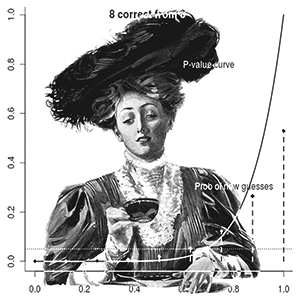
In the design of experiments in statistics, the lady tasting tea is a famous randomized experiment devised by English statisticia Ronald A. Fisher and reported in his book ‘The Design of Experiments’ (1935). The experiment is the original exposition of Fisher’s notion of a ‘null hypothesis’ (what you expect to happen before you run an experiment, i.e. nothing). Fisher’s description is less than ten pages in length and is notable for its simplicity and completeness regarding terminology, calculations, and design of the experiment. The example is loosely based on an event from his life. The lady in question was biologist Muriel Bristol.
Bristol claimed to be able to tell whether the tea or the milk was added first to her daily cup of tea. Fisher proposed to give her eight cups, four of each variety, in random order. One could then ask what the probability was for her getting the number she got correct, but just by chance. She got all eight cups correct. In popular science, David Salsburg published a book entitled ‘The Lady Tasting Tea,’ which describes Fisher’s experiment and ideas on randomization.
Posted in Food, Science |
Leave a Comment »
June 3, 2015

Grit in psychology is a positive, non-cognitive trait based on an individual’s passion for a particular long-term goal or endstate, coupled with a powerful motivation to achieve their respective objective. This perseverance of effort promotes the overcoming of obstacles or challenges that lie within a gritty individual’s path to accomplishment, and serves as a driving force in achievement realization. Commonly associated concepts within the field of psychology include ‘perseverance,’ ‘hardiness,’ ‘resilience,’ ‘ambition,’ ‘need for achievement,’ and ‘conscientiousness.’ These constructs can be conceptualized as individual differences related to the accomplishment of work rather than latent ability.
This distinction was brought into focus in 1907 when American psychologist William James challenged the field to further investigate how certain individuals are capable of accessing richer trait reservoirs enabling them to accomplish more than the average person, but the construct dates back at least to Victorian polymath Francis Galton, and the ideals of persistence and tenacity have been understood as a virtue at least since Aristotle. Although the last decade has seen a noticeable increase in research focused on achievement-oriented traits, there continues to be difficulty in aligning specific traits and outcomes.
read more »
Posted in Education, Health, Science |
Leave a Comment »
June 1, 2015
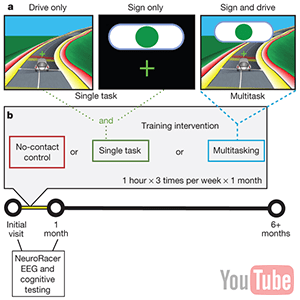
NeuroRacer is a video game designed by a team of researchers at the University of California, San Francisco led by cognitive neuroscientist Adam Gazzaley as a way to help with mental cognition.
It was designed as an intervention for ‘top-down modulation deficits in older adults.’ A study on 60-85 year olds showed that the multitasking nature of the game caused improvements in tasks outside of the game involving working memory and sustained attention.
Posted in Education, Games, Health |
Leave a Comment »


 The Daily Omnivore