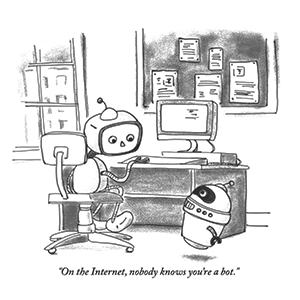
The Dead Internet Theory is an online conspiracy theory that asserts that the Internet now consists almost entirely of bot activity and automatically generated content that is manipulated by algorithmic curation, marginalizing organic human activity.
These intelligent bots are assumed to have been made, in part, to help manipulate algorithms and boost search results in order to ultimately manipulate consumers. Further, proponents of the theory accuse government agencies of using bots to manipulate public perception. The date given for this ‘death’ is generally around 2016 or 2017.
The dead Internet theory emerged in the late 2010s or early 2020s. While the exact origins of the theory are difficult to pinpoint, some point to a thread on the forum Agora Road’s Macintosh Cafe in 2021 as the origin of the term. It was inspired by concerns about the Internet’s increasing complexity, dependence on fragile infrastructure, potential cyberattack vulnerabilities, and most importantly, the exponential increase in artificial intelligence capabilities and use. The theory gained traction in discussions among technology enthusiasts, researchers, and futurists who sought to explore the potential risks associated with our reliance on the Internet. The conspiracy theory has entered public culture through widespread coverage, and has been discussed on various high-profile YouTube channels.
Generative pre-trained transformers (GPTs), a type of large language model (LLM), employ artificial neural networks to produce human-like content. The first of these models was developed by the company OpenAI. These models have created a significant amount of controversy. In one example, Timothy Shoup of the Copenhagen Institute for Futures Studies stated that, ‘in the scenario where GPT-3 ‘gets loose’, the internet would be completely unrecognizable.’ He predicted that in such a scenario, 99% to 99.9% of content online might be AI generated by 2025 to 2030. These predictions have been used as evidence for the dead internet theory.
In 2016, the security firm Imperva released a report on bot traffic and found that bots were responsible for 52% of web traffic, the first time it surpassed human traffic. This report has been used as evidence in reports on the dead internet theory.
Several accounts on Twitter started posting tweets starting with the phrase ‘I hate texting’ followed by an alternative activity, such as ‘i hate texting i just want to hold ur hand,’ or ‘i hate texting just come live with me.’ These posts received tens of thousands of likes, and many suspected them to be bot accounts. These accounts have been used as an example by proponents of the dead internet theory.
The percentage of user accounts run by bots became a major issue during Elon Musk’s acquisition of Twitter. During this process, Musk disputed Twitter’s claim that less than 5% of their monetizable daily active users (mDAU) were bots. During this dispute, Musk commissioned the company Cybra to estimate what percentage of Twitter accounts were bots, with one study estimating 13.7% and the second estimating 11%. These bot accounts are thought to be responsible for a disproportionate amount of the content generated. This incident has been pointed to by believers in the dead internet theory as evidence.
There is a market online for fake YouTube views to boost a video’s credibility and reach broader audiences. At one point, fake views were so prevalent that some engineers were concerned YouTube’s algorithm for detecting them would begin to treat the fake views as default and start misclassifying real ones. YouTube engineers coined the term ‘the inversion’ to describe this phenomenon. YouTube bots and the fear of ‘the inversion’ were cited as support for the dead internet theory in the Agora Road’s Macintosh Cafe thread.


 The Daily Omnivore
Leave a comment