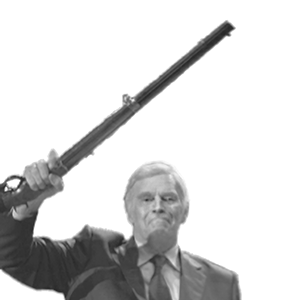
Guns don’t kill people, people kill people is a slogan popularized by the National Rifle Association of America (NRA) and other gun advocates. The slogan and connected understanding dates back to at least the 1910s, and it became widely popular among gun advocates in the second half of the 20th century, so much so that some have labeled it a cliché.
Gun control proponents claim the slogan is an example of bumper sticker logic and supports the larger folk psychology behind gun advocacy. In colloquial use, both parts of the statement are largely considered true. However, when the statement is used in the context of gun debates it becomes misdirection and can be considered a fallacy.
The statement does not say anything about gun control. It further only references that people are violent in general, and says nothing of gun ownership and gun violence. Further, the statement presents two polarizing extremes, namely that either the guns or the people are entirely to blame, while this is not the case with either gun-rights advocates or opponents, as they usually lie somewhere between the two extremes.
American, Canadian, Dutch, French, and Israeli philosophers, criminologists, psychiatrists, lawyers, and others have considered the statement. In the context of proximate and ultimate causation, the statement is a case of ‘mistaken relevance of proximate causation’ (overemphasis on the immediate or superficial causes of gun violence at the expense of deeper, more systemic issues.).
The statement has been considered in the context of technological neutrality, technological determinism, value neutrality, and the instrumentalist philosophy of technology. When arguing that guns have moral value and technological agency, the responsibility of the human is also considered. The gun-human relation becomes a key factor in analysis. Law in the United States already has parallels, for example in the case of regulations for automatic firearms. Scientifically, the statement is inaccurate since it is the bullets and the kinetic energy that causes damage to the body.
There are numerous variations that extend the slogan to mental health and social issues, including some that convey that guns make it easier for people to kill, and others in which ‘people’ is substituted with criminals, toddlers, children, bullets, or other nouns. For the purpose of analyzing the slogan and explaining different points of view, experts replace ‘guns’ with other terms, such as cars, knives, butter knives, nuclear weapons, and weapons systems. A recent variation ‘3D printers don’t kill people—guns do’ aims to address the concept of a 3D printed gun and the regulation of the technology behind gun creation.
The NRA was involved in gun control politics as early as the period when the 1911 Sullivan gun control legislation was passed in New York. It was during this time that the slogan came into usage as a reason against gun control. American investigative journalist Jack Anderson has called the statement the organization’s ‘first article of faith.’ Its usage on bumper stickers dates back to at least the 1970s. Along with other slogans and themes such as ‘if guns are outlawed only outlaws will have guns’ and ‘America doesn’t have a gun problem, it has a crime problem,’ it has been a part of pro-gun public relation campaigns. It is one of the main slogans of the NRA, and a favorite.
In 1968, during the introduction of the National Gun Crime Prevention Act bill, a frequently-asked-questions list was framed. The twenty-third question in that list was, ‘What about the argument that ‘guns don’t commit crimes, people do?’ The answer provided accepted that people with guns commit crimes and included statistics for gun-related robberies and assaults. The statistics also included the number of Americans killed in the past five years through gun violence, and specifically referenced the assassinations of John Kennedy, Martin Luther King, and Robert Kennedy. In 1971 with regard to handgun control and the argument Congressman Abner Mikva said that guns not only make it easier to kill resulting in more murders, but guns also make it more practical and inviting to kill.
In 1997 Charlton Heston as president of the NRA said on ‘Meet the Press,’ ‘There are no good guns. There are no bad guns. Any gun in the hands of a bad man is a bad thing.’ Two years later he would be quoted saying ‘this is not about guns, this is about maladjusted kids.’ The statement has an impact on the larger gun debate and its general message can be heard in response to shootings, even in the United States Congress. In 1999, following the Columbine High School massacre, representatives in the House of Representatives paraphrased their own versions of the slogan into their floor debate statements.
President Bill Clinton has referenced and addressed the statement a number of times. In 1995 at Georgetown University he said, ‘… The NRA’s position on gun violence, the Brady Bill, and the assault weapons ban. Their position is: Guns don’t kill people, people do. Find the people who do wrong, throw them in jail … Do not infringe upon my right to keep and bear arms, even to keep and bear arsenals or artillery or assault weapons. Do not do that because I have not done anything wrong, and I have no intention of doing anything wrong …’
David Kyle Johnson, a professor of philosophy, considers the statement in the context of proximate and ultimate causation. Johnson concludes that the argument results in a ‘mistaken relevance of proximate causation.’ The statement, while laying focus on the fact that people are the ‘ultimate cause’ of the killing, does not say anything about the proximate cause, for example whether gun control should follow. The focus on what should happen to the guns becomes secondary.
American philosopher Joseph C. Pitt explains that the slogan presents a false dilemma as it tries to force a choice between what does the killing, guns or people, when in fact there is no reason to suppose that the answer is either/or. While it is true that guns cannot result in fatalities by themselves, that people do the killing and not guns, it is also true that people rarely kill using only their body. American philosopher Michael W. Austin, also concluding the slogan presents a false dilemma, explains that the slogan aims to convey that since people are flawed, it isn’t a gun issue. Austin explains that existing law in the United States such as the National Firearms Act, which regulates automatic weapons, already consider the situation as a combined human-gun issue.
In a paper on the history of gun laws in Nazi Germany (which he argues were actually more permissive than those of the preceding Weimar Republic) law professor Bernard Harcourt, then based at the University of Chicago, says that the argument applies with equal force to the gun laws it is frequently voiced in opposition to, particularly with reference to Nazi gun laws, falsely alleged to have been introduced by Adolf Hitler with a laudatory reference to the country having enacted the world’s first laws mandating firearm registration: ‘After all, the NRA stands for the proposition that ‘it’s not guns that kill people, it’s people who kill people.’ The central idea here is that instrumentalities—in this case handguns—are just that: instrumentalities. They are not to be blamed for what people do wrongly with them. If you follow the logic of that argument, then you would expect a member of the NRA to respond in the same manner when confronted with the Nazi-gun-registration argument: ‘It’s not gun registration that produces gun confiscation and genocide, it’s people who do.”
University of Chicago law professor Bernard Harcourt, writing about the history of gun laws in Nazi Germany, suggests that these laws were actually more relaxed than the ones before Hitler came to power in the Weimar Republic. He points out that Nazi Germany is often erroneously credited with introducing the first gun registration laws. Harcourt notes that references to Nazi gun laws are often use to oppose current gun regulations, implying that such laws could lead to harmful outcomes like those in Nazi Germany, but, he counters, if NRA supporters truly believe in their saying, then they should also believe that gun registration itself isn’t harmful. Instead, it’s how people misuse that information that could be harmful. In other words, just as guns themselves aren’t blamed for deaths, gun registration shouldn’t be blamed for bad outcomes like confiscation or genocide. Instead, it’s the actions of people that determine these outcomes.
From the technological neutrality perspective, the statement ‘guns don’t kill people’ and connected reasoning convey a proposition that guns are tools, inanimate, amoral, and neutral. Guns are not punished for killing people. Gun advocates understand that since the weapon does not do the killing it does not matter which weapon is used. The caliber does not matter, the type of bullet does not matter, nor does the type of magazine. This reasoning leads to the view that all weapons do not kill by themselves and the weapon does not matter. In a 2018 study, American criminologists and professors Anthony Braga and Philip J. Cook find that caliber does matter when it comes to gun-related fatalities, that is to say that certain features of guns do matter when it comes to killings.
The opposing view is simplified as ‘guns do kill people.’ It is argued that guns have moral agency and technological agency, while the person pulls the trigger, the gun provides the technology to launch the bullet. When stating that guns have a moral role, this does not change the responsibility of the human. The argument that guns have moral value leads to a gun having political value. Since guns are responsible for some of the harm, they should also be regulated.
Canadian criminologist Thomas Gabor points to the ‘superficial truth’ that guns cannot kill without a human; superficial since guns do have a part in the creation of violence. The gun increases the lethality of people who kill, increasing the chance of mass killings. Marketing and advertising for guns similarly point to the gun’s power, its deterrent power, and that the gun is irreplaceable when it comes to self-defense. The human factor also encompasses people who are part of research and development to manufacturing to the marketing logistics chain. The money spent by lobbyists is another truth backing the lethality of guns. However, the view of gun advocates changes when it comes to crime, suicide, or accidents, the gun now becomes replaceable. The ‘stopping power’ of guns does not make guns the most ‘effective tool’ against violence.
In 1993, following the Long Island Rail Road shooting, Senator Daniel Patrick Moynihan stated that ‘guns don’t kill people, bullets do’ amidst proposing bans on select ammunition, taxes on others, and increased scrutiny in general. Moynihan reasoned that even if there was a blanket ban on guns in the United States, there were already enough in homes to last for at least two centuries; this was not the case with bullets whose stock could last only a few years and hence addressing bullets was a need.
Michael Moore, a filmmaker, has given his version of the slogan, ‘guns don’t kill people, Americans kill people.’ This is based on statistics of relative gun ownership and corresponding gun violence in countries such as Canada, Japan and other rich countries. A common comparison is made to Switzerland and its high level of gun ownership but low level of gun violence. Leading from this is an adapted conclusion ‘Guns don’t kill people – a complex mix of national characteristics and historical factors eventually coming to a boil does.’


 The Daily Omnivore
Leave a comment