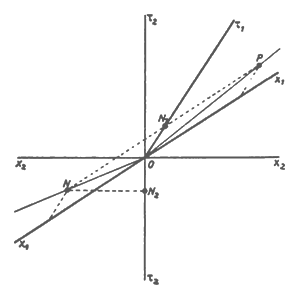
A tachyonic [tak-ee-on-ik] antitelephone is a hypothetical device in theoretical physics that could be used to send signals into one’s own past. Albert Einstein in 1907 presented a thought experiment of how faster-than-light signals can lead to a paradox of causality, which was described by Einstein and Arnold Sommerfeld in 1910 as a means ‘to telegraph into the past.’ The same thought experiment was described by physicist Richard Chace Tolman in 1917; thus, it is also known as Tolman’s paradox.
A device capable of ‘telegraphing into the past’ was later also called a ‘tachyonic antitelephone’ by science fiction writer and astrophysicist Gregory Benford. According to current understanding of physics, no such faster-than-light transfer of information is actually possible.
Benford wrote about such paradoxes in general, offering a scenario in which two parties are able to send a message two hours into the past: ‘The paradoxes of backward-in-time communication are well known. Suppose A and B enter into the following agreement: A will send a message at three o’clock if and only if he does not receive one at one o’clock. B sends a message to reach A at one o’clock immediately on receiving one from A at three o’clock. Then the exchange of messages will take place if and only if it does not take place. This is a genuine paradox, a causal contradiction.
He thus concluded that superluminal particles such as tachyons are therefore not allowed to convey signals.


 The Daily Omnivore
Leave a comment