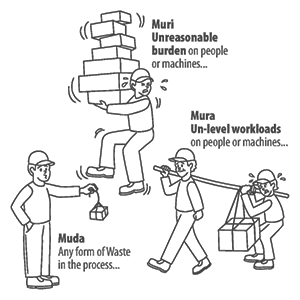
Muda [moo-duh] is a Japanese word meaning ‘futility,’ ‘uselessness,’ or ‘wastefulness,’ and is a key concept in lean process thinking such as in the Toyota Production System (TPS), denoting one of three types of deviation from optimal allocation of resources. The other types are known by the Japanese terms ‘mura’ (‘unevenness’) and ‘muri’ (‘overload’). Waste in this context refers to the wasting of time or resources rather than wasteful by-products.
From an end-customer’s point of view, value-added work is any activity that produces goods or provides a service for which a customer is willing to pay; muda is any constraint or impediment that causes waste to occur.
One of the key steps in lean process and TPS is to identify which activities add value and which do not, then to progressively work to improve or eliminate them. Taiichi Ohno, ‘father’ of the Toyota Production System, originally identified seven forms of muda or waste in lean manufacturing, recalled with the mnemonic TIM WOOD:
Transporting: Every time a product is touched or moved unnecessarily there is a risk that it could be damaged, lost, delayed, etc. as well as being a cost for no added value. Transporting does not add value to the product, i.e. is not a transformation for which the consumer is willing to pay.
Inventory: Whether in the form of raw materials, work-in-progress (WIP), or finished goods, represents a capital outlay that cannot yet produce an income. The longer a product sits in one of these states, the more it contributes to waste. The smooth, continuous flow of work through each process ensures excess amounts of inventory are minimized.
Motion: In contrast to transportation, which refers to damage and transaction costs associated with moving the product, motion refers to the damage and costs inflicted on what creates the product. This can include wear and tear for equipment, repetitive strain injuries for workers or unnecessary downtime.
Waiting: Whenever the product is not in transportation or being processed, it is waiting (typically in a queue). In traditional processes, a large part of an individual product’s life is spent waiting to be worked on.
Overproduction: Making more of a product than is required results in several forms of waste, typically caused by production in large batches. The customer’s needs often change over the time it takes to produce a larger batch. Over-production has been described as the worst kind of waste.
Over processing: Doing more to a product than is required by the end-customer results in it taking longer and costing more to produce. This also includes using components that are more precise, complex, expensive or higher quality than absolutely required.
Other forms of waste later described include Defects (having to discard or rework a product due to earlier defective work or components results in additional cost and delays) and Unused Skills (organizations often under-utilize the skills their workers have or permit workers to operate in silos so that knowledge is not shared).


 The Daily Omnivore
Leave a comment