March 21, 2024

Catturd (b. 1964) is the online identity of right-wing American Twitter shitposter and Internet troll Phillip Buchanan. The account is known for its scatological humor, as well as spreading conspiracy theories and disinformation. Buchanan lives in Wewahitchka, Florida, on a ‘ranch in the middle of nowhere.’
He is thrice-divorced. He married his first wife, whom he met at a gym when she was 19 and he was in his early twenties, in 1986. The marriage was annulled in 1988. By 1991, Buchanan had married and divorced another woman. His third marriage happened a few years later, while he was working at a post office. They parted in 1998 and divorced in 2002. Buchanan claims to have served in the US Army. In the 90s, he filed for Chapter 7 bankruptcy, and later fronted a band in Tallahassee, Florida.
read more »
Posted in Humor, Politics, Technology |
Leave a Comment »
March 19, 2024

In literary and historical analysis, presentism is a term for the introduction of present-day ideas and perspectives into depictions or interpretations of the past. Some modern historians seek to avoid presentism in their work because they consider it a form of cultural bias, and believe it creates a distorted understanding of their subject matter. The practice of presentism is regarded by some as a common fallacy when writing about the past.
The debate surrounding presentism in historical analysis is ongoing, with some arguing that completely divorcing moral judgments from historical inquiry may lead to a relativistic approach that fails to acknowledge the universal nature of certain moral principles. Balancing historical context with ethical considerations remains a challenge for historians and philosophers alike.
read more »
Posted in Language, Politics, World |
Leave a Comment »
March 12, 2024

‘The Anxiety of Influence: A Theory of Poetry’ is a 1973 book by Harold Bloom, literary critic and Sterling Professor of humanities at Yale. It was the first in a series of books that advanced a new ‘revisionary’ or antithetical approach to literary criticism. Bloom’s central thesis is that poets are hindered in their creative process by the ambiguous relationship they necessarily maintain with precursor poets.
He argues that ‘the poet in a poet’ is inspired to write by reading another poet’s poetry and will tend to produce work that is in danger of being derivative of existing poetry, and, therefore, weak. Because poets historically emphasize an original poetic vision in order to guarantee their survival into posterity, the influence of precursor poets inspires a sense of anxiety in living poets. Thus Bloom attempts to work out the process by which the small minority of ‘strong’ poets manage to create original work in spite of the pressure of influence.
read more »
Posted in Art, Language |
1 Comment »
March 11, 2024

The Sloot Digital Coding System is an alleged data sharing technique that its inventor claimed could store a complete digital movie file in 8 kilobytes of data — violating Shannon’s source coding theorem (which establishes the statistical limits to data compression) by many orders of magnitude. The alleged technique was developed in 1995 by Romke Jan Bernhard Sloot (1945-1999), a Dutch electronics engineer.
In 1999, just days before the conclusion of a contract to sell his invention, Sloot died suddenly of a heart attack. The source code was never recovered, and the technique and claim have never been reproduced or verified.
read more »
Posted in Money, Technology |
Leave a Comment »
March 3, 2024
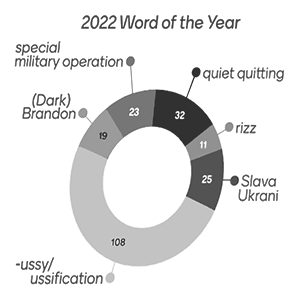
ussy is an English-language suffix derived from the word pussy used to create novel portmanteau terms, usually referring to hole-shaped objects. The suffix has existed within LGBT slang in the form ‘bussy’ (boy pussy) since the early 2000s, but was popularized in the late 2010s and early 2020s on social media platforms including TikTok. It was named the American Dialect Society’s word of the year for 2022.
‘Bussy’ and ‘mussy’ (man pussy) first appearing on the internet between 1999 and 2004. An April 2017 Tumblr post popularized the suffix with the term ‘thrussy’ (from throat), and it was further spread as part of the ‘one thicc bih’ Internet meme that began to spread about a month later. A 2018 study of ussy usage on Twitter as part of the meme identified 1,338 ‘pussy blends’ used in tweets from June to August 2017.
read more »
Posted in Humor, Language, Sex |
Leave a Comment »


 The Daily Omnivore