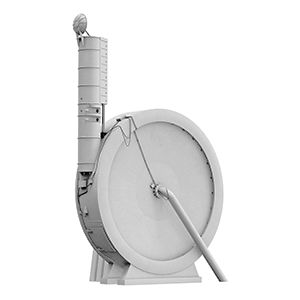
SpinLaunch is a spaceflight technology development company working on mass accelerator technology to move payloads to space.[3] As of September 2022, the company has raised US$150 million in funding, with investors including Kleiner Perkins, Google Ventures, Airbus Ventures, ATW Partners, Catapult Ventures, Lauder Partners, John Doerr, and the Byers Family.
SpinLaunch’s projected cost per kg of payload is approximately $1,250 – $2,500. This projection is significantly less expensive than SpaceX’s current price per kg of payload on the Falcon 9 of $6,000. SpaceX’s projected cost per kg on Starship, however, is less than $1,000 per kg. What real costs and prices for either SpinLaunch or Starship remains to be seen.
SpinLaunch was founded in 2014 by Jonathan Yaney in Sunnyvale, California. The company’s headquarters are in Long Beach.[6] In 2020 it opened a launch site. SpinLaunch continued development of its 140,000 square-foot (13,000 m2) corporate headquarters in Long Beach, and of its flight test facility at Spaceport America in New Mexico.[7] In 2022, SpinLaunch received a launch contract from NASA to test a payload.
SpinLaunch is developing a kinetic energy space launch system that aims to reduce dependency on traditional chemical rockets, with the goal of significantly lowering the cost of access to space while increasing launch frequency. The system utilizes centrifugal force with slingshot action to accelerate rockets to eventually reach low Earth orbit. The vacuum-sealed centrifuge is able to spin a rocket at speeds of up to 4,700 mph (7,500 km/h; 2.1 km/s) before releasing it on a trajectory path headed towards low Earth orbit. Once the rocket reaches an altitude of roughly 200,000 ft (60 km), the rocket would then ignite its engines in order to reach an orbital speed of 17,150 mph (27,600 km/h; 7.666 km/s). Such rockets would be able to carry payloads of up to 440 lb (200 kg), with a peak centrifugal acceleration of approximately 10,000 g. Historical predecessors of this system include centrifugal guns.
If successful, the centrifuge sling launch concept is projected to lower the cost of launches and use less power, with the price of a single space launch potentially reduced by a factor of 20 to under US$500,000.
The major limitation of the system are the G-forces on the payload. Any equipment or goods delivered by SpinLaunch must be capable of withstanding up to 10,000 G’s of force for 30 minutes during the centrifugal acceleration process. Additionally, no more than 880 lb (400 kg) of payload can be sent per launch.
On October 22, 2021 at its Spaceport America facility in New Mexico, SpinLaunch conducted its first vertical test of their accelerator at 20% of its full power capacity, hurling a 10-foot-long (3.0 m) passive projectile to an altitude of “tens of thousands of feet.” This test accelerator is 108 ft (33 m) in diameter, which makes it a one-third scale of the operational system that is being designed. The company’s first 10 test flights reached as much as 30,000 feet (9,100 m) in altitude.
A September 2022 test flight successfully carried payloads from NASA, Airbus US, Cornell Engineering’s Space Systems Design Studio (SSDS), and from Outpost. The flight followed the trajectory that had been laid in for it. After the flight all contents of the payload were inspected and found to be in good order.
In 2024, the Portland State Aerospace Society (student group) collaborated with SpinLaunch to demonstrate that a 1U CubeSat could survive extremely high G-forces with minimal modifications. SpinLaunch hardened the 1U design by moving the battery cells to rest directly on the satellite’s floor and aligning the long axis of battery cells with the G vector (like pillars under compression). They also added a small amount of glue to the electronics, especially large things like some capacitors. but the frame and solar cells remained mostly the same.


 The Daily Omnivore
Leave a comment