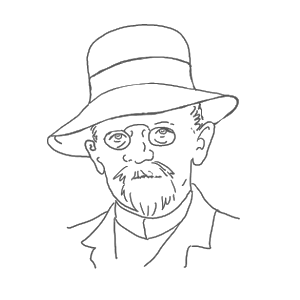
In mathematics, Hilbert’s program, formulated by German mathematician David Hilbert in the early 1920s, was a proposed solution to the foundational crisis of mathematics, when early attempts to clarify the foundations of mathematics were found to suffer from paradoxes and inconsistencies. Hilbert wanted to ground all existing theories to a finite, complete set of axioms, and provide a proof that these axioms were consistent. He proposed that the consistency of more complicated systems, such as real analysis, could be proven in terms of simpler systems.
Gödel’s incompleteness theorems, published in 1931, showed that Hilbert’s program was unattainable for key areas of mathematics. In his first theorem, Gödel showed that any consistent system with a computable set of axioms which is capable of expressing arithmetic can never be complete. In his second theorem, he showed that such a system could not prove its own consistency, so it certainly cannot be used to prove the consistency of anything stronger with certainty. This refuted Hilbert’s assumption that a finitistic system could be used to prove the consistency of itself, and therefore could not prove everything else. Many current lines of research in mathematical logic, such as proof theory and reverse mathematics, can be viewed as natural continuations of Hilbert’s original program.


 The Daily Omnivore