April 28, 2025
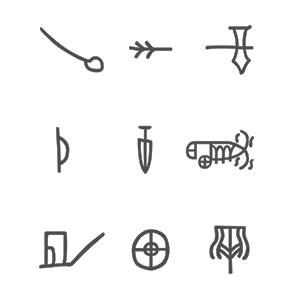
Linear B is the earliest known form of written Greek. It is a Mycenaean syllabic script that predates the Greek alphabet by several centuries, the earliest known examples dating to around 1450 BCE. It is adapted from the earlier Linear A, an undeciphered script perhaps used for writing the Minoan language. Linear B, found mainly in the palace archives at Knossos, Kydonia, Pylos, Thebes, and Mycenae, disappeared with the fall of Mycenaean civilization (1750-1050 BCE) during the Late Bronze Age collapse. The succeeding period, known as the Greek Dark Ages, provides no evidence of the use of writing.
Linear B was deciphered in 1952 by English architect and self-taught linguist Michael Ventris based on the research of American classicist Alice Kober. It is the only Bronze Age Aegean script to have been deciphered, with Linear A, Cypro-Minoan, and Cretan hieroglyphic remaining unreadable.
read more »
Posted in Language, World |
Leave a Comment »
April 21, 2025

Prussian blue (also known as Berlin blue, Brandenburg blue, Parisian and Paris blue) is a dark blue pigment produced by oxidation of ferrous ferrocyanide salts. Turnbull’s blue is essentially identical chemically, excepting that it has different impurities and particle sizes—because it is made from different reagents—and thus it has a slightly different color.
Prussian blue was created in the early 18th century and is the first modern synthetic pigment. It is prepared as a very fine colloidal dispersion, because the compound is not soluble in water. It contains variable amounts of other ions and its appearance depends sensitively on the size of the colloidal particles. The pigment is used in paints, it became prominent in 19th-century aizuri-e Japanese woodblock prints, and it is the traditional ‘blue’ in technical blueprints.
read more »
Posted in Art, Science |
Leave a Comment »
April 13, 2025
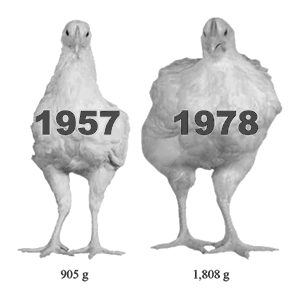
Woody breast is an abnormal muscle condition that impacts the texture and usability of chicken breast meat. The affected meat is described as tough, chewy, and gummy due to stiff or hardened muscle fibers that spread through the filet. The specific cause is not known but may be related to factors associated with rapid growth rates.
Companies often use a three-point scale to grade the woodiness of a particular breast. Although distasteful to many, meat that exhibits woody breast is not known to be harmful to humans who consume it. When detected by suppliers, product shown to have the condition present may be discounted or processed as ground chicken.
read more »
Posted in Food, Money |
Leave a Comment »
April 7, 2025

Belphegor’s prime is the palindromic prime number 1000000000000066600000000000001 (1030 + 666 × 1014 + 1), a number which reads the same both backwards and forwards and is only divisible by itself and one. It first discovered by Harvey Dubner, a mathematician known for his discoveries of many large prime numbers and prime number forms. For Belphegor’s prime in particular, he discovered the prime while determining a sequence of primes it belongs to.
The name “Belphegor’s prime” was coined by author Clifford A. Pickover in 2012. Belphegor is one of the Seven Princes of Hell; specifically, ‘the demon of inventiveness.’ The number itself contains superstitious elements that have given it its name: the number 666 at the heart of Belphegor’s prime is widely associated as being the number of the beast, used in symbolism to represent one of the creatures in the apocalypse or, more commonly, the devil. This number is surrounded on either side by thirteen zeroes and is 31 digits in length (thirteen reversed), with thirteen itself long regarded superstitiously as an unlucky number in Western culture.
Posted in Science |
Leave a Comment »


 The Daily Omnivore