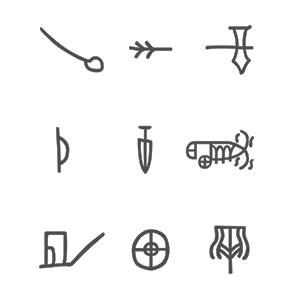
Linear B is the earliest known form of written Greek. It is a Mycenaean syllabic script that predates the Greek alphabet by several centuries, the earliest known examples dating to around 1450 BCE. It is adapted from the earlier Linear A, an undeciphered script perhaps used for writing the Minoan language. Linear B, found mainly in the palace archives at Knossos, Kydonia, Pylos, Thebes, and Mycenae, disappeared with the fall of Mycenaean civilization (1750-1050 BCE) during the Late Bronze Age collapse. The succeeding period, known as the Greek Dark Ages, provides no evidence of the use of writing.
Linear B was deciphered in 1952 by English architect and self-taught linguist Michael Ventris based on the research of American classicist Alice Kober. It is the only Bronze Age Aegean script to have been deciphered, with Linear A, Cypro-Minoan, and Cretan hieroglyphic remaining unreadable.
Linear B consists of around 87 syllabic signs and over 100 ideographic signs. These ideograms or ‘signifying’ signs symbolize objects or commodities. They have no phonetic value and are never used as word signs in writing a sentence. The application of Linear B texts appear to have been mostly confined to administrative contexts, mainly at Mycenaean palatial sites.
Linear B has roughly 200 signs, divided into syllabic signs with phonetic values and ideograms with semantic values. The representations and naming of these signs have been standardized by a series of international colloquia starting in Paris in 1956. After the third meeting in 1961 at the Wingspread Conference Center in Racine, Wisconsin, a standard proposed primarily by Emmett L. Bennett, Jr. became known as the Wingspread Convention, which was adopted by a new organization, the Comité International Permanent des Études Mycéniennes (CIPEM: Permanent International Committee of Mycenaean Studies), affiliated in 1970 by the fifth colloquium with UNESCO.
Many of the signs are identical or similar to those in Linear A; however, Linear A encodes an as yet unknown language, and it is uncertain whether similar signs had the same phonetic values.
Linear B’s ideograms express the type of object concerned (e.g. a cow, wool, a spear) and a unit of measure. They are never used as word signs in writing a sentence, unlike Japanese kanji or Hittite cuneiform. Ideograms are typically at the end of a line before a number and appear to signify to which object the number applies. Many of the values remain unknown or disputed. Some commodities such as cloth and containers are divided into many different categories represented by distinct ideograms. Livestock may be marked with respect to sex.
The numerical references for the ideograms were originally devised by Ventris and Bennett and divided into functional groups corresponding to the breakdown of Bennett’s index. The groups are numbered beginning 100, 110, 120 etc., with some provision of spare numbers for future additions; the official CIPEM numberings used today are based on Ventris and Bennett’s numbering, with the provision that three or four letter codes (written in small capitals), based on Latin words that seemed relevant at the time, are used where the meanings are known and agreed. Unicode (as of version 5.0) encodes 123 Linear B ideograms.
The oldest Linear B tablets are probably those from the Room of Chariot Tablets at Knossos, and date to the latter half of the 15th century BCE. The Aegean is responsible for many of the early Greek language words that have to do with daily life such as words for tools and items that are seen every day.
The major cities and palaces used Linear B for records of disbursements of goods. Wool, sheep, and grain were some common items, often given to groups of religious people. A number of tablets also deal with military matters. As is often the case with cuneiform tablets, when the buildings they were housed in were destroyed by fire many of the tablets were baked which preserved them.
The Greeks of the historical era were unable to decipher Linear B, but its ideograms are sometimes mentioned by ancient authors. For example, Plutarch gives an account of the Spartan king Agesilaus II (r. 400–360 BCE) sending a bronze tablet with ‘many letters marvelously old, for nothing could be made of them’ to Egyptian priests in the hope they could understand them.
The modern excavation Knossos was led by British archaeologist Arthur Evans in 1900, though successful in extracting several tablets, ‘only a comparatively small proportion of the tablets were preserved in their entirety,’ the causes of destruction being rainfall through the roof of the storage room, crumbling of small pieces, and being thrown away by workmen who failed to identify them.
In the early 1950s, Alice Kober studied Linear B and managed to construct grids, linking similar symbols in groups of threes. Kober noticed that a number of Linear B words had common roots and suffixes. This led her to believe that Linear B represented an inflected language, with nouns changing their endings depending on their case. However, some characters in the middle of the words seemed to correspond with neither a root nor a suffix. Because this effect was found in other known languages, Kober surmised that the odd characters were bridging syllables, with the beginning of the syllable belonging to the root and the end belonging to the suffix. This was a reasonable assumption, since Linear B had far too many characters to be considered alphabetic and too few to be logographic; therefore, each character should represent a syllable. Kober’s systematic approach allowed her to demonstrate the existence of three grammatical cases and identify several pairs of signs that shared vowels or consonants with one another.
Kober also showed that the two-symbol word for ‘total’ at the end of livestock and personnel lists, had a different symbol for gender. This gender change with one letter, usually a vowel, is most frequent in Indo-European languages. Kober had rejected any speculation on the language represented, preferring painstaking cataloguing and analysis of the actual symbols, though she did believe it likely that Linear A and Linear B represented different languages.
The convention for numbering the symbols still in use today was first devised by Emmett L. Bennett Jr. Working alongside fellow academic Alice Kober, by 1950 Bennett had deciphered the metrical system, based on his intensive study of Linear B tablets unearthed at Pylos. He concluded that those tablets contained exactly the same script as the Linear B found at Knossos, and he classified and assigned identification numbers to the Linear B signs as he prepared a publication on the Pylos tablets. Like Kober, Bennett was also an early proponent of the idea that Linear A and B represented different languages. His book ‘The Pylos Tablets’ became a crucial resource for Michael Ventris.
In 1935, the British School at Athens was celebrating its fiftieth anniversary with an exhibition at Burlington House, London. Among the speakers was Arthur Evans, then 84 years old; a teenage Michael Ventris was present in the audience. In 1940, the 18-year-old Ventris had an article ‘Introducing the Minoan Language’ published in the ‘American Journal of Archaeology.’ After wartime service as a navigator with RAF Bomber Command, and a post-war year in Occupied Germany, he returned to civilian life, and completed qualification as an architect. Ventris continued with his interest in Linear B, corresponding with known scholars, who usually but not always replied.
Ventris and John Chadwick, a university lecturer in Ancient Greek philology, performed the bulk of the decipherment of Linear B between 1951 and 1953. At first Ventris chose his own numbering method, but later switched to Bennett’s system. His initial decipherment was achieved using Kober’s classification tables, to which he applied his own theories. Some Linear B tablets had been discovered on the Greek mainland. Noticing that certain symbol combinations appeared only on the tablets found in Crete, he conjectured that these might be names of places on the island. This proved to be correct.
Working with the symbols he could decipher from this, Ventris soon unlocked much text and determined that the underlying language of Linear B was in fact Greek. This contradicted general scientific views of the time, and indeed Ventris himself had previously agreed with Evans’s hypothesis that Linear B was not Greek.
Ventris’s first public announcement of his breakthrough came on 1 July 1952, on BBC Radio, with Ventris describing the language of Linear B as ‘A difficult and archaic Greek, seeing that it’s five hundred years older than Homer, and written in a rather abbreviated form, but Greek nevertheless.’ Ventris’ discovery was of significance in demonstrating a Greek-speaking Minoan-Mycenaean culture on Crete, and thus presenting Greek in writing centuries earlier than had been previously accepted.


 The Daily Omnivore
Leave a comment