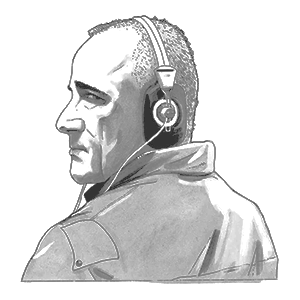
Zersetzung [zer-set-zung] (German for ‘decomposition’ and ‘disruption’) was a psychological warfare technique used by the Ministry for State Security (Stasi) to repress political opponents in East Germany during the 1970s and 1980s. Zersetzung served to combat alleged and actual dissidents through covert means, using secret methods of abusive control and psychological manipulation to prevent anti-government activities.
Among the defining features of it was the widespread use of offensive counterespionage methods as a means of repression. People were commonly targeted on a preemptive and preventive basis, to limit or stop activities of political dissent and cultural incorrectness that they may have gone on to perform, and not on the basis of crimes they had actually committed. Zersetzung methods were designed to break down, undermine, and paralyze people behind ‘a facade of social normality’ in a form of ‘silent repression.’
The Stasi used operational psychology and its extensive network of between 170,000 and over 500,000 informal collaborators to launch personalized psychological attacks against targets to damage their mental health and lower chances of a ‘hostile action’ against the state. Among the collaborators were youths as young as 14 years of age.
The use of Zersetzung is well documented due to Stasi files published after the Berlin Wall fell, with several thousands or up to 10,000 individuals estimated to have become victims, 5,000 of whom sustained irreversible damage. Special pensions for restitution have been created for Zersetzung victims.
The goal of Zersetzung is the fragmentation, paralysis, disorganization, and isolation of the hostile and negative forces, in order to impede the hostile and negative activities, to largely restrict, or to totally avert them, and if applicable to prepare the ground for a political and ideological reestablishment.
The term Zersetzung is generally translated into English as ‘decomposition,’ although it can be variously translated as ‘decay,’ ‘corrosion,’ ‘undermining,’ ‘biodegradation,’ or ‘dissolution.’ The term was first used in a prosecutorial context in Nazi Germany, namely as part of the Wehrkraftzersetzung or Zersetzung der Wehrkraft (German for ‘corroding of defensive strength’), a sedition offense from 1938 to 1945). In Western parlance, Zersetzung can be described as the active application of psychological destabilization procedures by the State apparatus.
The impetus for Zersetzung began after the GDR signed the Basic Treaty, 1972 with West Germany to respect human rights, or at least announce its intention to do so, and the Helsinki accords in 1975. Consequently, the SED regime decided to reduce the number of political prisoners, which was compensated for by practicing dissident repression without imprisonment or court judgements.
British journalist Luke Harding, who had experienced treatment on the part of Russia’s FSB in Vladimir Putin’s Russia that was similar to Zersetzung, writes in his book:
‘As applied by the Stasi, Zersetzung is a technique to subvert and undermine an opponent. The aim was to disrupt the target’s private or family life so they are unable to continue their ‘hostile-negative’ activities towards the state. Typically, the Stasi would use collaborators to garner details from a victim’s private life. They would then devise a strategy to ‘disintegrate’ the target’s personal circumstances—their career, their relationship with their spouse, their reputation in the community. They would even seek to alienate them from their children. […] The security service’s goal was to use Zersetzung to ‘switch off’ regime opponents. After months and even years of Zersetzung a victim’s domestic problems grew so large, so debilitating, and so psychologically burdensome that they would lose the will to struggle against the East German state. Best of all, the Stasi’s role in the victim’s personal misfortunes remained tantalizingly hidden. The Stasi operations were carried out in complete operational secrecy. The service acted like an unseen and malevolent god, manipulating the destinies of its victims.’
‘It was in the mid-1970 that Honecker’s secret police began to employ these perfidious methods. At that moment the GDR was finally achieving international respectability. […] Honecker’s predecessor, Walter Ulbricht, was an old-fashioned Stalinist thug. He used open terror methods to subdue his post-war population: show trials, mass arrests, camps, torture and the secret police.’
‘But two decades after east Germany had become a communist paradise of workers and peasants, most citizens were acquiescent. When a new group of dissidents began to protest against the regime, Honecker came to the conclusion that different tactics were needed. Mass terror was no longer appropriate and might damage the GDR’s international reputation. A cleverer strategy was called for. […] The most insidious aspect of Zersetzung is that its victims are almost invariably not believed.’
The Stasi used Zersetzung essentially as a means of psychological oppression and persecution. Findings of operational psychology were formulated into method at the Stasi’s College of Law (JHS), and applied to political opponents in an effort to undermine their self-confidence and self-esteem. Operations were designed to intimidate and destabilize them by subjecting them to repeated disappointment, and to socially alienate them by interfering with and disrupting their relationships with others as in social undermining. The aim was to induce personal crises in victims, leaving them too unnerved and psychologically distressed to have the time and energy for anti-government activism. The Stasi intentionally concealed their role as mastermind of the operations. Author Jürgen Fuchs was a victim of Zersetzung and wrote about his experience, describing the Stasi’s actions as ‘psychosocial crime,’ and ‘an assault on the human soul.’
Although its techniques had been established effectively by the late 1950s, Zersetzung was not rigorously defined until the mid-1970s, and only then began to be carried out in a systematic manner in the 1970s and 1980s. It is difficult to determine how many people were targeted. Some sources indicate that around 5,000 people were ‘persistently victimized’ by Zersetzung. At the College of Legal Studies, the number of dissertations submitted on the subject of Zersetzung was in double figures. It also had a comprehensive 50-page Zersetzung teaching manual, which included numerous examples of its practice.
Beginning with intelligence obtained by espionage, the Stasi established ‘sociograms’ and ‘psychograms’ which it applied for the psychological forms of Zersetzung. They exploited personal traits, such as homosexuality, as well as supposed character weaknesses of the targeted individual—for example a professional failure, negligence of parental duties, pornographic interests, divorce, alcoholism, dependence on medications, criminal tendencies, passion for a collection or a game, or contacts with circles of the extreme right—or even the veil of shame from the rumors poured out upon one’s circle of acquaintances.
Tactics and methods employed under Zersetzung generally involved the disruption of the victim’s private or family life. This often included psychological attacks, in a form of gaslighting. Other practices included property damage, sabotage of cars, purposely incorrect medical treatment, smear campaigns including sending falsified compromising photos or documents to the victim’s family, denunciation, provocation, psychological warfare, psychological subversion, wiretapping, and bugging.
In the name of the target, the Stasi made little announcements, ordered products, and made emergency calls, to terrorize them. To threaten or intimidate or cause psychoses the Stasi accessed the target’s living quarters and left visible traces of its presence, by adding, removing, and modifying objects such as the socks in one’s drawer, or by altering the time that an alarm clock was set to go off.
The Stasi manipulated relations of friendship, love, marriage, and family by anonymous letters, telegrams and telephone calls as well as compromising photos, often altered. In this manner, parents and children were supposed to systematically become strangers to one another. To provoke conflicts and extramarital relations the Stasi put in place targeted seductions by Romeo agents. An example of this was the attempted seduction of activist Ulrike Poppe by Stasi agents who tried to break down her marriage.
For the Zersetzung of groups, it infiltrated them with unofficial collaborators, sometimes minors. The work of opposition groups was hindered by permanent counter-propositions and discord on the part of unofficial collaborators when making decisions. To sow mistrust within the group, the Stasi made believe that certain members were unofficial collaborators; moreover by spreading rumors and manipulated photos, the Stasi feigned indiscretions with unofficial collaborators, or placed members of targeted groups in administrative posts to make others believe that this was a reward for the activity of an unofficial collaborator. They even aroused suspicions regarding certain members of the group by assigning privileges, such as housing or a personal car. Moreover, the imprisonment of only certain members of the group gave birth to suspicions.
Punks were one such group which were considered as being culturally and politically incorrect, and thereby deemed ‘hostile negative.’ This led to them being persecuted with ‘the usual battery of ‘decomposition’ methods’ which were used to ‘discredit individuals and splinter, disorientate and […] dissolve’ the various groupings.
Because the scale and nature of Zersetzung were unknown both to the general population of the GDR and to people abroad, revelations of the Stasi’s malicious tactics were met with some degree of disbelief by those affected. Many still express incomprehension at how the Stasi’s collaborators could have participated in such inhuman actions.


 The Daily Omnivore