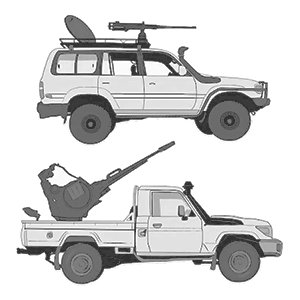
The Toyota War of 1987 was the last phase of the Chadian–Libyan War. It takes its name from the Toyota pickup trucks, primarily the Toyota Hilux and the Toyota Land Cruiser, used to provide mobility for the Chadian troops as they fought against the Libyans, and as technicals, non-standard tactical vehicles (NSTV) modified to carry heavy weapons for combat use.
The 1987 war resulted in a heavy defeat for Libya, which, according to American sources, lost one tenth of its army, with 7,500 men killed and US$1.5 billion worth of military equipment destroyed or captured. Chadian forces suffered 1,000 deaths.
At the opening of 1987, the last year of the war, the Libyan expeditionary force was still impressive, comprising 8,000 soldiers, 300 tanks, multiple rocket launchers (rocket artillery) and regular artillery pieces, Mi-24 helicopters, and sixty combat aircraft. These forces did not have a unified command but were divided into an Operational Group South, active in the Tibesti with 2,500 men, and an Operational Group East, centered in Faya-Largeau.
Though formidable, the Libyan military disposition in Chad was marred by serious flaws. The Libyans were prepared for a war in which they would provide ground and air support to their Chadian allies, who would then act as assault infantry, and provide reconnaissance. By 1987, however, Muammar Gaddafi had lost his allies, exposing Libya’s inadequate knowledge of the area. Libyan garrisons came to resemble isolated and vulnerable islands in the Chadian Sahara. Also significant was the low morale among the troops, who were fighting in a foreign country, and the structural disorganization of the military of Libya, which was in part induced by Muammar Gaddafi’s fear of a military coup against him. This fear led him to avoid the professionalization of the armed forces.
The Libyans also had to deal with the greatly strengthened Chadian National Armed Forces (FANT), which was composed of 10,000 highly motivated soldiers, led by experienced and able commanders, such as Idriss Déby, Hassan Djamous and Head of State Hissène Habré himself. And while FANT previously had no air power, limited mobility, and few anti-tank and anti-aircraft weapons, by 1987, it could count on the French Air Force to keep Libyan aircraft grounded and, most importantly, to provide 400 new Toyota pickups equipped with MILAN anti-tank guided missiles. It is these trucks that gave the name “Toyota War” to this last phase of the Chadian-Libyan conflict.
In March 1987, the main Libyan air base of Ouadi Doum was captured by Chadian forces. Although strongly defended by minefields, 5,000 soldiers, tanks, armored vehicles, and aircraft, the Libyans’ base fell to a smaller Chadian attacking force led by Djamous equipped with trucks mounted with machine guns and antitank weapons. Observers estimated that, in the Chadian victories in the first three months of 1987, more than 3,000 Libyan soldiers had been killed, captured, or deserted. Large numbers of tanks, armored personnel carriers, artillery, fixed-wing aircraft, and helicopters were captured or destroyed. In some cases, Libya sent its own aircraft to bomb abandoned Libyan equipment to deny its use to the Chadians. It was reported that, in many cases, Libyan soldiers had been killed while fleeing to avoid battle. At Ouadi Doum, panicked Libyans had suffered high casualties running through their own minefields.
These military actions left Habré in control of Chad and in a position to threaten the expulsion of Libya from the Aouzou Strip, affected the international perception of Libya as a significant regional military power, and cast renewed doubt on the competence and determination of Libyan soldiers, especially in engagements beyond the country’s borders to which they evidently felt no personal commitment. The Toyota War attracted considerable interest in the United States, where the possibility of using Habré to overthrow Gaddafi was given serious consideration. As part of the Reagan Administration’s support for his government, Habré, during a visit to Washington, received a pledge of US$32 million worth of aid, including Stinger anti-aircraft missiles.
In August 1987, the encouraged Chadians carried their offensive into the disputed Aouzou Strip, occupying the town of Aouzou following another battle in which the Libyans suffered severe losses in troops and abandoned equipment. In retaliation, Libya intensified its air bombardments of towns in the north, usually from altitudes beyond the range of FANT’s shoulder-fired missiles. Appeals by Habré for French air missions to defend the area against the bombing were rejected, as Aouzou had been retaken against the wishes of French President François Mitterrand. Instead, Mitterrand called for international mediation to settle competing claims to the disputed territory.
After a succession of counterattacks, toward the end of August, the Libyans finally drove the 400 Chadian soldiers out of the town. This victory – the first by Libyan ground forces since the start of the Toyota War – was apparently achieved through close-range air strikes, which were followed by ground troops advancing cross-country in jeeps, Toyota all-terrain trucks, and light armored vehicles. For the Libyans, who had previously relied on ponderous tracked armor, the assault represented a conversion to the desert warfare tactics developed by FANT. To highlight the victory, Gaddafi flew foreign journalists to the region, so the news of his victory could reach the headlines.
Habré quickly reacted to this setback and to the continued bombing of FANT concentrations in northern Chad. On September 5, 1987, he mounted a surprise raid against the key Libyan air base at Maaten al-Sarra. Reportedly, 1,000 Libyans were killed, 300 were captured, and hundreds of others were forced to flee into the surrounding desert. Chad claimed that its troops destroyed about 32 aircraft – including Mikoyan-Gurevich MiG-21 and MiG-23 fighters, Sukhoi Su-22 fighter-bombers, and Mil Mi-24 helicopters – before the FANT column withdrew to Chadian soil.
The attack had been opposed by France, which refused to provide FANT with intelligence and logistical support, causing FANT to suffer considerable losses. The French Defence Minister André Giraud [fr] let it be known that ‘France was not implicated in any way’ in the attack and ‘had not been informed of it.’ The American reaction was markedly different, as it had previously supported the attempted reconquest of the Aouzou Strip; it now welcomed the Chadian raid.
Because of domestic opposition, internal demoralization, and international hostility, Gaddafi assumed a more conciliatory attitude following his defeat. On the other side, Habré also found himself vulnerable, as the French feared that the attack on Maatan as-Sarrah was only the first stage of a general offensive into Libya proper, a possibility that France was not disposed to tolerate. As a result, Mitterrand forced Habré to accept the mediation efforts of the Organisation of African Unity’s Chairman, Kenneth Kaunda of Zambia, which resulted in a ceasefire on 11 September.
It was assumed that war would, sooner or later, resume, but in the end the ceasefire violations were relatively minor. Gaddafi announced in May 1988 that he would recognise Habré as President of Chad ‘as a gift to Africa,’ even if Libya refused to leave the disputed Aouzou Strip. On 3 October the two countries resumed diplomatic relations, and another important step was made when the two countries agreed in September 1990 to refer the dispute to the International Court of Justice. In 1994, the court ruled in favor of Chad, thus definitively solving the Aouzou controversy by assigning the territory to the southern country.


 The Daily Omnivore
Leave a comment