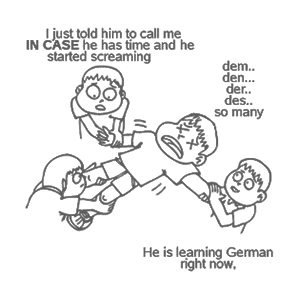
In grammar, case changes what a noun, adjective, or pronoun does in a sentence. It is a set of forms which depend on the syntax (how the words go together). Case is an example of inflection, which is often an affix, a part of a word that is added to other words, that signals a grammatical relationship. Long ago, Old English used several cases, but Modern English does not normally use cases except in pronouns.
In Latin, nouns pack several ideas into one word. Nouns must be masculine (Latin: ends in -us), feminine (ends in -a) or neutral (ends in -um). Also, adjectives must agree with the nouns by changing their endings. English is one of the few European languages that does not usually have gender for nouns.
read more »


 The Daily Omnivore