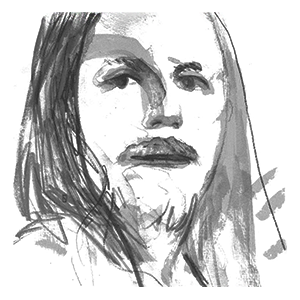
Wolfgang Beltracchi [bel-trah-kee] (b. 1951) is a German former art forger and visual artist who has admitted to forging hundreds of paintings in an international art scam netting millions of euros. Beltracchi, together with his wife Helene, sold forgeries of alleged works by famous artists, including Max Ernst, Heinrich Campendonk, Fernand Léger, and Kees van Dongen. Though he was found guilty for forging 14 works of art that sold for a combined $45m (£28.6m), he claims to have faked ‘about 50’ artists. The total estimated profits Beltracchi made from his forgeries surpasses $100m.
In 2011, after a 40-day trial, Beltracchi was found guilty and sentenced to six years in a German prison. His wife, Helene, was given a four-year sentence, and both were ordered to pay millions in restitution. Beltracchi was freed in 2015, having served just over three years in prison. He is today a successful artist who sells his paintings and sculptures to international collectors without the protection of art makers and the international art market.
His father was an art restorer and muralist. According to his own statements, Beltracchi first copied a Pablo Picasso painting when he was 14 years old. He was expelled from secondary school when he was 17 and later went to art school in Aachen. As a young man, he used drugs such as LSD and opium and started doing art forgeries ‘a little.’ He travelled through Europe and lived in Amsterdam and Morocco. He also lived in Mallorca, Spain and France.
In the 1980s, Beltracchi ran an art gallery for a short time with a business partner. The two had a falling out, with the partner accusing Beltracchi of stealing paintings from his house, an accusation Beltracchi vehemently denies. Fischer met Helene Beltracchi in 1992 and, after marrying in 1993, adopted her surname.
Beltracchi did not copy existing and well known paintings, but painted his own paintings imitating the style of the artists in question. He made up the titles and motives, or claimed that a painting of his was a lost work that was only known by its title in old documents or catalogs.
He and his wife also established a false provenance for the works, claiming that Helene Beltracchi’s grandfather—the wealthy industrialist Werner Jägers—had been friends with the German-Jewish art dealer Alfred Flechtheim in the 1920s. They claimed that Flechtheim sold a cache of works to Jägers before going into exile during the Second World War. Many of the paintings that Wolfgang Beltracchi sold (forged by him) allegedly came from this collection.
There were several important holes in this story. For one, Jägers had been a member of the Nazi Party in the 1930s, making it unlikely that he would have befriended a Jewish dealer. Secondly, the Düsseldorf Alfred Flechtheim gallery’s expert, Ralph Jentsch, recognised that a label used to authenticate one of the forgeries, was itself a forgery.
Beltracchi’s labels purported his works came from the ‘Flechtheim Collection’ and on the verso had a strategically placed adhesive label bearing a picture based on a miniature woodcut in portrait format, the lower half of which had a roughly sketched, depicting the storied gallery’s owner in profile. Space has been left for adding the artist’s name or the title of the work by hand; in the upper third, rough capital letters on a black background boldly spell out the words ‘Sammlung Flechtheim.’ Despite all this, his story held enough weight for the Beltracchis to use it for many years.
When the credibility of the story was questioned, the Beltracchis delivered proof that the paintings had been in the family since the 1920s. They delivered old family photographs with Helene Beltracchi’s grandmother in a room with the paintings in question in the background. Actually, the old looking photographs had been produced by Wolfgang Beltracchi himself; the woman on the photographs being Helene Beltracchi, dressed up as her own grandmother. They also created fake labels proclaiming that the paintings were from the ‘Sammlung Flechtheim’—the Flechtheim Collection.
Finally he was caught after having sold a work ‘by’ Heinrich Campendonk via Kunsthaus Lempertz. The painting was then sold to a company in Malta for €2.88 million. Beltracchi had used a paint tube produced in the Netherlands. Technical analysis by Nicholas Eastaugh revealed that the paint contained titanium white (which was not specified on the label), a pigment that had not been in use in Campendonk’s times. As Beltracchi remembered, because he had not mixed his own paint this one time, the forgery was uncovered.
Wolfgang and Helene Beltracchi were arrested in 2010 in Freiburg. Their accomplice Otto Schulte-Kellinghaus, who helped place several of the forgeries in the market, was also arrested. During the trial in autumn 2011, Beltracchi admitted forging 14 paintings: three by Heinrich Campendonk; two by André Derain; one by Kees van Dongen; five by Max Ernst; one by Fernand Léger; and two by Max Pechstein. Beltracchi and his accomplices thank their relatively mild sentences to a deal with the parties involved. Originally the court had planned to hear more than 160 witnesses and ten experts. The prosecutor estimated that Beltracchi had made a profit of €16 million.
Beltracchi was sentenced to six years in jail. His wife Helene was sentenced to four years, and Otto Schulte-Kellinghaus to five years. Helene’s sister Jeanette was given a 21-month suspended sentence.
Wolfgang and Helene Beltracchi were allowed to serve their sentences in an open prison, as long as they had regular jobs. They were employed by a friend’s photo studio, leaving prison in the morning and returning after work. While serving his sentence, Beltracchi, in collaboration with a photographer, produced a number of mixed-media works, including paintings embedding photographs of himself. The collaboration ended in September 2012. Helene Beltracchi was released from prison in February 2013. Wolfgang Beltracchi was released from prison in January 2015. He agreed to paint only in his own name and to move from Germany to France.
Beltracchi’s forgeries embarrassed many art evaluation firms and numerous customers have sought legal remedy against the art specialists who mistakenly certified the artworks’ authenticity.
Burkhard Leismann, director of the Kunstmuseum Ahlen [de], was charged in 2013 with being an accomplice in the attempted sale of a fake Fernand Léger painting titled Nature morte while knowing the painting to be fake. Leismann denied the charges. The case was closed without going to trial, after Leismann signed a deal with German authorities in 2014 and paid a €7500 fine.
A French tribunal ruled in 2013 that Werner Spies and gallery owner Jacques de La Béraudière were to pay an art collector €652,883. The collector had bought Tremblement de terre, a fake painting by Max Ernst, after Spies had declared it to be a genuine Max Ernst painting. However, this decision was overturned by the Court of Appeal of Versailles which ruled that Spies had ‘expresse[d] an opinion outside of a determined transaction’ and could not therefore ‘be charged with a responsibility equivalent to that of an expert consulted in the context of a sale.’ The Court further held that it ‘cannot be required of the author of a catalogue raisonné to subject each work in a catalogue published under his responsibility to the execution of a scientific expert assessment, which requires the removal of fragments of the work and represents a significant cost.’


 The Daily Omnivore