May 16, 2023

Kudzu [kuhd·zoo] (also called Japanese arrowroot or Chinese arrowroot) is a group of climbing, coiling, and trailing deciduous perennial vines native to much of East Asia, Southeast Asia, and some Pacific islands, but invasive in many parts of the world, primarily North America.
The vine densely climbs over other plants and trees and grows so rapidly that it smothers and kills them by blocking most of the sunlight and taking root space. The plants are in the genus Pueraria, in the pea family Fabaceae, subfamily Faboideae. Kudzu is edible, but often sprayed with herbicides.
read more »
Posted in Food, Science, World |
Leave a Comment »
May 15, 2023
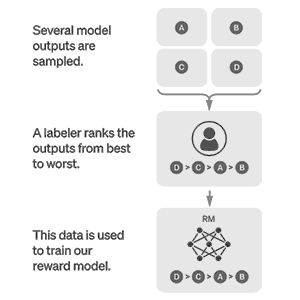
In machine learning, reinforcement learning from human feedback (RLHF) is a method of training AI models by learning from responses by humans about its performance. If an AI model makes a prediction or takes an action that is incorrect or suboptimal, human feedback can be used to correct the error or suggest a better response.
Over time, this helps the model to learn and improve its responses. RLHF is used in tasks where it’s difficult to define a clear, algorithmic solution but where humans can easily judge the quality of the AI’s output (e.g. if the task is to generate a compelling story, humans can rate different AI-generated stories on their quality, and the AI can use their feedback to improve its story generation skills).
read more »
Posted in Technology |
Leave a Comment »
May 11, 2023

Plate smashing is a Greek custom involving the intentional smashing of plates or glasses during celebratory occasions. While it occurs more rarely today, it continues to be seen on certain occasions, such as weddings, although plaster plates are more likely to be used. The custom probably derives from an ancient practice of ritually ‘killing’ plates on mourning occasions, as a means of dealing with loss.
Breaking plates may also be related to the ancient practice of conspicuous consumption, a display of one’s wealth, as plates or glasses are thrown into a fireplace following a banquet instead of being washed and reused. 1969, the autocratic military dictatorship of Georgios Papadopoulos, banned plate smashing. Another modern variation on the custom is for diners at small Greek restaurants or tavernas to buy trays of flowers that they can throw at singers and each other.
Posted in Money, World |
Leave a Comment »
April 27, 2023

System D is a manner of responding to challenges that require one to have the ability to think quickly, to adapt, and to improvise when getting a job done. The term gained wider popularity after appearing in the 2006 publication of Anthony Bourdain’s ‘The Nasty Bits.’ Bourdain references finding the term in Nicolas Freeling’s memoir, ‘The Kitchen,’ about Freeling’s years as a Grand Hotel cook in France.
The term is a direct translation of French Système D. The letter D refers to any one of the French nouns ‘débrouille,’ ‘débrouillardise,’ or ‘démerde’ (French slang). The verbs se débrouiller and se démerder mean ‘to make do,’ ‘to manage, ‘especially in an adverse situation. Basically, it refers to one’s ability and need to be resourceful.
read more »
Posted in Food, Language, World |
Leave a Comment »
April 25, 2023

The clear craze was a marketing fad from the late 1980s to early 2000s, often equating transparency with purity. Inspired by Ivory’s ’99 and 44/100 percent pure’ campaign for bath soap, and by low-calorie or ‘light’ beverages, sodas were redesigned in the 1980s and 1990s as being free of artificial dyes, such as the caffeine-free and preservative-free Crystal Pepsi. Personal hygiene products were then relaunched as clear dye-free gels, and many electronics had transparent cases.
Gillette released versions of its existing deodorants and shaving creams in a clear gel form, which have continued indefinitely. Through the 1990s, the clear trend included transparent watches, staplers, calculators, handheld gaming devices such as the Nintendo Game Boy, and computers such as Apple’s iMac G3.
read more »
Posted in Money, Technology |
Leave a Comment »
April 19, 2023

Sheng nu (‘leftover ladies’) is a derogatory Chinese term for women who remain unmarried in their late twenties and beyond. Most prominently used in China, the term has also been used colloquially to refer to women in India, North America, and other parts of Asia. The term compares unmarried women to leftover food and has gone on to become widely used in the mainstream media focusing on the negative connotations and positive reclamation of the term.
While initially backed and disseminated by pro-government media in 2007, the term eventually came under criticism from government-published newspapers two years later. The equivalent term for men, ‘guang gun’ meaning ‘bare branches,’ is used to refer to men who do not marry and thus do not add ‘branches’ to the family tree. Similarly, ‘shengnan’ (‘leftover men’) has also been used, though this term is not as commonly used as ‘leftover women’ in Chinese society and single males reaching a certain age will often be labeled as either ‘golden bachelors’ or ‘diamond single man.’
read more »
Posted in Language, Sex, World |
1 Comment »
April 16, 2023

Philanthrocapitalism or philanthropic capitalism is a way of doing philanthropy, which mirrors the way that business is done in the for-profit world. It may involve venture philanthropy that actively invests in social programs to pursue specific philanthropic goals that would yield return on investment over the long term, or in a more passive form whereby ‘social investors’ benefit from investing in socially-responsible programs.
The term was coined by Matthew Bishop and Michael Green in their book ‘Philanthrocapitalism: How the Rich Can Save The World.’ The book was endorsed by Bill Clinton, who wrote in its foreword that this concept drives the Clinton Foundation. The shift in implementing business models in charity is not a new concept – John D. Rockefeller and Andrew Carnegie sought to apply their business strategies in their philanthropy in the 20th century. Since then, a significant increase in charity spending by other organizations such as the Bill & Melinda Gates Foundation and Chan Zuckerberg Initiative, both described as examples of philanthrocapitalism, has been noted.
read more »
Posted in Money, Politics |
Leave a Comment »
April 10, 2023
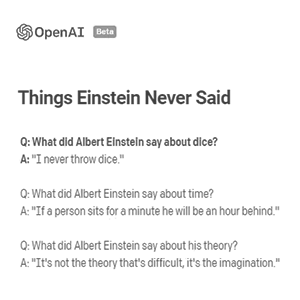
In artificial intelligence (AI), a hallucination or artificial hallucination (also occasionally called delusion) is a confident response by an AI that does not seem to be justified by its training data. For example, a hallucinating chatbot with no knowledge of Tesla’s revenue might internally pick a random number (such as $13.6 billion) that the chatbot deems plausible, and then go on to falsely and repeatedly insist that Tesla’s revenue is $13.6 billion, with no sign of internal awareness that the figure was a product of its own imagination.
Users complained that such bots often seemed to ‘sociopathically’ and pointlessly embed plausible-sounding random falsehoods within its generated content. Another example of hallucination in artificial intelligence is when the AI or chatbot forget that they are one and claim to be human.
read more »
Posted in Technology |
Leave a Comment »
March 8, 2023

The need for cognition (NFC), in psychology, is a personality variable reflecting the extent to which individuals are inclined towards effortful cognitive activities. Need for cognition has been variously defined as ‘a need to structure relevant situations in meaningful, integrated ways’ and ‘a need to understand and make reasonable the experiential world.’
Higher NFC is associated with increased appreciation of debate, idea evaluation, and problem solving. Those with a high need for cognition may be inclined towards high elaboration. Those with a lower need for cognition may display opposite tendencies, and may process information more heuristically, often through low elaboration.
read more »
Posted in Science |
Leave a Comment »
February 25, 2023


Pseudolaw consists of statements, beliefs, or practices that are claimed to be based on accepted law or legal doctrine, but which deviate significantly from most conventional understandings of law and jurisprudence, or which originate from non-existent statutes or legal principles the advocate or adherent incorrectly believes exist.
Canadian legal scholar Donald J. Netolitzky defined pseudolaw as ‘a collection of legal-sounding but false rules that purport to be law,’ a definition that distinguishes pseudolaw from arguments that fail to conform to existing laws such as novel arguments or an ignorance of precedent in case law.
read more »
Posted in Language, Money, Politics |
1 Comment »
February 16, 2023

$100 hamburger is aviation slang for the excuse a general aviation pilot might use to fly. A $100 hamburger trip typically involves flying a short distance (less than two hours), eating at an airport restaurant, and then flying home. In Perth, Western Australia, a similar mentality resulted in the ‘Rotto Bun Run’. A group of pilots who had run out of hot cross buns on Good Friday decided to fly to the closest open bakery on Rottnest Island. The run is now an annual charity event.
$100′ originally referred to the approximate cost of renting or operating a light general aviation aircraft, such as a Cessna 172, for the time it took to fly round-trip to a nearby airport. However, increasing fuel prices have since caused an increase in hourly operating costs for most airplanes, and a Cessna 172 now costs US$95–$180 per Hobbs hour to rent, including fuel.
Posted in Humor, Money |
1 Comment »
February 3, 2023

The Hawking Index (HI) is a mock mathematical measure of how far people will read through a book before giving up. The index is named after physicist Stephen Hawking’s ‘A Brief History of Time,’ which was dubbed ‘the most unread book of all time.’ It was invented by American mathematician Jordan Ellenberg, who created it in a blog for the ‘Wall Street Journal’ in 2014.
Ellenberg relied on data from Kindle users for his model. ‘A Brief History of Time’ scored 6.6% on the HI, meaning Ellenberg estimated that only 6.6% of readers finished the book.
read more »
Posted in Humor, Language, Science |
1 Comment »



