November 22, 2019
Luther Blissett is a multiple-use name, an ‘open pop star’ informally adopted and shared by hundreds of artists and activists all over Europe and the Americas since 1994. The pseudonym first appeared in Bologna, Italy, in mid-1994, when a number of cultural activists began using it for staging a series of urban and media pranks and to experiment with new forms of authorship and identity.
From Bologna the multiple-use name spread to other European cities, such as Rome and London, as well as countries such as Germany, Spain, and Slovenia. Sporadic appearances of Luther Blissett have been also noted in Canada, the United States, Finland and Brazil.
read more »
Posted in Art, Humor, Politics |
Leave a Comment »
November 18, 2019

Plausible deniability is the ability of people (typically senior officials in a chain of command) to deny knowledge of or responsibility for any damnable actions committed by others in an organizational hierarchy because of a lack of evidence that can confirm their participation, even if they were personally involved in or at least willfully ignorant of the actions.
In the case that illegal or otherwise disreputable and unpopular activities become public, high-ranking officials may deny any awareness of such acts to insulate themselves and shift blame onto the agents who carried out the acts, as they are confident that their doubters will be unable to prove otherwise.
read more »
Posted in Politics, War, World |
1 Comment »
November 17, 2019

Bromide [broh-mahyd] in literary usage means a phrase, cliché, or platitude that is trite or unoriginal. It can be intended to soothe or placate; it can suggest insincerity or a lack of originality in the speaker. It can also refer to a commonplace or tiresome person, a bore.
A now outdated usage of ‘bromide’ is a photographic print, stemming from the use of silver bromide in photographic films, emulsions and papers. Its original usage was as a chemical term, referring to bromine salts.
read more »
Posted in Health, Language, Science |
Leave a Comment »
November 12, 2019
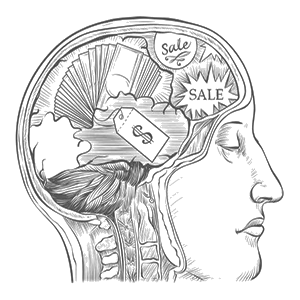
The term homo economicus, or economic man, is the sometimes satirical portrayal of humans as agents who are consistently rational, narrowly self-interested, and who pursue their subjectively-defined ends optimally.
In game theory, homo economicus is often modeled through the assumption of perfect rationality. It assumes that agents always act in a way that maximize utility as a consumer and profit as a producer, and are capable of arbitrarily complex deductions towards that end. They will always be capable of thinking through all possible outcomes and choosing that course of action which will result in the best possible result.
read more »
Posted in Money, Philosophy, Politics |
Leave a Comment »
November 7, 2019

Rationality is the quality or state of being rational, i.e. agreeable to reason. Rationality implies the conformity of a person’s beliefs with their reasons to believe and of their actions with their reasons for action. When a goal or problem requires making a decision, rationality factors in all information that is available (e.g. complete or incomplete knowledge).
It is meaningless to assert rationality without also specifying the background model assumptions describing how the problem is framed and formulated. Rationality is relative: in models that optimize for personal benefit, self-interested or even selfish behavior is rational; in models that favor benefiting the group over the individual, purely selfish behavior is deemed irrational.
read more »
Posted in Money, Philosophy, Politics |
Leave a Comment »
November 1, 2019
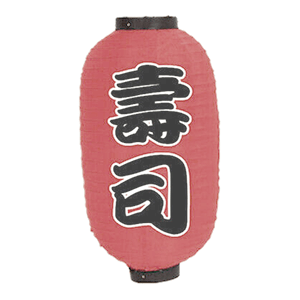
An izakaya [ee-zah-ka-yah] is a type of informal Japanese pub. They are casual places for after-work drinking. They have been compared to Irish pubs, tapas bars, and early American saloons and taverns.
The word ‘izakaya’ is a compound word consisting of ‘i’ (‘to stay’) and ‘sakaya’ (‘sake shop’), indicating that izakaya originated from sake shops that allowed customers to sit on the premises to drink. Izakaya are sometimes called ‘akachōchin’ (‘red lantern’) in daily conversation, as such paper lanterns are traditionally found in front of them.
read more »
Posted in Food, World |
Leave a Comment »
October 16, 2019

False equivalence is a logical fallacy in which two completely opposing arguments appear to be logically equivalent when in fact they are not. This fallacy is categorized as a fallacy of inconsistency.
False equivalence is a common result when an anecdotal similarity is pointed out as equal, but the claim of equivalence doesn’t bear because the similarity is based on oversimplification or ignorance of additional factors. False equivalence arguments are often used in journalism and in politics, where the minor flaws of one candidate may be compared to major flaws of another.
read more »
Posted in Language, Philosophy, Politics |
Leave a Comment »
October 15, 2019
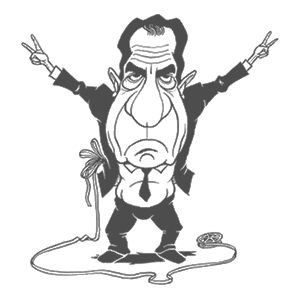
Rose Mary Woods (1917–2005) was Richard Nixon’s secretary from his days in Congress in 1951, through the end of his political career. Before H. R. Haldeman and John Ehrlichman became the operators of Nixon’s presidential campaign, Woods was Nixon’s gatekeeper.
Fiercely loyal to Nixon, Woods claimed responsibility in a 1974 grand jury testimony for inadvertently erasing up to five minutes of the 181⁄2 minute gap in a June 20, 1972, audio tape. Her demonstration of how this might have occurred—which depended upon her stretching to simultaneously press controls several feet apart (what the press dubbed the ‘Rose Mary Stretch’)—was met with considerable ridicule.
read more »
Posted in Politics |
Leave a Comment »
October 8, 2019
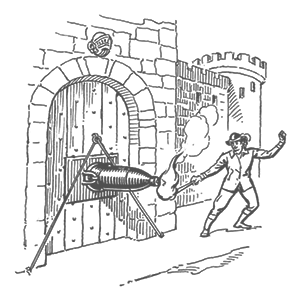
‘Hoist with his own petard’ is a phrase from a speech in William Shakespeare’s play ‘Hamlet’ that has become proverbial.
The phrase’s meaning is literally that the bomb-maker (a “petard” is a small explosive device) is blown up (‘hoisted’ off the ground) by his own bomb, and indicates an ironic reversal, or poetic justice.
read more »
Posted in Art, Language, War |
Leave a Comment »
October 2, 2019

Rocket mail is the delivery of mail by rocket or missile. The rocket lands by deploying an internal parachute upon arrival. It has been attempted by various organizations in many different countries, with varying levels of success. It has never become widely seen as being a viable option for delivering mail, due to the cost of the schemes and numerous failures.
The collection of philatelic material (‘stamps’) used for (and depicting) rocket mail is part of a specialist branch of aerophilately known as astrophilately.
read more »
Posted in Technology, War, World |
Leave a Comment »
September 24, 2019

The firehose of falsehood is a propaganda technique in which a large number of messages are broadcast rapidly, repetitively, and continuously over multiple channels (such as news and social media) without regard for truth or consistency.
Since 2014, when it was successfully used by Russia during its annexation of Crimea, this model has been adopted by other governments and political movements around the world.
read more »
Posted in Language, Politics, War |
Leave a Comment »
September 23, 2019

A punchline concludes a joke; it is intended to make people laugh. It is the third and final part of the typical joke structure: set-up, premise, punch line. In a broader sense, ‘punchline’ can also refer to the unexpected and funny conclusion of any performance, situation or story.
The exact origin of the term is unknown, though the classic three-part joke format was well-established in Vaudeville by the beginning of the 20th century. Merriam-Webster dictionary pegs the first use in 1921. It has also been argued that the term’s origin is related to the British weekly magazine ‘Punch.’
read more »
Posted in Art, Language |
Leave a Comment »


 The Daily Omnivore