January 29, 2018

A Mary Sue is an idealized and seemingly perfect fictional character. Typically, this character is recognized as an author insert or wish fulfillment. They can usually perform better at tasks than should be possible given the amount of training or experience, and usually are able through some means to upstage the protagonist of an established fictional setting, such as by saving the hero.
The term comes from the name of a character created by fan fiction writer Paula Smith in 1973 for her parody story ‘A Trekkie’s Tale’ published in her fanzine ‘Menagerie.’ The story starred Lieutenant Mary Sue (‘the youngest Lieutenant in the fleet — only fifteen and a half years old’), and satirized unrealistic characters in Star Trek fan fiction.
read more »
Posted in Art, Politics |
Leave a Comment »
January 12, 2018
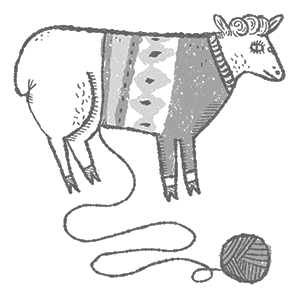
The sweater curse, or the ‘curse of the love sweater,’ is a knitting folktale which claims that if a knitter gives a hand-knit sweater to a significant other, it will lead to the recipient breaking up with them. In an alternative formulation, the relationship will end before the sweater is even completed. In a 2005 poll, 15% of active knitters said that they had experienced the sweater curse firsthand, and 41% considered it a possibility that should be taken seriously.
Despite its name, the ‘sweater curse’ is treated in knitting literature not as a superstition governed by paranormal forces, but rather as a real-world pitfall of knitting that has rational explanations. Several plausible mechanisms for the sweater curse have been proposed, but it has not been studied systematically.
read more »
Posted in Art, Humor, Sex |
1 Comment »
January 6, 2018

Porter is a dark style of beer developed in London from well-hopped beers made from brown malt. The name was first recorded in the 18th century, and is thought to come from its popularity with street and river porters.
The history and development of stout and porter are intertwined. The name ‘stout’ as used for a dark beer is believed to have come about because strong porters were marketed under such names as ‘Extra Porter,’ ‘Double Porter,’ and ‘Stout Porter.’ The term ‘Stout Porter’ would later be shortened to just ‘Stout.’ For example, Guinness Extra Stout was originally called Extra Superior Porter and was only given the name Extra Stout in 1840.
read more »
Posted in Food |
Leave a Comment »
December 16, 2017

A gingerbread house is a novelty confectionery shaped like a building that is made of cookie dough, cut and baked into appropriate components like walls and roofing. The usual material is crisp ginger biscuit made of gingerbread. Another type of model-making with gingerbread uses a boiled dough that can be molded like clay to form edible statuettes or other decorations. These houses, covered with a variety of candies and icing, are popular Christmas decorations, often built by children with the help of their parents.
Records of honey cakes can be traced to ancient Rome. Food historians ratify that ginger has been seasoning foodstuffs and drinks since antiquity. It is believed gingerbread was first baked in Europe at the end of the 11th century, when returning crusaders brought back the custom of spiced breads from the Middle East. Ginger was not only tasty, it had properties that helped preserve the foodstuffs it was in.
read more »
Posted in Food, Philosophy |
1 Comment »
December 15, 2017

A gremlin is a fictitious mischievous creature that causes malfunctions in aircraft or other machinery. Their origin is found in myths among airmen, claiming that the gremlins were responsible for sabotaging aircraft.
Folklorist John W. Hazen states that some people derive the name from the Old English word ‘gremian’ (‘to vex’). While Carol Rose, in her book ‘Spirits, Fairies, Leprechauns, and Goblins: An Encyclopedia,’ attributes the name to a combination of Grimm’s Fairy Tales, and Fremlin Beer, a nineteenth century English brewery. Since World War II, different fantastical creatures have been referred to as gremlins, bearing varying degrees of resemblance to the originals.
read more »
Posted in Technology |
1 Comment »
December 7, 2017

Tommy Wiseau is an American actor and filmmaker. He produced and directed ‘The Room’ (2003), which has been described by many critics as ‘one of the worst movies ever made’ and has gained cult film status. He also directed the 2004 documentary ‘Homeless in America’ and the 2015 sitcom ‘The Neighbors.’
Wiseau is secretive about his early life. In various interviews, he has claimed to have lived in France ‘a long time ago,’ asserted that he grew up in New Orleans, and described having ‘an entire family’ in Chalmette, Louisiana.
read more »
Posted in Art, Humor |
Leave a Comment »
December 6, 2017
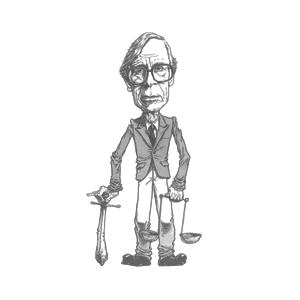
‘Justice as Fairness: Political not Metaphysical’ is an essay by John Rawls, published in 1985. In it he describes his conception of justice. It comprises two main principles of liberty and equality (with the latter subdivided into ‘Fair Equality of Opportunity’ and the ‘Difference Principle’).
Rawls arranges the principles in ‘lexical priority,’ ordering them from most fundamental and prerequisite to least with the Liberty Principle first, followed by Fair Equality of Opportunity, and concluding with the Difference Principle.
read more »
Posted in Philosophy, Politics |
Leave a Comment »
November 30, 2017

Dick Proenneke [pren-uh-kee] (1916 – 2003) was a self-educated naturalist who lived alone for nearly thirty years in the mountains of Alaska in a log cabin he had constructed by hand near the shore of Twin Lakes.
Proenneke hunted, fished, raised and gathered his own food, and also had supplies flown in occasionally. He documented his activities in journals and on film, and also recorded valuable meteorological and natural data. The journals and film were later used by others to write books and produce documentaries about his time in the wilderness.
read more »
Posted in Art, Science |
Leave a Comment »
November 28, 2017

The retail apocalypse refers to the closing of a large number of American retail stores beginning in 2016. Over 4,000 physical stores are affected as American consumers shift their purchasing habits due to various factors, including the rise of e-commerce.
Major department stores such as J.C. Penney and Macy’s have announced hundreds of store closures, and well-known apparel brands such as J. Crew and Ralph Lauren are struggling with profitability. Of the 1,200 shopping malls across the US, 50% are expected to close by 2023.
read more »
Posted in Money |
Leave a Comment »
November 25, 2017

The phrase ‘the best of all possible worlds‘ was coined by the German polymath Gottfried Leibniz in his 1710 work ‘Essays on the Goodness of God, the Freedom of Man and the Origin of Evil.’
The claim that the actual world is the best of all possible worlds is the central argument in Leibniz’s attempt to solve the problem of evil (i.e. why would a God that is all-loving, all-seeing, and all-powerful allow evil to exist). Historically, attempts to answer the question have been made using various arguments, for example, by explaining away evil or reconciling evil with good.
read more »
Posted in Philosophy |
1 Comment »
November 2, 2017

The small penis rule is an informal strategy used by authors to evade libel lawsuits. It was described in a ‘New York Times’ article in 1998:
”For a fictional portrait to be actionable, it must be so accurate that a reader of the book would have no problem linking the two,’ said Mr. Friedman. Thus, he continued, libel lawyers have what is known as ‘the small penis rule.’ One way authors can protect themselves from libel suits is to say that a character has a small penis, Mr. Friedman said. ‘Now no male is going to come forward and say, ‘That character with a very small penis, that’s me!”
Posted in Money, Politics, Sex |
Leave a Comment »
October 24, 2017

Barry Seal (1939 – 1986) was an American airline pilot who became a major drug smuggler for the Medellín Cartel. When Seal was convicted of smuggling charges, he became an informant for the Drug Enforcement Administration and testified in several major drug trials.
He was murdered in 1986 by contract killers hired by Pablo Escobar, head of the Medellín Cartel.
read more »
Posted in Drugs, Politics, War |
2 Comments »



