March 6, 2014

Hard to be a God is a 1964 science fiction novel by Arkady and Boris Strugatsky set in their ‘Noon Universe (a fictional setting in the 22nd century). The novel follows Anton, an undercover operative from the future planet Earth, in his mission on an alien planet, that is populated by human beings, whose society has not advanced beyond the Middle Ages. The novel’s core idea is that human progress throughout the centuries is often cruel and bloody, and that religion and blind faith can be effective tools of oppression, working to destroy the emerging scientific disciplines and enlightenment.
The title ‘Hard to be a God’ refers to Anton’s (known by his alias ‘don Rumata’ throughout the book) perception of his precarious role as an observer on the planet, for while he has far more advance knowledge than the people around him, he is forbidden to assist too actively, as it would interfere with the natural progress of history. The book pays a lot of attention to the internal world of the main character, showing his own evolution from an emotionally uninvolved ‘observer’ to the person who rejects the blind belief in theory when confronted with the cruelty of real events.
read more »
Posted in Language, Philosophy, Science |
Leave a Comment »
March 5, 2014
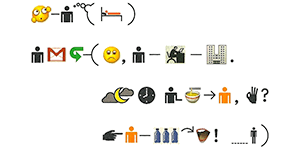
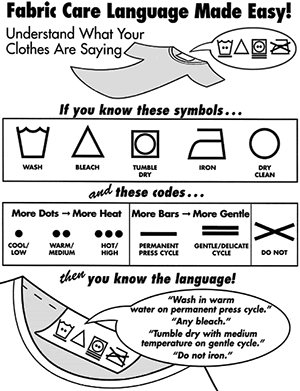
Pictograms [pik-tuh-gram] are small images that convey their meaning through a pictorial resemblance to a physical object. Early written symbols were based on pictograms (pictures which resemble what they signify) and ideograms (symbols which represent ideas). Ancient Sumerian, Egyptian, and Chinese civilizations developed them into logographic (word-based) writing systems including cuneiform and hieroglyphics, which also uses drawings as phonetic letters or determinative rhymes.
Pictograms are still in use as the main medium of written communication in some non-literate cultures in Africa, the Americas, and Oceania. In certain modern use, pictograms participate to a formal language (e.g. hazards pictograms such as the skull and crossbones, a common warning for poison). Pictograms have also been popularized in use on the web and in software, better known as ‘icons’ displayed on a computer screen in order to help user navigate a computer system or mobile device.
read more »
Posted in Language |
Leave a Comment »
March 4, 2014
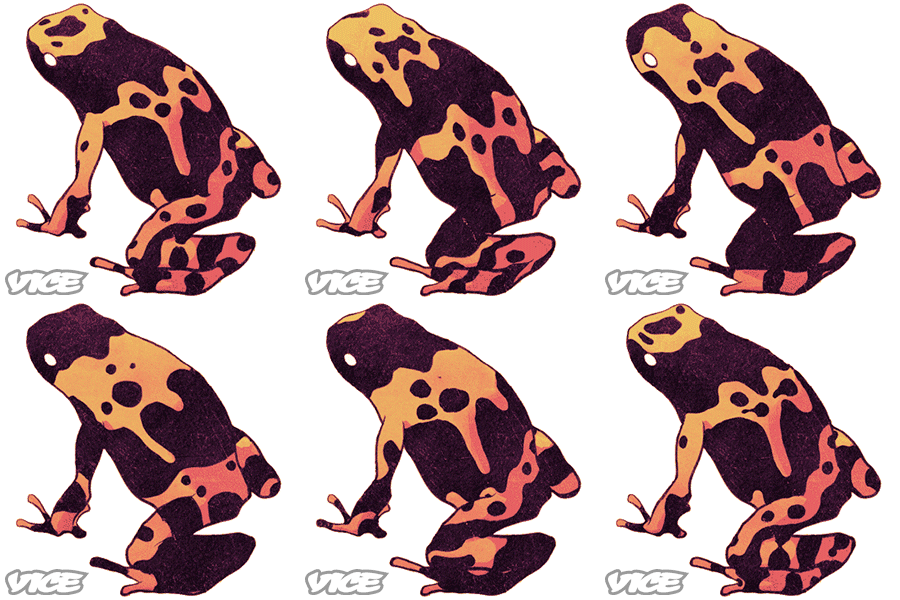
Psychoactive toads are amphibians from which psychoactive substances from the family of bufotoxins can be derived. The skin and poison of Bufo alvarius (Colorado River toad or Sonoran Desert toad) contain 5-MeO-DMT and bufotenin, which both belong to the family of hallucinogenic tryptamines. The skin or poison of the toads may produce psychoactive effects when ingested. To obtain the psychoactive substances the toxin of psychoactive toads is commonly milked from their poison glands. The milking procedure does not harm the toad — it consists of stroking the animal under its chin to initiate the defensive poison response.
Once the liquid toxin has been collected and dried, it can be used for its psychedelic effects. The toad takes about a month to refill its poison glands. Rumors dating from the 1970s claimed that groups of hippies, some including teenagers, were licking the psychoactive toads to get high. Albert Most, founder of the Church of the Toad of Light and a proponent of recreational use of Bufo alvarius poison, published a booklet titled ‘Bufo alvarius: The Psychedelic Toad of the Sonoran Desert’ in 1983 which explained how to extract and smoke the secretions.
Posted in Drugs, Science |
1 Comment »
March 3, 2014

Human nature refers to the distinguishing characteristics, including ways of thinking, feeling and acting, that humans tend to have naturally, independently of the influence of culture. The questions of what these characteristics are, what causes them, and how fixed human nature is, are amongst the oldest and most important questions in western philosophy. They have particularly important implications in ethics, politics, and theology. This is partly because human nature can be regarded as both a source of norms of conduct or ways of life, as well as presenting obstacles or constraints on living a good life.
The complex implications of such questions are also dealt with in art and literature, while the multiple branches of the aptly named Humanities (e.g. history, law, religion) together form an important domain of inquiry into human nature, and the question of what it is to be human. The branches of contemporary science associated with the study of human nature include anthropology, sociology, sociobiology, and psychology (particularly in evolutionary or developmental subfields). The nature versus nurture debate is a broadly inclusive and well-known instance of a discussion about human nature in the natural sciences.
read more »
Posted in Philosophy |
Leave a Comment »
March 1, 2014


Carbon fiber is a material consisting of long thing fibers about 5–10 μm in diameter (about half the width of a human hair) and composed mostly of carbon atoms. When used in a composite material it has the highest compressive strength of any reinforcing material, and it has a high strength to weight ratio and low coefficient of thermal expansion. The density of carbon fiber is also much lower than the density of steel.
Carbon fiber reinforced polymer (carbon fiber combined with a plastic resin and wound or molded) is very strong, but extremely rigid and somewhat brittle. However, carbon fibers are also composed with other materials, such as with graphite to form carbon-carbon composites, which have a very high heat tolerance.
read more »
Posted in Science, Technology |
Leave a Comment »
March 1, 2014
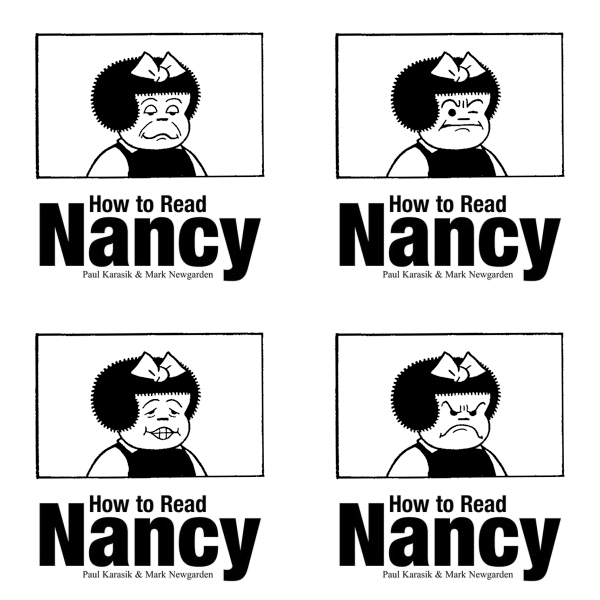
Comics studies is an academic field that focuses on comics and graphic novels. Formerly dismissed as less relevant pop culture texts, scholars in fields such as Semiotics and Composition Studies are now re-considering comics and graphic novels as complex texts deserving of serious scholarly study.
‘How to Read Nancy’ is a 1988 essay by underground cartoonists Mark Newgarden and Paul Karasik. The piece examines the comic strip ‘Nancy,’ focusing on creator Ernie Bushmiller’s use of the comics language in to deliver a gag. Finding correspondences to the minimalist architecture of Mies Van Der Rohe, the essay calls ‘Nancy’ ‘a complex amalgam of formal rules laid out by [its] designer.’
read more »
Posted in Art, Education, Language |
Leave a Comment »
February 28, 2014
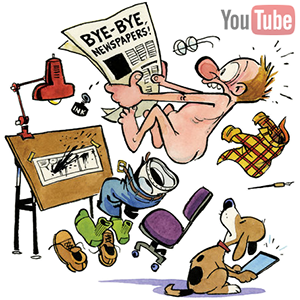
A comic strip is a sequence of drawings arranged in interrelated panels to display brief humor or form a narrative, often serialized, with text in balloons and captions. Throughout the 20th century and into the 21st, these were published in newspapers, with horizontal strips printed in black-and-white in daily newspapers, while Sunday newspapers offered longer sequences in special color comics sections.
Strips are written and drawn by a comics artist or cartoonist. As the name implies, comic strips can be humorous (for example, ‘gag-a-day’ strips such as ‘Blondie’ or ‘Marmaduke’). Starting in the late 1920s, comic strips expanded from their mirthful origins to feature adventure stories, as seen in ‘Popeye,’ ‘Captain Easy,’ ‘Buck Rogers,’ ‘Tarzan,’ and ‘The Adventures of Tintin.’ Soap-opera continuity strips such as ‘Judge Parker’ and ‘Mary Worth’ gained popularity in the 1940s. All are called, generically, comic strips, though cartoonist Will Eisner has suggested that ‘sequential art’ would be a better name.
read more »
Posted in Art |
Leave a Comment »
February 27, 2014
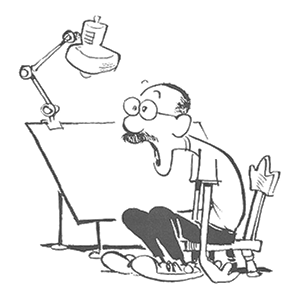
Bill Watterson (b. 1958) is an American artist and the author of the comic strip ‘Calvin and Hobbes,’ which was syndicated from 1985 to 1995. Watterson stopped drawing the strip at the end of 1995 with a short statement to newspaper editors and his readers that he felt he had achieved all he could in the medium.
Watterson is known for his views on licensing (he refused to merchandise his creations on the grounds that displaying their images on commercially sold mugs, stickers and T-shirts would devalue the characters and their personalities) and his move back into private life after ‘Calvin and Hobbes.’
read more »
Posted in Art, Humor, Language |
1 Comment »
February 26, 2014

The Discreet Charm of the Bourgeoisie (‘Le Charme discret de la bourgeoisie’) is a 1972 surrealist film directed by Luis Buñuel and written by Jean-Claude Carrière in collaboration with the director. The narrative concerns a group of upper-middle-class people attempting — despite continual interruptions — to dine together.
The film consists of several thematically linked scenes: five gatherings of a group of bourgeois friends, and the four dreams of different characters. The beginning of the film focuses on the gatherings, while the latter part focuses on the dreams, but both types of scenes are intertwined. There are also scenes involving other characters, such as two involving a Latin American female terrorist from the fictitious Republic of Miranda. The film’s world is not logical: the bizarre events are accepted by the characters, even if they are impossible or contradictory.
read more »
Posted in Art, Money, World |
Leave a Comment »
February 26, 2014
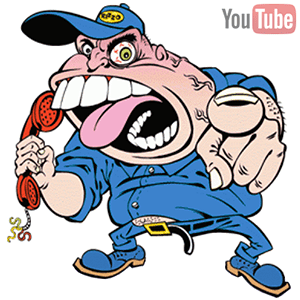
The Jerky Boys is an American comedy act from Queens, New York, whose routine consists of prank telephone calls and other related skits. The act was started in 1989 by childhood friends Johnny Brennan and Kamal Ahmed (who left in 2000).
The calls were made by ringing up unsuspecting recipients, or in response to classified advertisements placed in local New York-based newspapers. Each call was made in character, usually with over the top voices influenced by the duo’s family members.
read more »
Posted in Humor |
1 Comment »
February 26, 2014

The Tube Bar prank calls are a series of prank calls made in the mid-1970s to the Tube Bar in Jersey City, in which pranksters would ask the proprietor of the bar if they could speak to a fictitiously named customer. The fictitious names given by the pranksters were pun-like/homophones for other—oftentimes more offensive—phrases. Recordings of the calls were circulated widely on duped cassette tapes and may have been the inspiration for a running gag in ‘The Simpsons.’
John Elmo and Jim Davidson, later known collectively as ‘Bum Bar Bastards,’ would call the Tube Bar, operated by heavyweight boxer Louis ‘Red’ Deutsch, asking for customers such as ‘Pepe Roni’ (pepperoni), ‘Hal Ja-Like-a-Kick’ (how’d you like a kick), ‘Phil My-Pockets’ (fill my pockets), ‘Al Coholic’ (alcoholic), and ‘Mike Hunt’ (my cunt). Most of the time, Deutsch would call out the names.
read more »
Posted in Humor, Language |
Leave a Comment »
February 25, 2014

Robert H. Lustig is an American pediatric endocrinologist at the University of California, San Francisco (UCSF) where he is a Professor of Clinical Pediatrics. He practices in the field of neuroendocrinology, with an emphasis on the regulation of energy balance by the central nervous system. He also has a special interest in childhood obesity.
Lustig came to public attention through his efforts to establish that fructose can have serious deleterious effects on human (especially children’s) health if consumed excessively. In 2009, he delivered a lecture called ‘Sugar: The Bitter Truth’ that spread virally on YouTube, in which he calls fructose a ‘poison’ and equates its metabolic effects with those of ethanol.
read more »
Posted in Food, Health |
Leave a Comment »



